Commentary - (2025) Volume 15, Issue 4
Received: 31-Jul-2025, Manuscript No. jmcj-25-176896;
Editor assigned: 04-Aug-2025, Pre QC No. P-176896;
Reviewed: 18-Aug-2025, QC No. Q-176896;
Revised: 21-Aug-2025, Manuscript No. R-176896;
Published:
28-Aug-2025
, DOI: 10.37421/2165-7912.2025.15.631
Citation: Carrington, Helena S.. Streaming Disrupts TV: Industry's Digital Future. J Mass Communicat Journalism 15(2025):631.
Copyright: © 2025 Carrington S. Helena This is an open-access article distributed under the terms of the Creative Commons Attribution License, which permits unrestricted use, distribution and reproduction in any medium, provided the original author and source are credited.
The media landscape is experiencing a profound and rapid evolution, driven primarily by technological advancements and shifting consumer habits. Traditional television broadcasting, once a dominant force, now navigates a complex environment characterized by digital disruption and intense competition. This transformation impacts everything from content creation and distribution to audience engagement and regulatory oversight. Understanding these dynamics is crucial for grasping the current state and future trajectory of the television industry. Streaming services have profoundly impacted the traditional broadcasting industry, fundamentally altering established business models, content strategies, and audience consumption patterns. Broadcasters are making strategic adjustments to compete, including diversification into their own streaming platforms and rethinking content delivery [1].
Concurrently, research investigates the critical factors driving consumers to adopt Internet Protocol Television (IPTV) over conventional broadcasting. Perceived usefulness, ease of use, social influence, and competitive pricing emerge as key determinants, offering insights for broadcasters and service providers aiming to attract and retain audiences in the digital television era [2].
Here's the thing: linear television, despite facing intense competition from streaming, isn't dead. This area explores its enduring appeal and strategic opportunities, such as live event broadcasting and curated programming, while also addressing challenges like declining viewership and advertising revenue. It suggests pathways for linear broadcasting to innovate and remain relevant [3].
This means television news journalism is adapting significantly to the digital age. This adaptation involves integrating new technologies, platform diversification, and shifts in audience engagement. Maintaining journalistic integrity and quality in a fragmented media environment presents challenges, emphasizing the need for innovative storytelling and distribution strategies [4].
What this really means is that understanding audience engagement has never been more complex for broadcasters. New methodologies are emerging to measure how audiences interact with broadcast content across various platforms, from linear TV to social media. These provide crucial insights for content producers and advertisers seeking to maximize reach and impact [5].
The competition for sports broadcasting rights is fierce, particularly with the emergence of powerful digital platforms challenging traditional television broadcasters. This shift significantly impacts revenue streams, content accessibility, and the overall sports media ecosystem, necessitating strategic responses for rights holders and media companies [6].
Let's break it down: global television content distribution is undergoing a seismic shift due to digital disruption. Evolving strategies are being employed by broadcasters and content creators to reach international audiences, navigating complex licensing agreements, platform fragmentation, and regional content preferences in an increasingly interconnected world [7].
A key aspect of this evolution is comparing the effectiveness of television advertising on traditional broadcast platforms versus newer digital platforms. Audience fragmentation and different consumption behaviors necessitate adapted advertising strategies, offering insights into optimizing campaign performance across a diverse media landscape for brands and broadcasters alike [8].
Here's the thing: as television evolves into a digital-first environment, regulatory frameworks designed for traditional broadcasting are struggling to keep up. Critical examination of challenges and opportunities in re-regulating television and digital media advocates for policies that foster innovation while ensuring public interest and fair competition [9].
Finally, local television broadcasting faces unique pressures in today's media landscape. This area explores the survival strategies employed by local stations, focusing on their distinct role in community engagement, local news provision, and adapting to fragmented audiences and digital competition. It highlights the importance of localism for the future of broadcasting [10].
This collection of insights paints a comprehensive picture of a broadcasting industry in flux, adapting to digital transformation across content, technology, audience, and regulatory dimensions.
The television industry stands at a critical juncture, continuously reshaped by the pervasive influence of digital technologies and changing consumer expectations. This era is defined by the strategic shifts required of traditional broadcasters to remain viable and competitive in a landscape increasingly dominated by streaming services. Broadcasters are compelled to diversify their offerings, investing in their own digital platforms and reassessing conventional content delivery methods to adapt to these new consumption patterns [1]. This includes a careful analysis of the factors that drive consumers towards alternatives like Internet Protocol Television (IPTV), where aspects such as perceived usefulness, ease of use, social influence, and competitive pricing are fundamental in attracting new users and retaining existing ones in the digital realm [2].
Despite the challenges posed by these newer platforms, linear television is demonstrating remarkable resilience. Its enduring appeal is often tied to its capacity for live event broadcasting and curated programming, which continue to draw significant audiences. However, this traditional model is not without its struggles, facing issues like declining viewership and reduced advertising revenue. Innovative approaches are essential for linear broadcasting to secure its relevance and find new opportunities for growth within this evolving media ecosystem [3]. Alongside this, the sphere of television news journalism is undergoing a profound transformation, adapting to the digital age through the integration of advanced technologies and a conscious effort towards platform diversification. The goal is to maintain journalistic integrity and deliver quality content amidst a fragmented media environment, requiring fresh approaches to storytelling and distribution strategies that resonate with modern audiences [4].
What this really means is that understanding and accurately measuring audience engagement has become a paramount, yet increasingly complex, task for broadcasters. New methodologies are being developed to track how audiences interact with content across a multitude of platforms, encompassing everything from traditional linear television broadcasts to highly interactive social media channels. These insights are invaluable for content creators and advertisers who aim to maximize their reach and impact in a multi-platform world [5]. The competitive intensity extends deeply into the domain of sports broadcasting rights, where the emergence of powerful digital platforms now poses a direct challenge to established television broadcasters. This fierce competition significantly impacts the financial models, content accessibility, and the broader sports media ecosystem, demanding strategic foresight and agile responses from rights holders and media companies alike [6].
Furthermore, the digital disruption is fundamentally reshaping global television content distribution. Broadcasters and content creators are actively developing and implementing sophisticated strategies to effectively reach diverse international audiences. This involves navigating complex international licensing agreements, managing content across fragmented platform landscapes, and meticulously tailoring content to regional preferences in an increasingly interconnected global market [7]. This shift also influences the effectiveness of television advertising, creating a stark comparison between traditional broadcast platforms and the newer digital alternatives. The fragmentation of audiences and their varied consumption behaviors necessitate highly adapted advertising strategies, providing crucial insights for brands and broadcasters seeking to optimize campaign performance across a mixed media landscape [8].
Here's the thing: as television increasingly transitions to a digital-first environment, the regulatory frameworks originally designed for traditional broadcasting are struggling to keep pace. This presents both challenges and opportunities for re-regulating television and digital media. The discourse emphasizes the need for updated policies that not only foster innovation but also safeguard public interest and ensure fair competition across the industry [9]. Moreover, local television broadcasting faces its own unique set of pressures in this dynamic media environment. These local stations are employing specific survival strategies, leveraging their distinct role in fostering community engagement and providing localized news. Adapting to fragmented audiences and direct digital competition is crucial, underscoring the vital importance of localism for the long-term sustainability of broadcasting [10]. The collective body of work highlights a dynamic, multifaceted industry in continuous adaptation.
The broadcasting industry faces a seismic shift with the rise of streaming services, fundamentally altering traditional business models, content strategies, and audience consumption. This requires broadcasters to make strategic adjustments, often involving diversification into their own streaming platforms and rethinking content delivery. Concurrently, factors influencing consumer adoption of Internet Protocol Television, such as perceived usefulness, ease of use, social influence, and competitive pricing, are critical for attracting and retaining digital audiences. Here's the thing: linear television, despite fierce competition, maintains an enduring appeal through live events and curated programming, though it grapples with declining viewership and advertising revenue. News journalism on television is adapting by integrating new technologies and diversifying platforms to maintain integrity in a fragmented media environment. What this really means is that understanding audience engagement across multiple platforms, from linear TV to social media, has become vital for content producers and advertisers. The battle for sports broadcasting rights intensifies with digital platforms challenging traditional television, impacting revenue and content accessibility. Global television content distribution is also digitally disrupted, forcing broadcasters to evolve strategies for international audiences by navigating complex licensing and regional preferences. This means advertising effectiveness now differs between traditional and digital platforms, necessitating adapted strategies due to audience fragmentation. As television moves into a digital-first environment, regulatory frameworks designed for traditional broadcasting struggle to keep up, highlighting challenges in re-regulating media for public interest and fair competition. Local television broadcasting uniquely emphasizes community engagement and local news, showcasing vital survival strategies in this evolving landscape.
None
None
Peter B, Andreas K, Michael K. "The Streamers and Their Impact on the Future of Broadcasting".MedienWirtschaft 18 (2021):44-53.
Indexed at, Google Scholar, Crossref
Muhammad J, Muhammad HK, Muhammad AT. "Factors influencing IPTV adoption over traditional television".Telecommun Policy 44 (2020):102049.
Indexed at, Google Scholar, Crossref
Robert GP, Thomas FB, Sylvia MC. "The Future of Linear Television: Opportunities and Challenges".J Broadcast Electron Media 65 (2021):512-530.
Indexed at, Google Scholar, Crossref
Anastasia K, Anna V, Olga VD. "Journalism in the digital age: The role of television news in the new media environment".Media Commun 10 (2022):227-238.
Indexed at, Google Scholar, Crossref
Sang-Yun K, Hye-Jin K, Seung-Hyun L. "Measuring Audience Engagement with Broadcast Content in a Multi-Platform Era".Int J Commun 17 (2023):3014-3033.
Indexed at, Google Scholar, Crossref
Simon C, Paul W, Geoff D. "The Battle for Eyeballs: Sports Broadcasting Rights and the Rise of Digital Platforms".Sport Bus Manage 10 (2020):169-183.
Indexed at, Google Scholar, Crossref
Elizabeth FT, Michael JC, Richard AP. "Global Television Content Distribution: Strategies in an Era of Digital Disruption".J Public Relat Res 31 (2019):111-125.
Indexed at, Google Scholar, Crossref
Jae-Hwan L, Kyung-Mi L, Ji-Hoon K. "Television Advertising Effectiveness: A Comparison of Traditional Broadcast and Digital Platforms".J Advert Res 61 (2021):191-205.
Indexed at, Google Scholar, Crossref
Dwayne W, Jean-Jacques P, Marcella S. "Re-regulating Television in the Digital Age: Challenges and Opportunities for Media Policy".Telecommun Policy 46 (2022):102379.
Indexed at, Google Scholar, Crossref
Philip MN, Dana EM, Kevin PS. "Local Television Broadcasting in a Changing Media Landscape: Survival Strategies and Community Engagement".J Mass Commun Q 100 (2023):315-333.
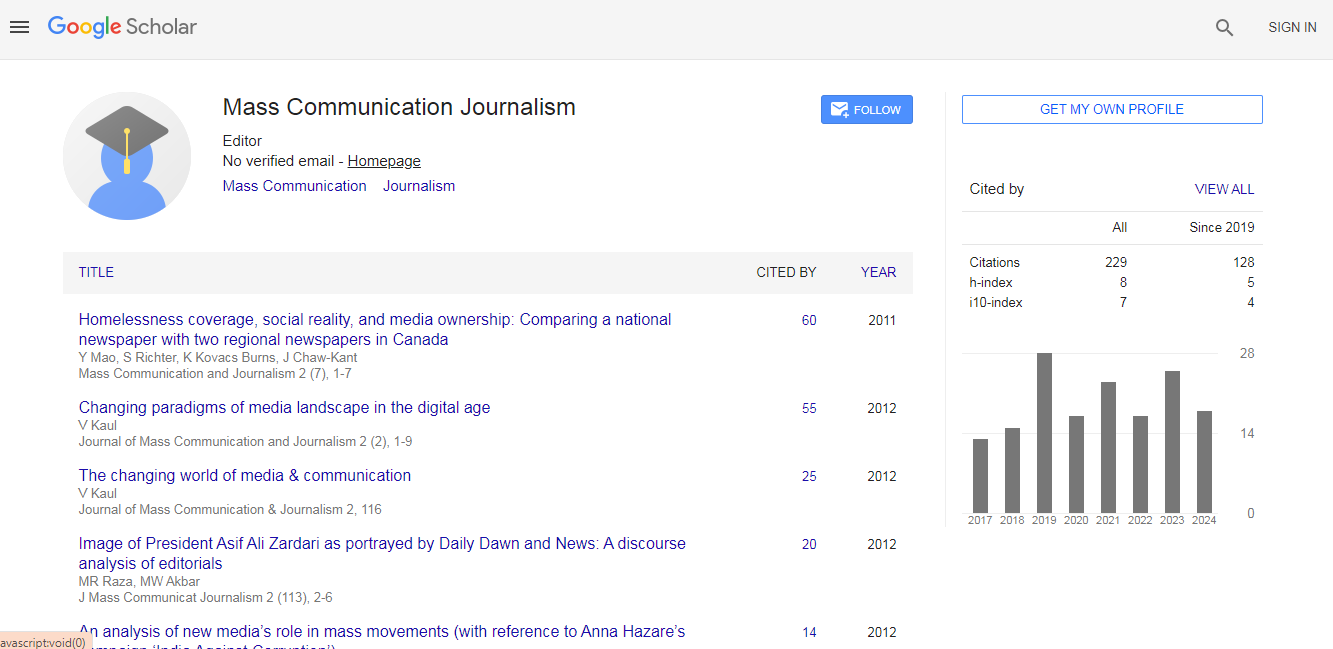
Journal of Mass Communication & Journalism received 205 citations as per Google Scholar report