Short Communication - (2025) Volume 14, Issue 3
Received: 01-May-2025, Manuscript No. iem-26-179792;
Editor assigned: 04-May-2025, Pre QC No. P-179792;
Reviewed: 14-May-2025, QC No. Q-179792;
Revised: 21-May-2025, Manuscript No. R-179792;
Published:
29-May-2025
, DOI: 10.37421/2169- 0316.2025.14.306
Citation: Wei, Chen. Strategies for Industrial Efficiency and Cost Reduction. J Ind Eng Manag 14 (2025):306.
Copyright: © 2025 Wei C. This is an open-access article distributed under the terms of the Creative Commons Attribution License, which permits unrestricted use, distribution
and reproduction in any medium, provided the original author and source are credited.
This article explores the multifaceted strategies and methodologies employed in modern industry to enhance efficiency and optimize cost management. A significant focus is placed on the critical role of cost analysis in achieving substantial improvements in industrial operations and profitability. The paper details how a deep understanding of cost drivers, coupled with strategic interventions, can lead to significant advancements in productivity and profitability, emphasizing systematic cost reduction techniques and the strategic allocation of resources to secure a competitive advantage [1].
The impact of digitalization on industrial cost management is a key area of investigation, highlighting how advanced analytical tools and artificial intelligence can fundamentally transform the way industrial costs are analyzed. By proposing a framework for integrating data from diverse operational units, a holistic perspective on costs is enabled, facilitating more precise forecasting, informed investment decisions, and the proactive identification of cost-saving opportunities, thereby reducing waste and improving operational agility [2].
Furthermore, the research delves into the application of Lean Six Sigma methodologies for the optimization of production costs. A case study is presented to illustrate how these integrated approaches can systematically identify and eliminate waste, reduce process variability, and enhance overall quality, directly contributing to substantial cost reductions through continuous improvement and employee engagement [3].
Activity-based costing (ABC) is examined for its effectiveness in pinpointing cost drivers within complex manufacturing settings. By accurately allocating overhead costs based on the activities that consume them, ABC provides a granular and precise understanding of product and service costs, empowering management with insights for informed decisions regarding process enhancements, product mix, and pricing strategies to boost profitability and efficiency [4].
The strategic integration of supply chain management and cost analysis is explored as a potent strategy for boosting industrial efficiency. Optimizing the entire supply chain, from procurement to final delivery, is shown to yield significant cost savings. The research investigates methods for improving supply chain visibility, fostering collaboration, and managing risks to reduce inventory costs, enhance logistics, and ensure timely deliveries, ultimately elevating operational efficiency [5].
The cost implications associated with the implementation of Industry 4.0 technologies in manufacturing are analyzed, providing an analytical framework for evaluating the return on investment for smart manufacturing initiatives. Investments in areas such as the Internet of Things (IoT), big data analytics, and automation are shown to lead to considerable operational cost reductions, superior product quality, and increased production flexibility, thereby enhancing overall industrial efficiency [6].
Energy efficiency is presented as a crucial component of cost reduction strategies in industrial operations. Methods for analyzing energy consumption patterns and identifying optimization opportunities are proposed. The implementation of energy-saving measures and investment in more efficient technologies can markedly reduce operating costs, lessen environmental impact, and improve industrial competitiveness [7].
The financial and operational benefits derived from implementing total quality management (TQM) for improved industrial efficiency are investigated. A comprehensive focus on quality throughout the production process is demonstrated to minimize rework, reduce scrap, and enhance customer satisfaction, all of which contribute to lower costs and increased productivity, underscoring the importance of a cultural shift for successful TQM implementation [8].
Predictive maintenance strategies are examined for their role in reducing operational costs and enhancing the efficiency of industrial machinery. By leveraging data analytics to anticipate equipment failures, companies can proactively schedule maintenance, thereby minimizing unplanned downtime and associated repair expenses. This approach not only yields cost savings but also boosts asset reliability and longevity, supporting sustained industrial performance [9].
Finally, the integration of circular economy principles into industrial cost management is explored as a driver for efficiency. Designing products for extended lifespan, repairability, and recyclability is shown to reduce raw material costs, waste disposal expenses, and the demand for new production, thereby improving both economic and environmental performance through the assessment of circular business models [10].
The critical role of cost analysis in achieving industrial efficiency is thoroughly examined, highlighting how a comprehensive understanding of cost drivers and strategic interventions can lead to substantial improvements in productivity and profitability. The focus remains on implementing systematic cost reduction techniques and optimizing resource allocation to gain a competitive edge, with key strategies such as lean manufacturing, activity-based costing, and the use of digital technologies for real-time cost monitoring being discussed [1].
Digitalization's profound impact on cost management is explored, detailing how advanced analytics and artificial intelligence can revolutionize industrial cost analysis. A proposed framework for integrating data from various operational units provides a holistic view of costs, enabling more accurate forecasting, enhanced investment decision-making, and proactive identification of cost-saving opportunities, leading to reduced waste, improved supply chain visibility, and greater operational agility [2].
The optimization of production costs through the application of Lean Six Sigma methodologies is a central theme, with a case study demonstrating how these integrated approaches systematically identify and eliminate waste, reduce process variability, and improve overall quality. This directly translates into significant cost reductions, emphasizing the importance of continuous improvement and employee involvement for achieving sustainable cost efficiencies [3].
The effectiveness of activity-based costing (ABC) in pinpointing cost drivers within intricate manufacturing environments is investigated. By allocating overhead costs based on the activities that consume them, ABC offers a more accurate portrayal of product and service costs, equipping management with granular insights for informed decisions on process improvements, product mix, and pricing strategies aimed at enhancing overall profitability and efficiency [4].
The strategic integration of supply chain management and cost analysis is presented as a method to enhance industrial efficiency. Optimizing the entire supply chain, from procurement to delivery, is shown to generate substantial cost savings. The research examines methods for improving visibility, collaboration, and risk management within the supply chain to cut inventory costs, streamline logistics, and ensure timely delivery, thereby boosting operational efficiency [5].
The cost implications of implementing Industry 4.0 technologies in manufacturing are analyzed, including the development of an analytical framework for evaluating the return on investment (ROI) of smart manufacturing initiatives. Investments in IoT, big data analytics, and automation are discussed as drivers of significant operational cost reductions, improved product quality, and increased production flexibility, ultimately contributing to greater overall industrial efficiency [6].
Energy efficiency is examined as a fundamental cost reduction strategy in industrial operations. The paper proposes methods for analyzing energy consumption patterns and identifying opportunities for optimization. By implementing energy-saving measures and adopting more efficient technologies, industries can substantially lower operating costs, decrease their environmental footprint, and enhance their overall competitiveness [7].
The financial and operational benefits of implementing total quality management (TQM) for improved industrial efficiency are explored. A focus on quality throughout the production process is shown to minimize rework, reduce scrap, and enhance customer satisfaction, leading to lower costs and higher productivity. The research underscores the necessity of a cultural shift for the successful implementation of TQM [8].
Predictive maintenance strategies are investigated for their efficacy in reducing operational costs and improving the efficiency of industrial machinery. Analyzing data to anticipate equipment failures enables proactive maintenance scheduling, minimizing unplanned downtime and associated repair expenses. This strategy not only saves money but also enhances asset reliability and longevity, supporting sustained industrial performance [9].
Finally, the integration of circular economy principles into industrial cost management is explored as a pathway to improved efficiency. Designing products for longevity, repairability, and recyclability can reduce raw material costs, waste disposal expenses, and the need for new production, thereby enhancing economic and environmental performance. Frameworks for assessing the cost-effectiveness of circular business models are provided [10].
This collection of research highlights various strategies for enhancing industrial efficiency and reducing costs. Key approaches include comprehensive cost analysis, leveraging digitalization and AI for better cost management, and implementing Lean Six Sigma methodologies for production optimization. Activity-based costing offers granular insights into cost drivers, while strategic supply chain management integration yields significant savings. The adoption of Industry 4.0 technologies and a focus on energy efficiency are also crucial. Furthermore, total quality management and predictive maintenance contribute to cost reduction by minimizing waste and downtime. Finally, adopting circular economy principles offers a sustainable path to economic and environmental improvements through product design for longevity and recyclability.
None
None
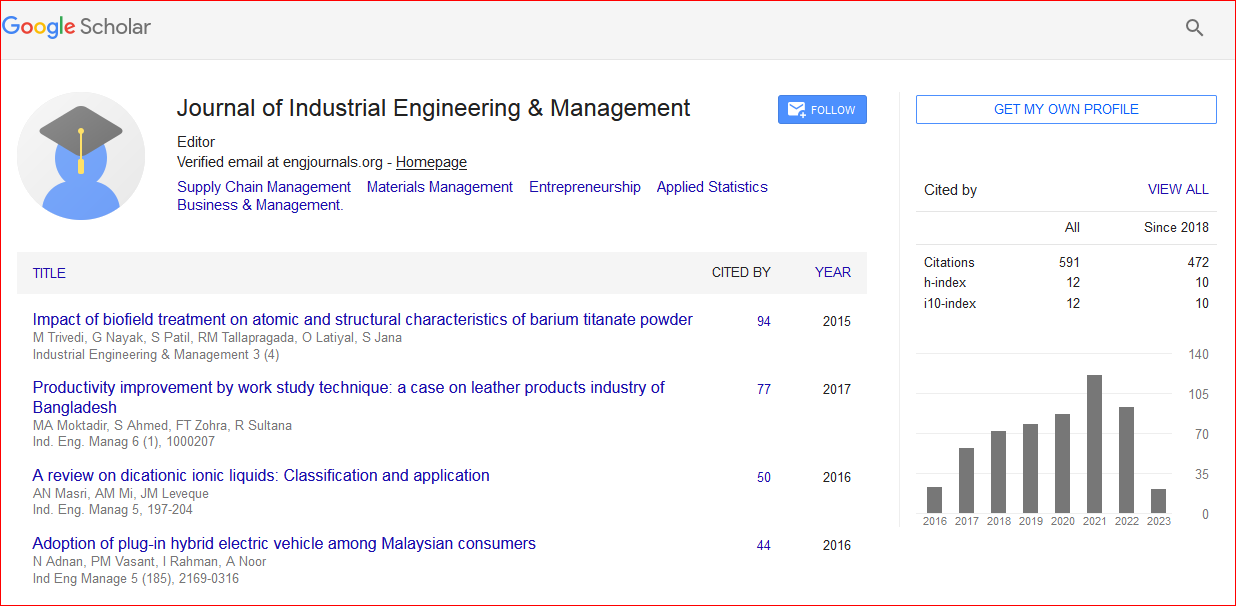
Industrial Engineering & Management received 739 citations as per Google Scholar report