Perspective - (2025) Volume 14, Issue 3
Received: 01-Jun-2025, Manuscript No. jbfa-25-174148;
Editor assigned: 03-Jun-2025, Pre QC No. P-174148;
Reviewed: 17-Jun-2025, QC No. Q-174148;
Revised: 23-Jun-2025, Manuscript No. R-174148;
Published:
30-Jun-2025
, DOI: 10.37421/2167-0234.2025.14.536
Citation: Ivanova, Tatiana. ”Strategic Management: Organizations, Stakeholders, Global Challenges.” J Bus Fin Aff 14 (2025):536.
Copyright: © 2025 Ivanova T. This is an open-access article distributed under the terms of the Creative Commons Attribution License, which permits unrestricted use, distribution and reproduction in any medium, provided the original author and source are credited.
Multinational enterprises strategically align core business operations with the United Nations Sustainable Development Goals (SDGs), converting strategic actions into tangible outcomes through intentional integration of sustainability into global strategy. This arises from deliberate strategic choices, not just ad-hoc initiatives [1].
Organizations achieve ambidexterityâ??simultaneously exploring new opportunities and exploiting existing capabilitiesâ??in digital transformation by leveraging a dynamic capabilities framework for organizational learning and resource reconfiguration, essential for navigating rapid technological shifts. Effective digital strategies involve continuous adaptation of business models to maintain competitive advantage [2].
This research re-evaluates the link between a firm's engagement with social issues and its financial performance, emphasizing the strategic salience of these issues. Not all social issues are equally important, their impact depending on embedding in core strategy and stakeholder landscape. Carefully chosen and managed stakeholder engagement leads to superior long-term performance [3].
Strategic alliances influence organizational learning and innovation outcomes, serving as critical conduits for knowledge transfer and co-creation. The strategic importance lies in selecting appropriate partners and designing alliance structures that facilitate deep learning, which in turn drives sustained innovation and competitive advantage [4].
This article investigates resource orchestration in enabling business model innovation, framed within a dynamic capabilities perspective. Firms must actively sense, seize, and reconfigure their resources to adapt and innovate business models in response to changing market conditions, creating new value propositions and competitive differentiation [5].
This study explores the relationship between formal organizational structure and a firm's ability to achieve ambidexterityâ??excelling in both exploitation and exploration. A contingency perspective suggests optimal structure depends on various contextual factors, with successful firms strategically adapting structures to balance competing demands [6].
This paper re-examines the resource-based view (RBV) of the firm in dynamic and rapidly changing business environments. For resources to provide sustainable competitive advantage, they must be continuously reconfigured and adapted, requiring firms to develop dynamic capabilities to effectively manage and leverage their resource base [7].
This article advocates for a fundamental shift towards stakeholder capitalism, where corporate strategy explicitly aims to create value for all stakeholders. Integrating the interests of employees, customers, suppliers, communities, and investors leads to more resilient and successful organizations, fostering innovation, building trust, and enhancing long-term performance [8].
This paper focuses on how organizations can design and manage robust ecosystem strategies, particularly in rapidly evolving digital landscapes. Building resilience within an ecosystem requires strategic foresight, careful partner selection, and adaptive governance mechanisms, moving beyond traditional linear value chains to orchestrate complex networks [9].
Strategic management must evolve to effectively address global 'grand challenges' such as climate change, inequality, and public health crises. Businesses need to adopt a broader strategic lens, moving beyond traditional profit maximization to integrate social and environmental impact as core strategic objectives, unlocking new avenues for innovation [10].
Multinational enterprises (MNEs) are actively strategizing to align their core business operations with the United Nations Sustainable Development Goals (SDGs), recognizing that successful contributions stem from deliberate strategic choices rather than ad-hoc initiatives [1]. This highlights a broader imperative for strategic management to evolve and address global 'grand challenges,' such as climate change and inequality. It means businesses must integrate social and environmental impact into their core strategic objectives, moving beyond traditional profit maximization to unlock new innovation avenues and redefine corporate purpose [10].
Here's the thing about social issues and firm performance: their strategic salience is key. The impact of a firm's engagement with social issues on its financial performance depends on how deeply these issues are embedded in its core strategy and stakeholder landscape. Carefully chosen and managed stakeholder engagement can lead to superior long-term performance, unlike generic approaches [3]. What this really means is a fundamental shift towards stakeholder capitalism, where corporate strategy aims to create value for all stakeholdersâ??employees, customers, suppliers, communities, and investors. This holistic approach fosters innovation, builds trust, and ultimately enhances long-term resilience and societal impact [8].
Organizations face the challenge of achieving ambidexterityâ??balancing the exploration of new opportunities with the exploitation of existing capabilitiesâ??especially amidst digital transformation. Digital technologies are crucial here, enabling novel organizational learning and resource reconfiguration essential for navigating rapid technological shifts. Effective digital strategies require continuous adaptation and re-evaluation of business models [2]. This pursuit of ambidexterity is also intricately linked to formal organizational structure. Research shows that the optimal structure is contingent on various contextual factors, implying that successful firms strategically adapt their structures to balance these competing demands based on their specific objectives and environment [6].
Strategic alliances are vital conduits for organizational learning and innovation outcomes. They facilitate knowledge transfer and co-creation, expanding firms' knowledge bases and enabling the development of novel solutions. The strategic importance lies in selecting appropriate partners and designing alliance structures that genuinely foster deep learning, which in turn drives sustained innovation and competitive advantage [4].
When it comes to business model innovation, resource orchestration is key, viewed through a dynamic capabilities lens. Firms must actively sense, seize, and reconfigure their resources to adapt and innovate their business models in changing market conditions. This goes beyond mere resource acquisition; it involves strategically integrating, transforming, and leveraging resources to create new value propositions and sustain differentiation [5]. This idea echoes the re-examination of the resource-based view (RBV) in dynamic environments, which argues that for resources to provide a sustainable competitive advantage, they must be continuously reconfigured and adapted. Firms must develop dynamic capabilities to manage and leverage their resource base effectively, ensuring its ongoing relevance [7].
Finally, designing and managing robust ecosystem strategies is paramount, particularly in rapidly evolving digital landscapes. Building resilience within such an ecosystem requires strategic foresight, careful partner selection, and adaptive governance mechanisms. Firms need to move beyond traditional linear value chains, orchestrating complex networks of partners, and continuously adapting their roles and interactions to respond to disruptions and capitalize on new opportunities [9].
This collection of research explores how modern organizations navigate complex strategic landscapes. It highlights the critical role of multinational enterprises in aligning business operations with Sustainable Development Goals (SDGs) through deliberate strategic choices, moving beyond ad-hoc initiatives. Organizations also achieve ambidexterity in digital transformation by leveraging dynamic capabilities for continuous learning and resource reconfiguration, ensuring competitive advantage. The work emphasizes that a firm's engagement with social issues significantly impacts financial performance, especially when these issues are strategically embedded and managed with a nuanced stakeholder approach. Strategic alliances are shown to be vital for organizational learning and innovation, acting as conduits for knowledge transfer and co-creation. Further, effective resource orchestration, framed within a dynamic capabilities perspective, is crucial for business model innovation, enabling firms to adapt and reconfigure resources in evolving markets. The papers also examine how formal organizational structures influence a firm's ability to balance exploration and exploitation, suggesting a contingency perspective where structures are strategically adapted. The resource-based view of the firm is re-examined, underscoring the need for continuous resource reconfiguration to sustain competitive advantage in dynamic environments. A significant theme is the advocacy for stakeholder capitalism, proposing that creating value for all stakeholders â?? employees, customers, suppliers, communities, and investors â?? fosters resilience, innovation, and long-term corporate success. Finally, the research calls for strategic management to broaden its scope to address global 'grand challenges,' integrating social and environmental impacts as core objectives, thereby redefining the purpose and value of modern corporations.
None
None
Indexed at, Google Scholar, Crossref
Indexed at, Google Scholar, Crossref
Indexed at, Google Scholar, Crossref
Indexed at, Google Scholar, Crossref
Indexed at, Google Scholar, Crossref
Indexed at, Google Scholar, Crossref
Indexed at, Google Scholar, Crossref
Indexed at, Google Scholar, Crossref
Indexed at, Google Scholar, Crossref
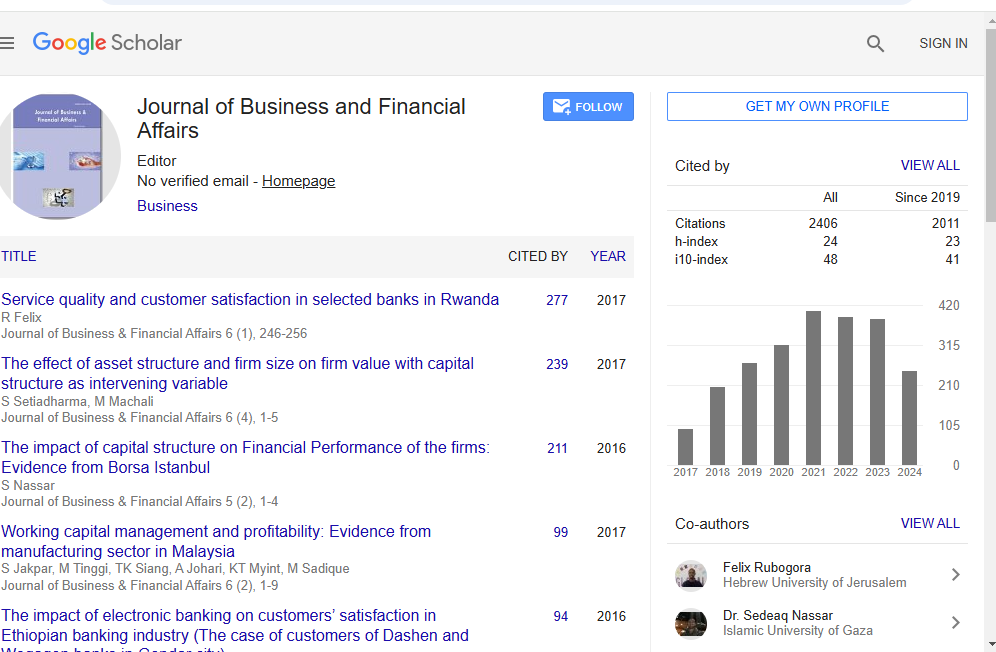
Journal of Business & Financial Affairs received 1726 citations as per Google Scholar report