Perspective - (2025) Volume 11, Issue 5
Received: 01-Oct-2025, Manuscript No. jssc-26-188313;
Editor assigned: 03-Oct-2025, Pre QC No. P-188313;
Reviewed: 17-Oct-2025, QC No. Q-188313;
Revised: 22-Oct-2025, Manuscript No. R-188313;
Published:
29-Oct-2025
, DOI: 10.37421/2472-0437.2025.11.322
Citation: White, Kevin. ”Steel Structure Safety: Integrity, Performance,
and Longevity.” J Steel Struct Constr 11 (2025):322.
Copyright: © 2025 White K. This is an open-access article distributed under the terms of the Creative Commons Attribution License, which permits unrestricted use, distribution
and reproduction in any medium, provided the original author and source are credited.
The structural integrity of steel construction projects is a paramount concern, necessitating rigorous assessment methodologies that have evolved significantly over time. Advanced techniques are now employed to detect and quantify degradation mechanisms such as fatigue, corrosion, and material deterioration, underscoring the importance of integrating numerical modeling with experimental testing to predict long-term performance and remaining service life of steel structures. This approach facilitates the development of reliable inspection protocols and the application of innovative monitoring systems for proactive safety management [1].
The dynamic behavior of steel frame buildings under seismic loads has been a subject of extensive investigation, considering various ground motion intensities and structural configurations. The findings emphasize the necessity of performance-based seismic design principles to ensure adequate resilience and prevent catastrophic failures, proposing refined design guidelines for improved ductility and energy dissipation capacity in steel structures subjected to extreme seismic events [2].
Long-term durability in corrosive environments is another critical aspect of steel construction. Research examines the effectiveness of various protective coatings and cathodic protection systems in mitigating corrosion-induced degradation, providing insights into accelerated aging tests and in-situ monitoring techniques to assess the remaining service life of corroded steel elements. Recommendations are made for selecting appropriate maintenance strategies and materials to enhance the longevity of steel constructions [3].
Advanced non-destructive testing (NDT) methods are crucial for evaluating the structural health of steel bridges, comparing the efficacy of techniques such as ultrasonic testing, acoustic emission, and infrared thermography in identifying internal flaws and assessing material integrity. The research highlights the potential of integrated NDT approaches for efficient and reliable condition assessment, leading to informed maintenance decisions and extended operational life [4].
Offshore steel platforms face extreme environmental conditions, requiring advanced numerical modeling techniques to simulate the effects of wave loads, wind, and currents on structural response. The research emphasizes the importance of considering cumulative damage mechanisms and fatigue life assessment for ensuring the long-term reliability of these critical structures, providing recommendations for robust design and inspection strategies [5].
The behavior of steel connections under cyclic loading is a critical aspect of seismic design. Analysis of various connection types and their response to repeated stress cycles, focusing on fracture mechanisms and energy dissipation, provides valuable data for improving the design of ductile and robust steel connections, contributing to enhanced seismic resilience in buildings and offering new insights into preventing premature failure [6].
A probabilistic approach to structural safety assessment is applied to steel storage tanks, considering uncertainties in material properties, loading conditions, and environmental factors to estimate the probability of failure. This highlights the importance of risk-informed decision-making for maintenance and inspection planning, offering a framework for quantifying reliability and ensuring the safe operation of these vital infrastructure components [7].
Real-time structural health monitoring of steel buildings using fiber optic sensors is explored, detailing the principles of fiber optic sensing and its application in measuring strain, temperature, and displacement. The research demonstrates the effectiveness of this technology in providing continuous and distributed monitoring data for early detection of structural anomalies, thereby enhancing safety and enabling timely interventions [8].
Fatigue life assessment of welded steel structures, a common failure mode in bridges and industrial equipment, is investigated. This involves reviewing current fatigue design codes and proposing advanced fracture mechanics-based methods for more accurate life prediction, emphasizing the importance of considering stress concentration effects and material variability in fatigue analysis to contribute to more reliable estimations of structural endurance [9].
Finally, the residual strength evaluation of fire-damaged steel structures addresses the degradation of mechanical properties of steel after exposure to elevated temperatures and assesses the remaining load-carrying capacity. The study proposes methodologies for repairing or strengthening fire-affected steel elements, aiming to restore structural integrity and ensure safety, providing critical guidance for post-fire structural assessments [10].
The structural integrity of steel construction projects is underpinned by comprehensive assessment methodologies, with advancements focusing on detecting and quantifying degradation mechanisms like fatigue and corrosion. These efforts integrate numerical modeling and experimental testing to forecast the long-term performance and service life of steel structures, supported by reliable inspection protocols and monitoring systems for safety management [1].
Investigating the seismic performance of steel frame buildings involves analyzing their dynamic behavior under various ground motions and structural configurations. This research underscores the significance of performance-based seismic design for ensuring resilience and preventing catastrophic failures, with proposed guidelines enhancing ductility and energy dissipation capacity in steel structures facing extreme seismic events [2].
Addressing the long-term durability of steel structures in corrosive environments involves evaluating the efficacy of protective coatings and cathodic protection systems. Studies utilize accelerated aging tests and in-situ monitoring to assess the remaining service life of corroded elements, offering recommendations for maintenance strategies and materials to prolong structural longevity [3].
For steel bridges, the application of advanced non-destructive testing (NDT) methods is pivotal for structural health monitoring. Comparisons of techniques like ultrasonic testing, acoustic emission, and infrared thermography highlight their capability in identifying internal flaws and assessing material integrity, promoting efficient condition assessment for informed maintenance decisions and extended operational life [4].
Offshore steel platforms require robust structural safety evaluations under extreme environmental conditions. Advanced numerical modeling simulates the impact of wave loads, wind, and currents, emphasizing the critical role of cumulative damage and fatigue life assessment for ensuring long-term reliability, with recommendations for design and inspection strategies [5].
The cyclic behavior and failure mechanisms of steel connections are crucial for seismic design. Analysis of various connection types under repeated stress cycles provides essential data for designing ductile and robust connections, enhancing seismic resilience in buildings and offering insights into preventing premature failure [6].
Probabilistic safety assessment is applied to steel storage tanks to quantify failure probabilities by considering uncertainties in material properties, loads, and environmental factors. This approach emphasizes risk-informed decision-making for maintenance and inspection, establishing a framework for reliability assessment and safe operation [7].
Real-time structural health monitoring of steel buildings is advanced through the use of fiber optic sensors, which measure strain, temperature, and displacement. This technology provides continuous, distributed data for early anomaly detection, thereby improving safety and enabling timely interventions [8].
Fatigue life assessment of welded steel structures, a prevalent failure mode, involves reviewing design codes and employing advanced fracture mechanics methods for accurate life prediction. The research stresses the importance of stress concentration effects and material variability in fatigue analysis for reliable structural endurance estimations [9].
Lastly, the residual strength of fire-damaged steel structures is evaluated by analyzing the degradation of steel properties at elevated temperatures and assessing remaining load-carrying capacity. Methodologies for repair and strengthening are proposed to restore integrity and ensure safety, offering critical guidance for post-fire assessments [10].
This collection of research highlights critical aspects of steel structure safety, encompassing structural integrity assessment, seismic performance, durability in corrosive environments, and non-destructive testing methods. Advanced techniques in numerical modeling, experimental testing, and real-time monitoring using fiber optic sensors are employed to predict long-term performance and remaining service life. The studies also address specific challenges such as the seismic behavior of steel frames, corrosion control, structural health monitoring of bridges and offshore platforms, the cyclic behavior of steel connections, probabilistic safety assessment of storage tanks, fatigue life assessment of welded structures, and the residual strength of fire-damaged structures. Overall, the research emphasizes the importance of robust design, reliable inspection protocols, and proactive safety management to ensure the longevity and resilience of steel constructions.
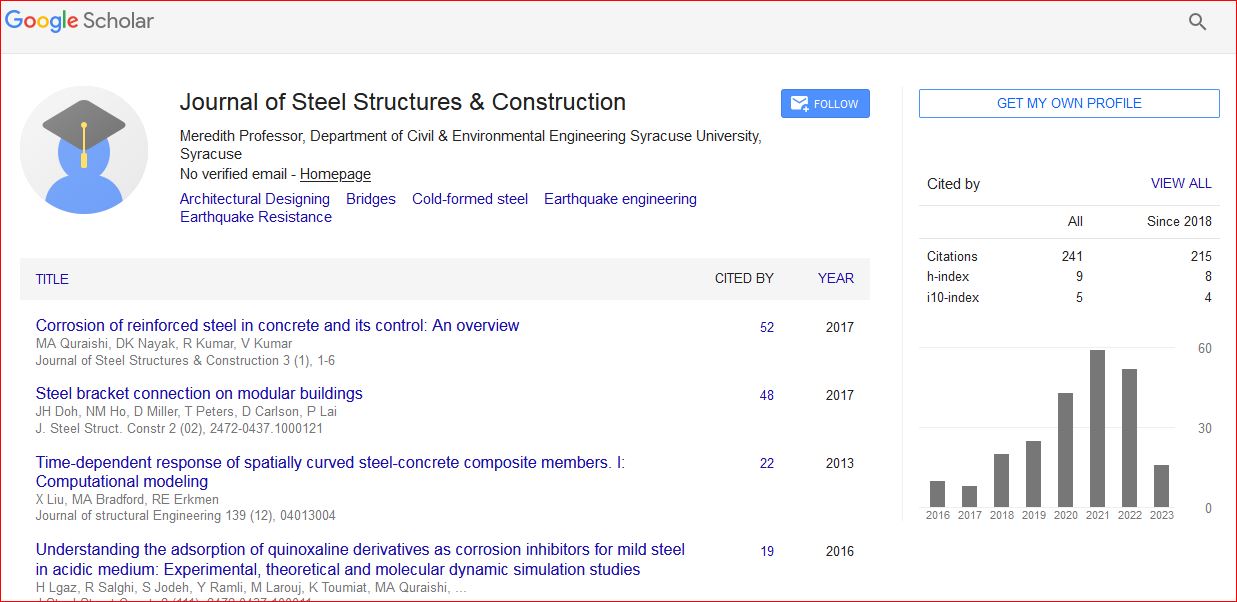
Journal of Steel Structures & Construction received 583 citations as per Google Scholar report