Brief Report - (2025) Volume 16, Issue 3
Received: 02-Jun-2025, Manuscript No. jbmbs-26-183386;
Editor assigned: 04-Jun-2025, Pre QC No. P-183386;
Reviewed: 18-Jun-2025, QC No. Q-183386;
Revised: 23-Jun-2025, Manuscript No. R-183386;
Published:
30-Jun-2025
, DOI: 10.37421/2155-6180.2025.16.273
Citation: Tanaka, Hiroshi. ”Statistical Methods for Omics Data Analysis.” J Biom Biosta 16 (2025):273.
Copyright: © 2025 Tanaka H. This is an open-access article distributed under the terms of the Creative Commons Attribution License, which permits unrestricted use, distribution and reproduction in any medium, provided the original author and source are credited.
The advent of high-throughput technologies in genomics and proteomics has generated unprecedented volumes of data, necessitating the development and application of sophisticated statistical methods for meaningful interpretation. These methods are paramount in uncovering intricate biological patterns and mechanisms that underpin life and disease. Early research in this domain often relied on fundamental association studies to identify relationships within biological data. As the scale and complexity of genomic and proteomic datasets grew, so did the need for more advanced analytical techniques capable of handling high dimensionality and inherent noise. This evolution has seen a significant shift towards machine learning and other advanced statistical modeling approaches to extract actionable insights from these vast biological information repositories [1].
The analytical landscape for high-throughput genomic data is continuously evolving, with a growing emphasis on sophisticated statistical models that can manage the intricacies of this information. Among these advanced techniques, Bayesian approaches and deep learning algorithms are gaining prominence. These models are particularly adept at addressing the inherent challenges of genomic data, such as the problem of multiple testing, where numerous statistical tests are performed simultaneously, increasing the likelihood of false positives. Feature selection, a critical step in identifying the most informative genetic variants, is also a major focus of these advanced statistical frameworks. The application of these methods is crucial for improving the accuracy and interpretability of findings derived from large-scale genomic experiments [2].
In parallel with genomic data analysis, the statistical analysis of transcriptomic and proteomic data has also seen significant advancements. The identification of differentially expressed genes and proteins is a fundamental step in understanding cellular responses to stimuli or disease states. Researchers are developing novel statistical techniques to robustly estimate effects and perform hypothesis testing under diverse experimental designs. These designs can range from simple comparisons to complex scenarios involving time-series data or the integration of multiple omics layers (multi-omics). Such work is vital for gaining a granular understanding of cellular functions and disease mechanisms at the molecular level [3].
The field of precision medicine, particularly in cancer research, heavily relies on the analysis of genomic profiles to guide treatment strategies. Machine learning algorithms, including techniques like support vector machines and random forests, have become indispensable tools for classifying disease subtypes based on these genomic signatures. The emphasis in these applications is not only on model development but also on rigorous feature selection and model validation. These strategies are essential to ensure that the developed predictive models can generalize effectively to new, unseen data, which is critical for their clinical utility in personalized oncology [4].
A significant frontier in biological data analysis is the integration of multi-omics data. This involves combining information from different molecular layers, such as genomics, transcriptomics, and proteomics, to construct a more holistic and comprehensive understanding of biological systems. However, this integration presents unique statistical challenges, particularly in data fusion, where data from different sources must be combined effectively, and in network inference, where relationships between biological entities are reconstructed. Overcoming these challenges is key to identifying critical molecular pathways and regulatory interactions that drive disease processes [5].
Single-cell RNA sequencing (scRNA-seq) has revolutionized our ability to study cellular heterogeneity. However, scRNA-seq data presents its own set of statistical challenges, including high levels of sparsity, the presence of batch effects due to variations in experimental conditions, and the need for dimensionality reduction to visualize and analyze the data effectively. Statistical modeling plays a crucial role in addressing these issues, enabling robust cell type identification and the inference of developmental trajectories, which are fundamental for understanding cellular diversity and differentiation [6].
Genome-wide association studies (GWAS) are instrumental in identifying genetic variants associated with common diseases. Statistical approaches for analyzing GWAS data are continuously being refined to enhance their power and precision. Particular attention is given to the analysis of rare variants, which may have a significant impact on disease risk but are often difficult to detect, and to complex gene-gene interactions. Methods for improving statistical power and controlling the rate of false discoveries in large-scale cohort studies are essential for accurately pinpointing genetic risk factors [7].
Proteomics, the study of proteins, offers a complementary perspective to genomics and transcriptomics. Statistical methods are central to various stages of proteomic data analysis, including the identification and quantification of peptides and proteins, as well as the testing for differential abundance of these molecules between different conditions. Addressing challenges such as experimental variability and the inherent high dimensionality of proteomic datasets is crucial for achieving reliable discoveries of disease biomarkers, which can serve as diagnostic or prognostic indicators [8].
Moving beyond correlational insights, there is a growing interest in applying causal inference methods to genomic and proteomic studies. The goal is to transition from identifying associations to understanding the underlying biological mechanisms and causal relationships. This involves developing and applying strategies for inferring causal links from both observational and experimental data. Such advancements contribute to a deeper understanding of gene function, protein interactions, and the complex pathways that lead to disease development and progression [9].
Transcriptomic data, particularly from RNA sequencing, provides a rich source of information about gene expression and regulation. Statistical methods are vital for identifying regulatory elements and reconstructing gene networks. Techniques for inferring gene regulatory networks aim to map the complex interactions between genes and their regulators, such as transcription factors. Analyzing transcription factor binding and understanding how these networks dynamically change in response to various stimuli or disease states are key objectives in this area of research [10].
Statistical methods form the bedrock of modern biological data analysis, enabling researchers to navigate the vast and complex datasets generated by genomic and proteomic studies. The evolution of these methodologies, from early association studies to sophisticated machine learning algorithms, reflects the increasing need to decipher intricate biological patterns, pinpoint disease biomarkers, and pave the way for personalized medicine. Handling the inherent noise and high dimensionality characteristic of this data requires robust statistical frameworks that continue to be refined and advanced [1].
Advanced statistical models, including Bayesian approaches and deep learning, are at the forefront of high-throughput genomic data analysis. These powerful tools are employed to tackle challenges such as multiple testing and feature selection, which are critical for identifying significant genetic variants linked to complex traits. The application of these sophisticated models significantly enhances the accuracy and interpretability of findings from large-scale genomic experiments, pushing the boundaries of our understanding [2].
Novel statistical techniques are continuously being developed for the analysis of transcriptomic and proteomic data, particularly for identifying differentially expressed genes and proteins. These methods focus on robust estimation and hypothesis testing, accommodating various experimental designs, including time-series and multi-omics integration. This work is fundamental to comprehending cellular responses and disease mechanisms at the molecular level [3].
In the realm of cancer research, machine learning algorithms such as support vector machines and random forests are instrumental in classifying disease subtypes based on genomic profiles. Emphasis is placed on effective feature selection and rigorous model validation strategies to ensure reliable generalization to new data. These insights are crucial for the development of predictive models essential for precision oncology [4].
The integration of multi-omics data, encompassing genomic, transcriptomic, and proteomic information, offers a more comprehensive view of biological systems. However, this integration introduces complex statistical challenges related to data fusion and network inference. Addressing these challenges is vital for accurately identifying key molecular pathways and regulatory interactions that underlie various diseases [5].
Statistical modeling is essential for analyzing single-cell RNA sequencing (scRNA-seq) data, which is characterized by sparsity, batch effects, and high dimensionality. The proposed methods facilitate robust cell type identification and trajectory inference, crucial for studying cellular heterogeneity and developmental processes [6].
Genome-wide association studies (GWAS) benefit immensely from refined statistical approaches that focus on identifying rare variants and complex interactions. These methods are designed to improve statistical power and control false discoveries in large cohorts, which is critical for uncovering genetic risk factors associated with common diseases [7].
Quantitative proteomics relies heavily on advanced statistical techniques for tasks such as peptide and protein identification, quantification, and differential abundance testing. These methods are designed to address experimental variability and the high dimensionality of proteomic datasets, leading to more reliable discovery of disease biomarkers [8].
Causal inference methods are increasingly being applied in genomics and proteomics to move beyond simple correlations and towards a deeper understanding of biological mechanisms. These strategies aim to infer causal relationships from observational and experimental data, thereby enhancing our comprehension of gene function and disease pathways [9].
Statistical methods are crucial for identifying regulatory elements and gene networks from transcriptomic data. Techniques for inferring gene regulatory networks, analyzing transcription factor binding, and understanding network dynamics under different conditions are key areas of research contributing to a deeper biological understanding [10].
This collection of research highlights the critical role of advanced statistical methods in analyzing large-scale genomic and proteomic data. Papers discuss the evolution of these techniques, from basic association studies to sophisticated machine learning and Bayesian approaches, essential for uncovering biological patterns, identifying disease biomarkers, and advancing personalized medicine. Challenges such as multiple testing, feature selection, data integration across multiple omics layers, and the specific issues arising from single-cell RNA sequencing are addressed. Furthermore, applications in cancer research, genome-wide association studies, and causal inference are explored, emphasizing the ongoing need for robust statistical frameworks to handle the complexity and noise inherent in biological data.
None
None
None
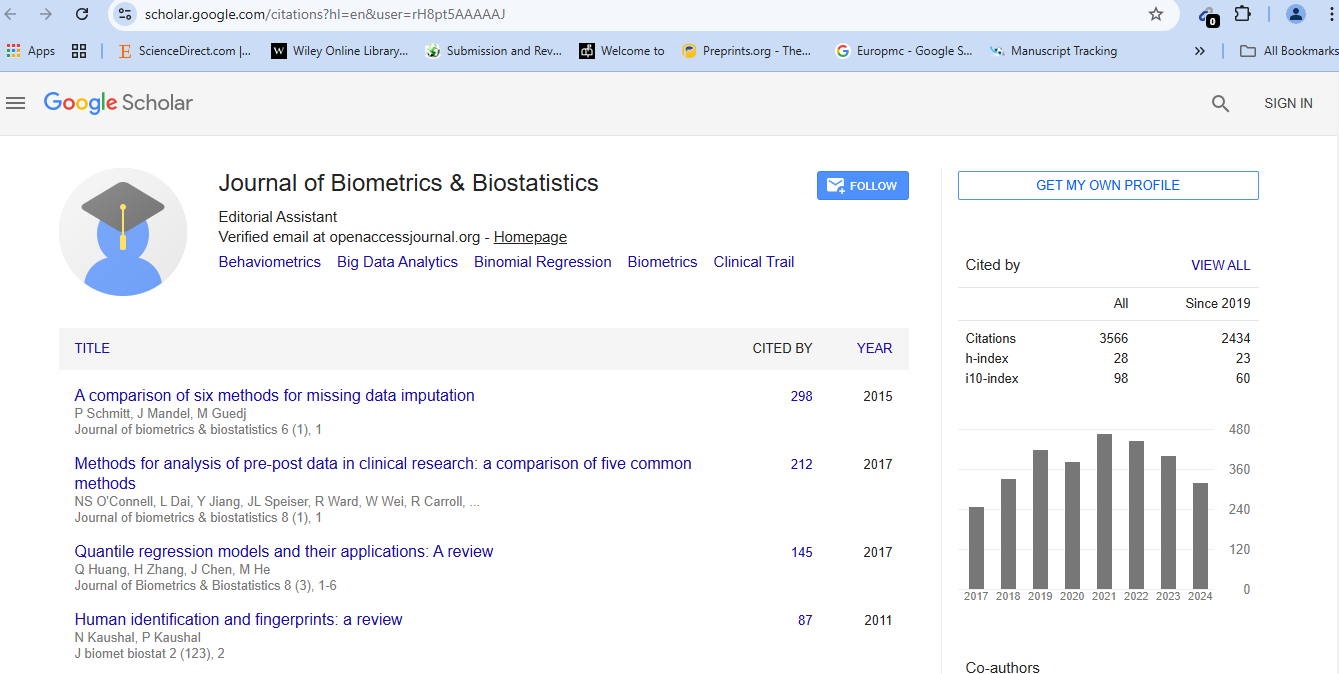
Journal of Biometrics & Biostatistics received 3496 citations as per Google Scholar report