Opinion - (2025) Volume 9, Issue 5
Received: 02-Sep-2025, Manuscript No. fsb-26-189972;
Editor assigned: 04-Sep-2025, Pre QC No. P-189972;
Reviewed: 18-Sep-2025, QC No. Q-189972;
Revised: 23-Sep-2025, Manuscript No. R-189972;
Published:
30-Sep-2025
, DOI: 10.37421/2577-0543.2025.9.258
Citation: Nair, Priya. ”Stability-Indicating Methods: Ensuring Drug Safety and Quality.” J. Formul. Sci. Bioavailability 09 (2025):258.
Copyright: © 2025 Nair P. This is an open-access article distributed under the terms of the Creative Commons Attribution License, which permits unrestricted use, distribution and reproduction in any medium, provided the original author and source are credited.
Stability-indicating methods are a cornerstone of pharmaceutical formulation development and validation, designed to meticulously separate and quantify active pharmaceutical ingredients from their degradation products. This process is critical for ensuring the safety and efficacy of medications throughout their intended shelf life, a task demanding analytical procedures capable of detecting subtle changes in drug concentration under various stress conditions such as heat, humidity, light, and pH variations [1].
The validation of these methods is a rigorous undertaking, confirming their specificity, linearity, accuracy, precision, detection limits, quantitation limits, and robustness, thereby instilling confidence in the quality of the final drug product [2].
A fundamental aspect of assessing pharmaceutical formulation shelf-life and storage conditions lies in the development of these specialized analytical methods. They must demonstrate exceptional specificity, ensuring that the measured analytical signal exclusively pertains to the analyte of interest, free from interference by excipients or degradation products. Integral to this development are forced degradation studies, which purposefully expose the drug to various stresses to generate potential degradants, thus proving the method's ability to resolve them effectively before subsequent validation for routine quality control [3].
Achieving a truly stability-indicating method necessitates stringent validation in accordance with established guidelines, such as those provided by the International Council for Harmonisation (ICH). This validation process is designed to confirm the method's capacity to accurately and precisely measure the active pharmaceutical ingredient (API) even in the presence of its impurities and degradation products. Key validation parameters rigorously assessed include specificity, linearity, range, accuracy, precision (encompassing repeatability and intermediate precision), detection limit (DL), quantitation limit (QL), and robustness, all of which collectively ensure the method's suitability for characterizing a drug product's stability profile [4].
The selection of appropriate analytical techniques is of paramount importance in the successful development of effective stability-indicating methods. Techniques such as high-performance liquid chromatography (HPLC) and ultra-high-performance liquid chromatography (UHPLC) are frequently chosen due to their inherent sensitivity, specificity, and remarkable resolution capabilities. When coupled with sensitive detectors like UV-Vis or mass spectrometry, these methods are adept at separating and identifying even structurally similar degradation products, thereby providing robust support for formulation development and ensuring overall product quality [5].
Forced degradation studies are absolutely indispensable in the process of developing stability-indicating methods. These studies intentionally subject the drug substance to conditions that promote degradation, including heat, light, humidity, oxidation, and exposure to acidic or basic hydrolysis. The primary objective is to identify potential degradation pathways and characterize the resulting degradation products. The chromatograms obtained from these studies are then meticulously examined to confirm that the chosen analytical method can effectively separate and detect these degradants from the parent compound, proactively safeguarding against the release of potentially toxic or ineffective drug products [6].
The robustness of a stability-indicating method represents a critical facet of its overall validation. This parameter assesses the method's resilience, that is, its capacity to maintain consistent and reliable results when subjected to small, deliberate variations in its operational parameters. Such variations might include adjustments to mobile phase composition, pH, column temperature, or flow rate. A truly robust method is essential for its successful and consistent implementation in routine quality control procedures and across diverse laboratory settings, ensuring unwavering reliability [7].
In the realm of modern pharmaceutical formulation development, the establishment of robust stability-indicating methods often involves the application of advanced analytical tools and innovative strategies. Techniques such as liquid chromatography-mass spectrometry (LC-MS) are increasingly employed due to their superior sensitivity and specificity, enabling the precise identification and characterization of unknown degradation products. The integration of these sophisticated analytical approaches facilitates a more comprehensive understanding of drug product stability and actively informs the design of formulations aimed at minimizing degradation [8].
The regulatory framework governing pharmaceutical development, particularly as defined by ICH guidelines, unequivocally mandates the development and validation of stability-indicating methods for all pharmaceutical products. These guidelines provide a comprehensive framework to ensure that analytical methods are not only fit for their intended purpose but also reliable and capable of accurately detecting changes in drug quality over time. Strict adherence to these standards is absolutely critical for securing regulatory approval and, most importantly, for ensuring patient safety, thus positioning stability-indicating methods as a fundamental pillar of pharmaceutical quality assurance [9].
The practical application of stability-indicating methods extends far beyond the initial stages of formulation development to encompass ongoing quality control and vital post-market surveillance activities. By consistently monitoring the stability of drug products using these validated methods, manufacturers can proactively identify any unforeseen degradation issues, ensure the unwavering consistency of product quality, and implement timely corrective actions when necessary. This continuous oversight is paramount for maintaining the integrity and safety of pharmaceutical products throughout their entire lifecycle [10].
In the context of formulation development, the successful establishment of a robust stability-indicating method is an iterative process that demands careful optimization and thorough characterization. A deep understanding of a drug's potential degradation pathways, coupled with the judicious selection of highly sensitive analytical tools, forms the bedrock of this endeavor. Ultimately, a well-developed and rigorously validated stability-indicating method provides the essential scientific evidence required to substantiate product shelf-life claims, thereby guaranteeing that patients consistently receive medications that are both safe and effective [11].
Stability-indicating methods are indispensable tools in the pharmaceutical industry, playing a crucial role in ensuring the quality, safety, and efficacy of drug products throughout their shelf life. These methods are specifically designed to differentiate and quantify the active pharmaceutical ingredient (API) from any degradation products that may form over time under various storage conditions. This is achieved through analytical procedures that can reliably detect and measure even minor alterations in drug concentration caused by degradation phenomena induced by stress factors like heat, humidity, light, and changes in pH. The comprehensive validation of these methods confirms essential attributes such as specificity, linearity, accuracy, precision, detection limits, quantitation limits, and robustness, collectively providing a high degree of confidence in the integrity of the final pharmaceutical product [1].
The development of stability-indicating methods is fundamentally important for accurately assessing the shelf-life and appropriate storage conditions for pharmaceutical formulations. A key requirement for these methods is specificity, which ensures that the analytical signal generated originates solely from the target analyte and is not influenced by excipients or potential degradation products. Forced degradation studies are an integral part of this development process, involving the intentional exposure of the drug to various stress conditions to generate a representative set of degradation products. These generated degradants are then used to confirm the analytical method's capability to resolve them effectively from the parent compound. Subsequent validation confirms the reliability of the method for routine quality control applications [2].
To establish a truly stability-indicating method, rigorous validation processes, often guided by ICH guidelines, are essential. This validation meticulously demonstrates the method's ability to accurately and precisely quantify the active pharmaceutical ingredient (API) in the presence of its known impurities and degradation products. The validation parameters that are critically evaluated include specificity, linearity, range, accuracy, precision (assessed through repeatability and intermediate precision), detection limit (DL), quantitation limit (QL), and robustness. Collectively, these validated attributes ensure that the method is entirely suitable for its intended purpose, particularly in characterizing the stability profile of a drug product [3].
The selection of appropriate analytical techniques is a paramount consideration when developing effective stability-indicating methods. High-performance liquid chromatography (HPLC) and ultra-high-performance liquid chromatography (UHPLC) are commonly utilized due to their inherent sensitivity, specificity, and superior resolution capabilities. When these chromatographic techniques are coupled with suitable detectors, such as UV-Vis detectors or mass spectrometers, they can effectively separate and identify even those degradation products that are structurally similar to the parent compound. This capability is vital for supporting robust formulation development and ensuring consistent product quality [4].
Forced degradation studies are an indispensable component in the development of stability-indicating methods. These studies deliberately induce the degradation of the drug substance under controlled stress conditions, including exposure to elevated temperatures, light, humidity, oxidizing agents, and acidic or basic environments. The primary goal of these studies is to identify potential degradation pathways and characterize the resultant degradation products. The chromatographic data generated from these studies are then thoroughly analyzed to verify that the selected analytical method can effectively separate and detect these degradants from the parent compound. This proactive approach is crucial for preventing the release of potentially toxic or ineffective drug products into the market [5].
The robustness of a stability-indicating method is a critical aspect that must be thoroughly evaluated during its validation. Robustness assesses the method's capacity to remain unaffected by minor, deliberate variations in its operational parameters. These variations might include changes in mobile phase composition, pH, column temperature, or flow rate. A robust method consistently delivers reliable and reproducible results, even when subjected to small deviations in these parameters, which is essential for its successful implementation in routine quality control settings and for ensuring consistency across different laboratory environments [6].
In contemporary pharmaceutical formulation development, advanced analytical tools and sophisticated strategies are increasingly employed to construct robust stability-indicating methods. Techniques such as liquid chromatography-mass spectrometry (LC-MS) offer significantly enhanced sensitivity and specificity, which are crucial for the accurate identification and characterization of unknown degradation products. The integration of these advanced analytical approaches enables a more profound and comprehensive understanding of drug product stability and provides invaluable insights that inform the design of formulations aimed at minimizing degradation pathways [7].
The regulatory landscape, significantly shaped by guidelines from the International Council for Harmonisation (ICH), mandates the development and validation of stability-indicating methods for all pharmaceutical products. These guidelines establish a standardized framework to ensure that analytical methods are not only fit for their intended purpose but also reliable and capable of detecting subtle changes in drug quality over time. Strict adherence to these regulatory standards is paramount for obtaining marketing authorization for pharmaceutical products and, most importantly, for ensuring patient safety. Consequently, stability-indicating methods have become a foundational element of pharmaceutical quality assurance systems [8].
The utility of stability-indicating methods extends well beyond the initial formulation development phase, encompassing ongoing quality control throughout the product's lifecycle and crucial post-market surveillance. By regularly employing validated stability-indicating methods to monitor drug product stability, manufacturers can promptly detect any unexpected degradation trends, ensure consistent product quality, and implement necessary corrective actions in a timely manner. This continuous oversight is vital for upholding the integrity, safety, and efficacy of pharmaceutical products throughout their entire market presence [9].
Within the scope of formulation development, the process of establishing a robust stability-indicating method involves a cycle of iterative optimization and comprehensive characterization. A deep understanding of the drug's degradation pathways, combined with the selection of highly sensitive and specific analytical tools, is fundamental to this process. A well-developed and thoroughly validated stability-indicating method ultimately provides the essential scientific evidence required to support claims regarding a product's shelf life, thereby ensuring that patients consistently receive medications that are both safe and effective [10].
Stability-indicating methods are essential for pharmaceutical formulation development and validation, ensuring drug safety and efficacy by separating the active ingredient from degradation products. These methods require rigorous validation, including demonstrating specificity, linearity, accuracy, and robustness, often using forced degradation studies to identify and resolve potential degradants. Techniques like HPLC and LC-MS are commonly employed for their sensitivity and specificity. Adherence to regulatory guidelines, such as those from ICH, is crucial for method validation and approval. The application of these methods extends to ongoing quality control and post-market surveillance, guaranteeing product integrity throughout its lifecycle. Robust development involves understanding degradation pathways and utilizing advanced analytical tools, providing scientific evidence for shelf-life claims and ensuring patient safety.
None
None
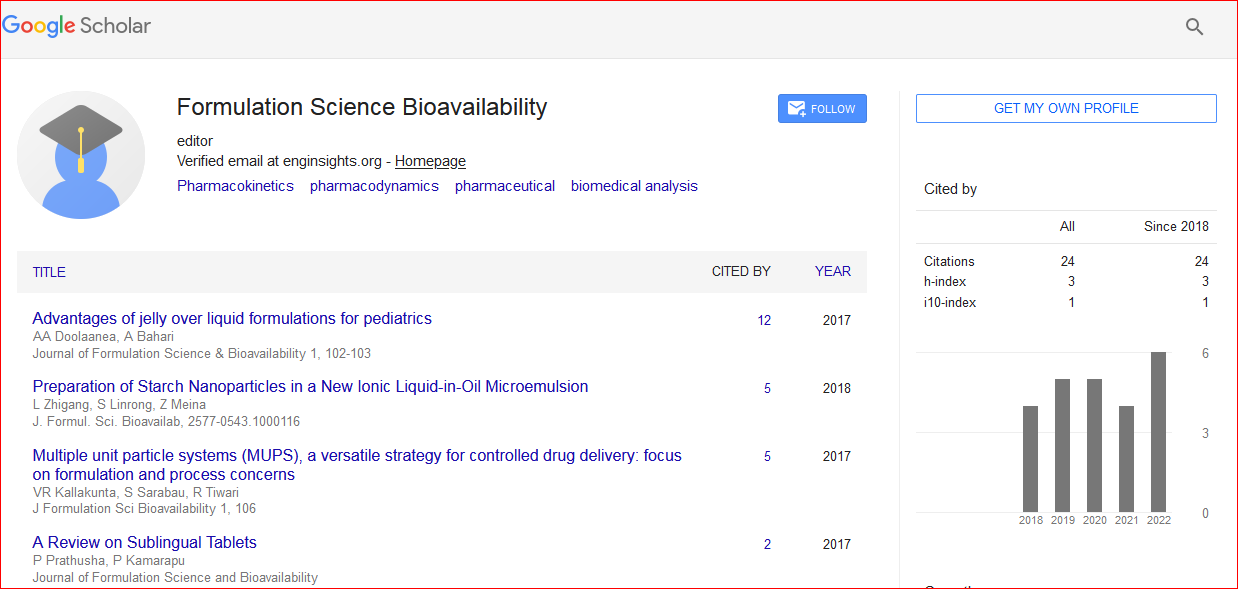
Journal of Formulation Science & Bioavailability received 23 citations as per Google Scholar report