Commentary - (2025) Volume 14, Issue 3
Received: 02-Jun-2025, Manuscript No. jsp-26-182257;
Editor assigned: 04-Jun-2025, Pre QC No. P-182257;
Reviewed: 18-Jun-2025, QC No. Q-182257;
Revised: 23-Jun-2025, Manuscript No. R-182257;
Published:
30-Jun-2025
, DOI: 10.37421/2165-7939.2025.14.726
Citation: Ferreira, Lucas A.. ”Spinal Infections: Diagnostic and Therapeutic Challenges.” J Spine 14 (2025):726.
Copyright: © 2025 Ferreira A. Lucas This is an open-access article distributed under the terms of the Creative Commons Attribution License, which permits unrestricted use, distribution and reproduction in any medium, provided the original author and source are credited.
Diagnosing spinal infections poses considerable challenges due to their often subtle onset and the overlap of their symptoms with other conditions, necessitating a meticulous and multifaceted approach for accurate identification and effective management. The initial suspicion of a spinal infection is primarily clinical, drawing upon patient history, physical examination, and an understanding of risk factors, which then guides the initiation of advanced diagnostic procedures to confirm or refute the diagnosis. The subsequent steps involve a comprehensive evaluation that integrates these clinical findings with detailed imaging studies and targeted microbiological investigations to pinpoint the exact nature and extent of the infection. [1] Developing an accurate diagnostic pathway for spinal infections requires a heightened awareness of subtle clinical indicators that may initially appear insignificant, alongside the prompt and judicious utilization of advanced imaging modalities, with magnetic resonance imaging (MRI) standing out as the primary modality. This careful consideration extends to understanding the prevalent pathogens responsible for spinal infections and their evolving resistance patterns, which is absolutely crucial for the selection of effective antimicrobial agents. [2] Osteomyelitis of the spine, a significant and potentially devastating form of spinal infection, demands a consistently high index of suspicion among clinicians, particularly when presented with patients who are immunocompromised or have a history of intravenous drug use, as these groups are at increased risk. Advanced MRI sequences, including the critical application of diffusion-weighted imaging, have demonstrated considerable utility in facilitating the early detection of spinal osteomyelitis. [3] Discitis, another common and clinically relevant manifestation of spinal infection, frequently presents with localized back pain and systemic symptoms such as fever, though these clinical signs can often be vague and unspecific, making early diagnosis challenging. In the context of suspected discitis, MRI remains the imaging modality of choice, offering superior visualization of the affected intervertebral discs and surrounding structures. [4] The role of positron emission tomography-computed tomography (PET-CT) in the diagnosis of spinal infections is becoming increasingly recognized and validated, especially in those challenging cases where MRI findings are equivocal or when evaluating the response to ongoing treatment. This advanced imaging technique can effectively help identify metabolically active inflammatory foci that strongly indicate the presence of infection. [5] Surgical management of spinal infections is an inherently complex undertaking that necessitates meticulous and careful preoperative planning to optimize patient outcomes and minimize potential complications. Key indications for surgical intervention typically encompass the presence of neurological deficit, demonstrable spinal instability, severe and intractable pain, failure of comprehensive conservative management, and the presence of a significant epidural abscess. [6] The growing emergence and spread of antibiotic-resistant pathogens within the context of spinal infections represent a formidable therapeutic challenge for clinicians worldwide, demanding innovative and adaptable treatment strategies. Judicious and evidence-based use of available antibiotics, always guided by robust susceptibility testing results, and a proactive consideration of novel antimicrobial agents are absolutely essential for successful treatment. [7] Biomarkers such as C-reactive protein (CRP) and erythrocyte sedimentation rate (ESR) play a profoundly vital role in both the initial diagnosis and the ongoing monitoring of spinal infections, serving as valuable indicators of inflammatory activity within the body. While these markers are not entirely specific to spinal infections, consistently elevated levels can significantly raise clinical suspicion and provide a means to track the effectiveness of treatment over time. [8] The differential diagnosis of spinal infections is notably broad and can encompass a wide array of conditions, including mechanical back pain, various inflammatory arthropathies, and neoplastic processes, underscoring the importance of a systematic diagnostic approach. A thorough and careful clinical evaluation, which crucially includes a detailed patient history and a comprehensive physical examination, is paramount to effectively guide further diagnostic investigations and prevent potential misdiagnosis. [9] Rehabilitation following the successful treatment of spinal infections is an undeniably integral and critical component of the overall recovery process, with a primary focus on systematically regaining lost strength, improving mobility, and restoring overall functional capacity. A truly multidisciplinary approach, invariably involving dedicated physical therapists, skilled occupational therapists, and experienced pain management specialists, is often necessary to comprehensively optimize patient outcomes and facilitate a successful return to daily activities. [10]
Diagnosing spinal infections presents significant challenges due to their often insidious onset and overlapping symptoms with other conditions. Early and accurate diagnosis hinges on a multimodal approach, combining clinical suspicion with advanced imaging and microbiological investigations. Treatment strategies are tailored to the specific pathogen and the extent of infection, typically involving a combination of antimicrobial therapy and surgical intervention for debridement and stabilization, aiming to eradicate infection and preserve neurological function. [1] The diagnostic pathway for spinal infections requires careful consideration of subtle clinical signs and prompt utilization of advanced imaging modalities like MRI. Understanding the common pathogens and their resistance patterns is crucial for effective antimicrobial selection. Surgical management often involves decompression, débridement, and sometimes fusion, with the goal of preventing further neurological compromise and stabilizing the spine. [2] Osteomyelitis of the spine, a significant cause of spinal infection, demands a high index of suspicion, especially in immunocompromised individuals or those with a history of intravenous drug use. Advanced MRI sequences, including diffusion-weighted imaging, can aid in early detection. Treatment typically involves prolonged antibiotic therapy, guided by culture results, and in some cases, surgical intervention for spinal stabilization and removal of infected material. [3] Discitis, another common form of spinal infection, often presents with back pain and fever. While clinical symptoms can be vague, MRI is the imaging modality of choice for diagnosis. Microbiological confirmation is essential for targeted antibiotic therapy. Surgical intervention may be required for severe cases involving neurological compromise or spinal instability. [4] The role of PET-CT in the diagnosis of spinal infections is increasingly recognized, particularly in cases where MRI is equivocal or when evaluating treatment response. It can help identify metabolically active inflammatory foci that may indicate infection. Combined with serological markers and microbiological data, PET-CT aids in a comprehensive diagnostic assessment. [5] Surgical management of spinal infections is complex and requires careful planning. Indications for surgery include neurological deficit, spinal instability, severe pain, failure of conservative management, and epidural abscess. Techniques range from simple debridement to complex spinal reconstruction and fusion, aiming to restore spinal stability and remove infected tissue. [6] The emergence of antibiotic-resistant pathogens in spinal infections poses a significant therapeutic challenge. Judicious use of antibiotics, based on susceptibility testing, and consideration of novel antimicrobial agents are essential. Strategies to prevent the development of resistance are also critical in patient management. [7] Biomarkers such as C-reactive protein (CRP) and erythrocyte sedimentation rate (ESR) play a vital role in the diagnosis and monitoring of spinal infections. While not specific, elevated levels can raise suspicion and track treatment response. Serial measurements are often more informative than single values. [8] The differential diagnosis of spinal infections is broad, encompassing mechanical back pain, inflammatory arthropathies, and malignancy. Careful clinical evaluation, including a thorough history and physical examination, is paramount to guide further investigations and avoid misdiagnosis. [9] Rehabilitation after spinal infection is an integral part of recovery, focusing on regaining strength, mobility, and function. A multidisciplinary approach involving physical therapists, occupational therapists, and pain management specialists is often necessary to optimize patient outcomes. [10]
Spinal infections present diagnostic and therapeutic challenges due to subtle symptoms and the need for multimodal approaches. Early diagnosis relies on clinical suspicion combined with advanced imaging like MRI and PET-CT, and microbiological investigations. Key conditions include osteomyelitis and discitis. Treatment involves tailored antimicrobial therapy and often surgical intervention for debridement, stabilization, and removal of infected tissue. Antibiotic resistance is a growing concern, necessitating judicious antibiotic use and susceptibility testing. Inflammatory biomarkers like CRP and ESR aid in diagnosis and monitoring. A broad differential diagnosis is essential, and rehabilitation plays a crucial role in recovery.
None
None
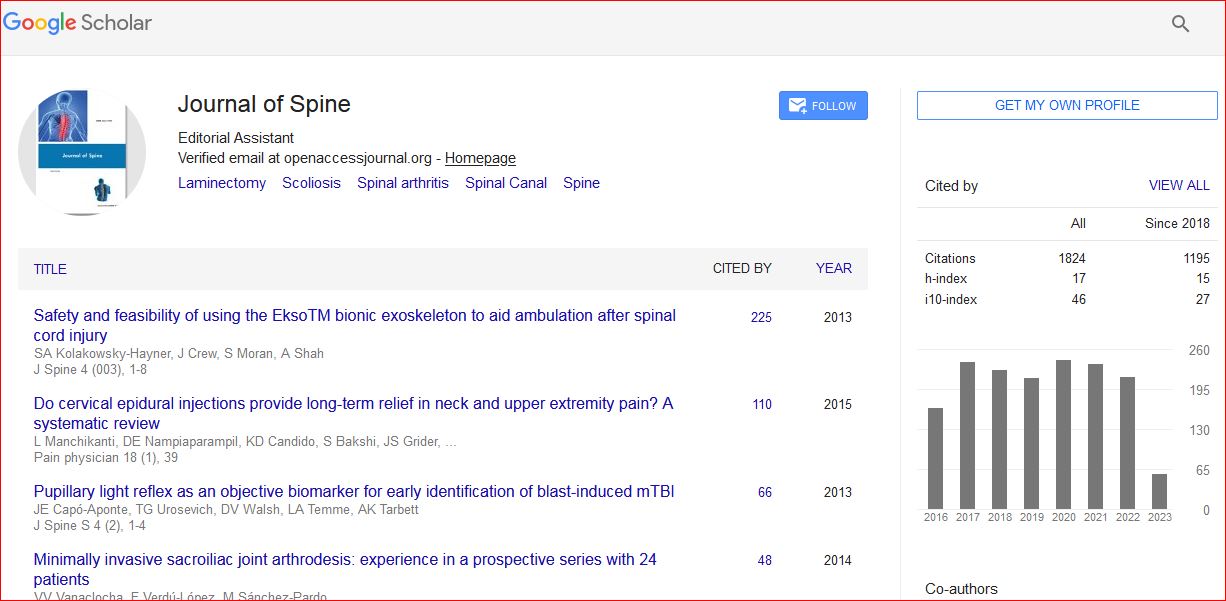
Journal of Spine received 2022 citations as per Google Scholar report