Short Communication - (2025) Volume 13, Issue 4
Received: 01-Aug-2025, Manuscript No. jaat-26-183173;
Editor assigned: 04-Aug-2025, Pre QC No. P-183173;
Reviewed: 18-Aug-2025, QC No. Q-183173;
Revised: 22-Aug-2025, Manuscript No. R-183173;
Published:
29-Aug-2025
, DOI: 10.37421/2329-6542.2025.13.371
Citation: Nguyen, Huy T.. ”Spacecraft GNC: Advancements in Precision and Autonomy.” J Astrophys Aerospace Technol 13 (2025):371.
Copyright: © 2025 Nguyen T. Huy This is an open-access article distributed under the terms of the Creative Commons Attribution License, which permits unrestricted use, distribution and reproduction in any medium, provided the original author and source are credited.
The field of Guidance, Navigation, and Control (GNC) for spacecraft represents a cornerstone of modern space exploration, enabling missions ranging from Earth observation to deep space rendezvous. Recent advancements have significantly enhanced the precision, reliability, and autonomy of these critical systems, allowing for more complex maneuvers and longer mission durations. This progress is driven by innovations in sensor fusion, adaptive control algorithms, and the integration of artificial intelligence techniques. The development of sophisticated methodologies and architectures underpins these advanced GNC systems, addressing the dynamic and often unpredictable nature of the space environment. These systems are crucial for ensuring mission success, particularly in the face of increasing mission complexity and the need for enhanced maneuverability. The focus on enhancing precision, reliability, and maneuverability is paramount for long-duration missions and complex orbital maneuvers [1].
One of the key areas of exploration involves the application of machine learning to improve GNC capabilities. Specifically, deep reinforcement learning is being employed to develop intelligent control policies that can adapt to uncertainties and nonlinear dynamics. This adaptive approach is essential for ensuring robustness in trajectory optimization and for developing control strategies that can respond effectively to unforeseen events. By leveraging these techniques, mission success rates can be improved, and reliance on pre-programmed maneuvers can be reduced, thereby increasing operational flexibility. The exploration of machine learning for robust trajectory optimization in spacecraft GNC addresses challenges posed by uncertainties and nonlinear dynamics [2].
In parallel, significant efforts are being directed towards improving navigation accuracy through innovative sensor fusion techniques. This is particularly vital for deep space missions where the distances involved and the lack of external references pose substantial challenges. By integrating data from multiple sensor types, such as star trackers and inertial measurement units, and employing advanced filtering methods like Kalman filtering, it is possible to mitigate noise and biases. This leads to more precise attitude and position estimation, which is fundamental for successful navigation. The focus on innovative sensor fusion techniques for enhanced navigation accuracy in deep space missions highlights the importance of combining diverse data sources. The integration of data from star trackers, inertial measurement units, and ground-based tracking, utilizing Kalman filtering and its advanced variants, is key to improving attitude and position estimation [3].
Another critical aspect of GNC system design is ensuring resilience against potential failures. Fault-tolerant control strategies are being developed to maintain mission continuity even when components malfunction. These strategies involve implementing redundancy management and reconfigurable control architectures. The goal is to ensure system resilience and maintain operational integrity throughout critical mission phases, thereby safeguarding valuable scientific payloads and expensive spacecraft hardware. The investigation into fault-tolerant control strategies for spacecraft GNC systems aims to maintain mission continuity in the event of component failures. Redundancy management and reconfigurable control architectures are explored to ensure system resilience and operational integrity [4].
For missions venturing beyond Earth's orbit, autonomous guidance capabilities are becoming increasingly indispensable. Novel approaches to autonomous guidance for lunar and interplanetary missions are being developed, focusing on real-time trajectory correction and hazard avoidance. The integration of onboard processing and advanced algorithms allows spacecraft to navigate dynamic celestial environments without constant ground control intervention, enabling greater mission flexibility and reducing communication latency. The presentation of novel approaches to autonomous guidance for lunar and interplanetary missions emphasizes real-time trajectory correction and hazard avoidance. The integration of onboard processing capabilities and advanced algorithms enables spacecraft to navigate and adapt to dynamic celestial environments [5].
Navigating through planetary atmospheres, particularly at hypersonic speeds, presents a unique set of challenges that require sophisticated aerodynamic modeling and guidance strategies. This involves accurately accounting for complex aerodynamic forces, extreme thermal loads, and atmospheric variations to ensure safe and precise re-entry trajectories. The development of advanced modeling techniques is crucial for mission success and for protecting both the spacecraft and any potential payloads during atmospheric entry. The exploration of computational fluid dynamics (CFD) and advanced aerodynamic modeling for precise atmospheric entry guidance is detailed. This includes accounting for complex aerodynamic forces, thermal loads, and atmospheric variations to ensure safe and accurate re-entry trajectories [6].
In the realm of smaller spacecraft, such as those in satellite constellations, robust attitude determination and control are paramount. Research in this area focuses on developing novel estimation techniques and utilizing compact actuators to overcome the limitations of onboard resources. Maintaining accurate attitude control in dynamic space environments is essential for a wide range of applications, from telecommunications to Earth observation. The investigation into robust attitude determination and control systems for small satellites using novel estimation techniques and compact actuators addresses the challenges of limited onboard resources. Solutions for maintaining accurate attitude control in dynamic space environments are provided [7].
As space missions target more challenging destinations like asteroids, intelligent navigation and path planning systems become critical. These systems integrate advanced vision-based navigation with probabilistic robotics to enable autonomous operation in unstructured and unknown environments. The ability to identify hazards and plan optimal paths in real-time is essential for the success of such exploratory missions. The focus on the development of intelligent navigation systems for asteroid exploration emphasizes autonomous path planning and hazard identification. Advanced vision-based navigation techniques are integrated with probabilistic robotics for robust operation in unstructured and unknown environments [8].
For missions involving multiple spacecraft operating in close proximity, such as formation flying, precise orbital maneuvering and relative navigation are indispensable. This requires the development of advanced control algorithms and relative navigation techniques to maintain specific spatial relationships between spacecraft for collaborative operations. Such capabilities are vital for advanced scientific observations and future in-space assembly. The discussion of challenges and advancements in precise orbital maneuvering for formation flying spacecraft covers advanced control algorithms and relative navigation techniques. These are required to maintain precise spatial relationships between multiple spacecraft for collaborative missions [9].
Finally, the exploration of emerging computational paradigms, such as quantum-inspired algorithms, offers a glimpse into the future of GNC optimization. These algorithms have the potential to solve complex optimization problems, like fuel-optimal trajectory planning, that are currently intractable for classical computers. This promises to unlock new levels of efficiency and capability in spacecraft GNC systems. The evaluation of the effectiveness of quantum-inspired algorithms for optimization problems within spacecraft GNC, such as fuel-optimal trajectory planning, highlights the potential of quantum computing to solve complex challenges [10].
Guidance, Navigation, and Control (GNC) systems are the critical enablers for modern space missions, ensuring that spacecraft can achieve their objectives accurately and reliably in the harsh environment of space. The continuous evolution of these systems is driven by the demands of increasingly ambitious missions, requiring greater autonomy, precision, and resilience. Recent breakthroughs in GNC are reshaping the landscape of space exploration, from intricate orbital maneuvers to far-reaching interplanetary journeys. The sophisticated methodologies and architectures underpinning advanced GNC systems are essential for enhancing precision, reliability, and maneuverability, especially during long-duration missions and complex orbital operations where the dynamic nature of space presents constant challenges. The focus on these enhancements is crucial for navigating the complexities of space and achieving mission goals. This field is characterized by a relentless pursuit of improved performance and robustness in the face of evolving mission requirements and environmental conditions [1].
The integration of artificial intelligence, particularly machine learning, into GNC is revolutionizing trajectory optimization and control strategies. Deep reinforcement learning, for instance, enables the development of intelligent control policies that can autonomously adapt to uncertainties and nonlinear dynamics inherent in spacecraft operations. This adaptive capability is vital for enhancing the robustness of GNC systems, allowing them to respond effectively to unexpected situations and reducing the need for pre-programmed maneuvers. Such advancements contribute significantly to improving mission success rates and increasing the overall autonomy of spacecraft operations. The application of machine learning for robust trajectory optimization in spacecraft GNC addresses challenges posed by uncertainties and nonlinear dynamics, demonstrating how deep reinforcement learning can develop intelligent control policies [2].
Precise navigation, especially in deep space, relies heavily on the sophisticated integration of data from multiple sensors. Advanced sensor fusion techniques, utilizing algorithms like Kalman filtering and its variants, are employed to combine information from sources such as star trackers, inertial measurement units, and ground-based tracking. This process is critical for mitigating noise and biases, leading to highly accurate estimates of a spacecraft's attitude and position. The development of these techniques is fundamental for ensuring that spacecraft can accurately determine their location and orientation, which is a prerequisite for any successful navigation and control task. Innovative sensor fusion techniques are being explored for enhanced navigation accuracy in deep space missions, integrating data from various sensors and using advanced filtering to improve estimations [3].
Ensuring the continuity of space missions in the event of hardware malfunctions is a significant challenge, addressed by the development of fault-tolerant GNC systems. These systems incorporate strategies for redundancy management and reconfigurable control architectures, allowing the spacecraft to adapt and continue its mission even if certain components fail. This resilience is crucial for maintaining operational integrity throughout critical mission phases, thereby protecting the spacecraft and its scientific objectives from catastrophic loss. The focus on fault-tolerant guidance, navigation, and control systems for critical space missions aims to maintain mission continuity despite potential component failures, employing redundancy and reconfigurable architectures [4].
As humanity expands its reach into the solar system, autonomous guidance capabilities are becoming increasingly vital for lunar and interplanetary missions. These systems enable spacecraft to perform real-time trajectory corrections and hazard avoidance maneuvers without constant reliance on ground control. By integrating advanced onboard processing power with sophisticated algorithms, spacecraft can navigate complex and dynamic celestial environments autonomously, reducing communication latency and increasing operational flexibility for these ambitious explorations. Novel approaches to autonomous guidance for lunar and interplanetary missions are presented, focusing on real-time trajectory correction and hazard avoidance enabled by onboard processing and advanced algorithms [5].
Navigating through the Earth's atmosphere during re-entry, particularly at hypersonic velocities, requires a deep understanding of complex aerodynamic phenomena. Advanced aerodynamic modeling and guidance strategies are essential for accurately predicting and controlling re-entry trajectories. This involves meticulous accounting for forces, thermal loads, and atmospheric variations to ensure the safety and precision of the re-entry process, which is critical for both crewed and uncrewed missions. The use of computational fluid dynamics (CFD) and advanced aerodynamic modeling for precise atmospheric entry guidance is detailed, emphasizing the need to account for complex forces and atmospheric conditions during re-entry [6].
For small satellites and satellite constellations, achieving and maintaining precise attitude determination and control is a significant challenge due to limited onboard resources. Research in this area focuses on developing novel estimation techniques and utilizing compact, efficient actuators. The ability to maintain accurate attitude control in dynamic space environments is crucial for a wide range of applications, including Earth observation, communication, and scientific research, underscoring the importance of robust solutions for these platforms. Robust attitude determination and control for small satellite constellations are investigated, addressing challenges related to limited resources and dynamic environments through novel estimation techniques and compact actuators [7].
Exploration of celestial bodies like asteroids demands sophisticated intelligent navigation and path planning capabilities. These systems integrate advanced vision-based navigation with probabilistic robotics to enable autonomous operation in unpredictable and unstructured environments. The ability to autonomously identify potential hazards and plot optimal paths is essential for the success of robotic missions venturing into the unknown, ensuring safe and efficient exploration. The development of intelligent navigation systems for asteroid exploration is discussed, highlighting autonomous path planning and hazard identification through vision-based techniques and probabilistic robotics [8].
Spacecraft formation flying, a key technology for advanced scientific missions and in-space assembly, requires highly precise orbital maneuvering and relative navigation. This involves the development of advanced control algorithms and relative navigation techniques that enable multiple spacecraft to maintain precise spatial relationships. Achieving and sustaining these formations is crucial for enabling collaborative observations and complex orbital operations, pushing the boundaries of space mission capabilities. Advanced control and relative navigation techniques for spacecraft formation flying are examined, focusing on maintaining precise spatial relationships for collaborative missions [9].
Looking towards the future, quantum-inspired algorithms are being explored for their potential to revolutionize optimization problems within spacecraft GNC, such as optimizing fuel usage for trajectory planning. The immense computational power offered by quantum computing, even in its nascent stages through quantum-inspired approaches, could enable spacecraft to solve complex optimization challenges that are currently beyond the reach of classical computers, leading to unprecedented mission efficiency and capability. The paper evaluates quantum-inspired algorithms for optimization problems in spacecraft GNC, particularly for fuel-optimal trajectory planning, exploring the potential of quantum computing for intractable challenges [10].
This collection of research highlights significant advancements in spacecraft Guidance, Navigation, and Control (GNC) systems. Key areas of development include sophisticated methodologies for enhanced precision and autonomy in complex space environments, the application of machine learning for adaptive trajectory optimization, and innovative sensor fusion techniques for improved navigation accuracy, especially in deep space. The research also addresses fault-tolerant control strategies to ensure mission resilience, novel autonomous guidance algorithms for lunar and interplanetary missions, and advanced aerodynamic modeling for atmospheric entry. Furthermore, robust attitude control for small satellites, intelligent navigation for asteroid exploration, and precise control for spacecraft formation flying are explored. Emerging trends include the evaluation of quantum-inspired algorithms for complex optimization problems in GNC.
None
None
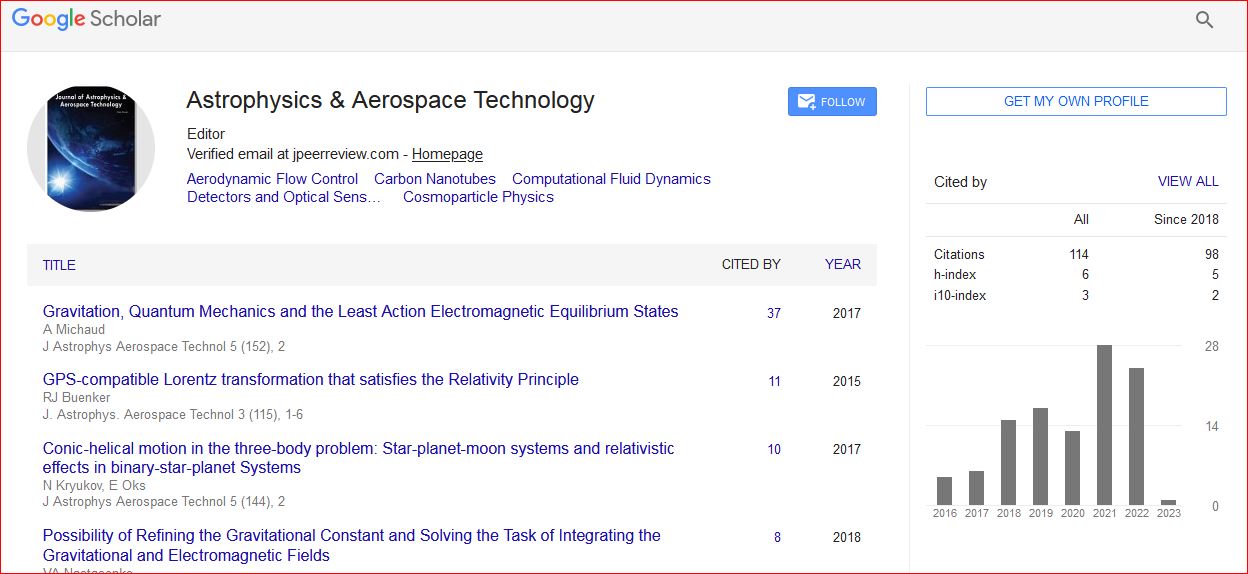
Astrophysics & Aerospace Technology received 114 citations as per Google Scholar report