Commentary - (2025) Volume 13, Issue 5
Received: 01-Oct-2025, Manuscript No. jaat-26-183176;
Editor assigned: 03-Oct-2025, Pre QC No. P-183176;
Reviewed: 17-Oct-2025, QC No. Q-183176;
Revised: 22-Oct-2025, Manuscript No. R-183176;
Published:
29-Oct-2025
, DOI: 10.37421/2329-6542.2025.13.373
Citation: Hayes, Jonathan M.. ”Space Weather Modeling: Aerospace Systems Protection.” J Astrophys Aerospace Technol 13 (2025):373.
Copyright: © 2025 Hayes M. Jonathan This is an open-access article distributed under the terms of the Creative Commons Attribution License, which permits unrestricted use,distribution and reproduction in any medium, provided the original author and source are credited.
Space weather modeling is an indispensable field for understanding and mitigating the complex effects of solar activity on vital aerospace systems. These advancements are pivotal in predicting phenomena that can significantly impact the functionality and safety of our endeavors in space. The continuous development in this area directly influences satellite operations, the design of spacecraft, and the safety of astronauts undertaking missions [1].
The impact of solar energetic particles (SEPs) on satellite electronics is a primary concern for the reliability and longevity of aerospace missions. Research focused on improving models for SEP propagation through the heliosphere is essential for better forecasting radiation doses. This foresight enables the development of more resilient, radiation-hardened components and the implementation of more effective operational strategies for satellites, ultimately extending their operational lifespan and enhancing their reliability [2].
Geomagnetic storms represent a significant threat to critical terrestrial infrastructure, including power grids, and pose a substantial risk to satellite constellations. Developments in data-driven models that assimilate real-time geomagnetic field data are crucial for providing more accurate short-term forecasts of storm intensity. Such improvements are vital for establishing proactive mitigation strategies within the aerospace sector to ensure system resilience [3].
The intricate interaction between the solar wind and Earth's magnetosphere serves as the fundamental driver of space weather phenomena. The latest advancements in magnetohydrodynamic (MHD) simulations are continuously refining our understanding of these complex interactions. These simulations provide essential inputs for sophisticated space weather models, thereby enhancing our ability to predict phenomena that directly affect aerospace systems [4].
Space weather significantly influences satellite drag, which can lead to orbital perturbations and ultimately affect the re-entry trajectory of spacecraft. Investigations into improved atmospheric density models, driven by comprehensive space weather indices, are vital for more accurately predicting these drag variations. Such precise predictions are indispensable for maintaining the operational orbits of extensive low Earth orbit (LEO) satellite constellations [5].
Accurate forecasting of ionospheric disturbances is paramount for the reliability of radio communication and navigation systems, particularly for aerospace vehicles. Recent advancements in ionospheric scintillation models, which effectively incorporate solar activity and geomagnetic indices, are leading to substantially improved predictions of signal degradation, ensuring uninterrupted operation of critical communication links [6].
The development of robust space weather alerts and warnings hinges on the integration of sophisticated modeling frameworks. Research focusing on the fusion of observational data from a diverse array of space-based and ground-based instruments with advanced numerical models is essential. This integration allows for the provision of timely and actionable information, which is critical for the aerospace community to respond effectively to evolving space weather conditions [7].
Crewed space missions face unique vulnerabilities to the multifaceted effects of space weather. Evaluating the effectiveness of current space weather models in predicting astronaut radiation exposure is a crucial undertaking. Furthermore, exploring novel modeling approaches is imperative for enhancing crew protection during extended voyages, particularly in deep space exploration where human presence is most at risk [8].
The continuous refinement and validation of space weather models are achieved through rigorous comparison of their predictions against observed phenomena. A critical assessment of the current state of space weather modeling is therefore necessary, identifying key areas for enhancement. Such assessments are vital to better serve the evolving and increasingly complex needs of the aerospace industry and its operations [9].
Coronal Mass Ejections (CMEs) originating from the Sun are a primary source of the most severe space weather events. Examining the latest CME propagation models and their efficacy in forecasting the arrival time and intensity of these energetic events at Earth is of utmost importance. This understanding is critical for safeguarding sensitive and valuable aerospace technology from their potentially damaging effects [10].
Space weather modeling plays a critical role in safeguarding aerospace systems from the dynamic impacts of solar activity. The sophistication of these models directly influences our capability to predict energetic particle events and geomagnetic storms, which are paramount for ensuring the robust operation of satellites, the integrity of spacecraft design, and the safety of astronauts. Integrating advanced modeling techniques with real-time observational data is essential for building a resilient space infrastructure [1].
The detrimental effects of solar energetic particles (SEPs) on satellite electronics necessitate enhanced predictive capabilities. This study highlights the importance of improved models for SEP propagation through the heliosphere, enabling more accurate forecasting of radiation doses. This advanced understanding facilitates the creation of more radiation-hardened satellite components and the adoption of effective operational protocols, thereby enhancing satellite lifespan and mission reliability [2].
Geomagnetic storms pose a significant threat to critical infrastructure, including power grids and satellite constellations. The development of data-driven models that effectively assimilate real-time geomagnetic field data is crucial for achieving more precise short-term forecasts of storm intensity. These enhanced forecasting abilities are vital for implementing proactive mitigation strategies within the aerospace sector, ensuring the resilience of space-based assets [3].
The interaction between the solar wind and Earth's magnetosphere is a fundamental driver of space weather. Advancements in magnetohydrodynamic (MHD) simulations are continuously improving our ability to model these complex interactions. The insights derived from these simulations provide critical inputs for space weather models, leading to a better prediction of phenomena that can affect aerospace systems [4].
Space weather conditions significantly influence atmospheric density, which in turn affects satellite drag. This research explores the application of improved atmospheric density models, informed by space weather indices, to more accurately predict variations in satellite drag. Such accurate predictions are indispensable for maintaining the stable operational orbits of satellite constellations, particularly those in low Earth orbit (LEO) [5].
Accurate forecasting of ionospheric disturbances is essential for the reliable functioning of radio communication and navigation systems utilized by aerospace vehicles. This paper details advancements in ionospheric scintillation models that integrate solar activity and geomagnetic indices, leading to more precise predictions of signal degradation, thereby enhancing the robustness of aerospace communication and navigation [6].
The establishment of effective space weather alerts and warnings relies heavily on integrated modeling frameworks. This research emphasizes the importance of fusing observational data from various space-based and ground-based instruments with numerical models. This synergistic approach ensures the timely dissemination of actionable information to the aerospace community, enabling prompt responses to space weather events [7].
Astronauts on crewed space missions are particularly susceptible to the effects of space weather. This study critically evaluates the efficacy of existing space weather models in forecasting radiation exposure for astronauts. Furthermore, it explores innovative modeling approaches designed to enhance crew protection during ambitious deep space exploration missions [8].
The continuous improvement of space weather models is driven by their validation against observed phenomena. This paper offers a comprehensive assessment of the current state of space weather modeling, pinpointing crucial areas that require further development. Such critical evaluations are fundamental to ensuring that models effectively meet the evolving needs of the aerospace industry [9].
Coronal Mass Ejections (CMEs) are a primary source of severe space weather events. This work delves into the latest CME propagation models and their capability to forecast the arrival time and intensity of these events at Earth. Such predictive accuracy is crucial for the effective protection of sensitive and high-value aerospace technology from the disruptive impacts of CMEs [10].
Space weather modeling is critical for aerospace systems, impacting satellite operations, spacecraft design, and astronaut safety. Advancements in predicting solar energetic particles (SEPs) and geomagnetic storms improve satellite resilience and lifespan. Data-driven models and magnetohydrodynamic simulations enhance forecasting of these phenomena. Space weather's effect on satellite drag and ionospheric disturbances is also a key focus for maintaining orbital stability and reliable communication. Integrated modeling frameworks and accurate alerts are vital for aerospace operations, especially for crewed missions requiring radiation protection. Continuous assessment and improvement of these models are essential for the aerospace industry. Forecasting Coronal Mass Ejections (CMEs) is crucial for protecting aerospace technology.
None
None
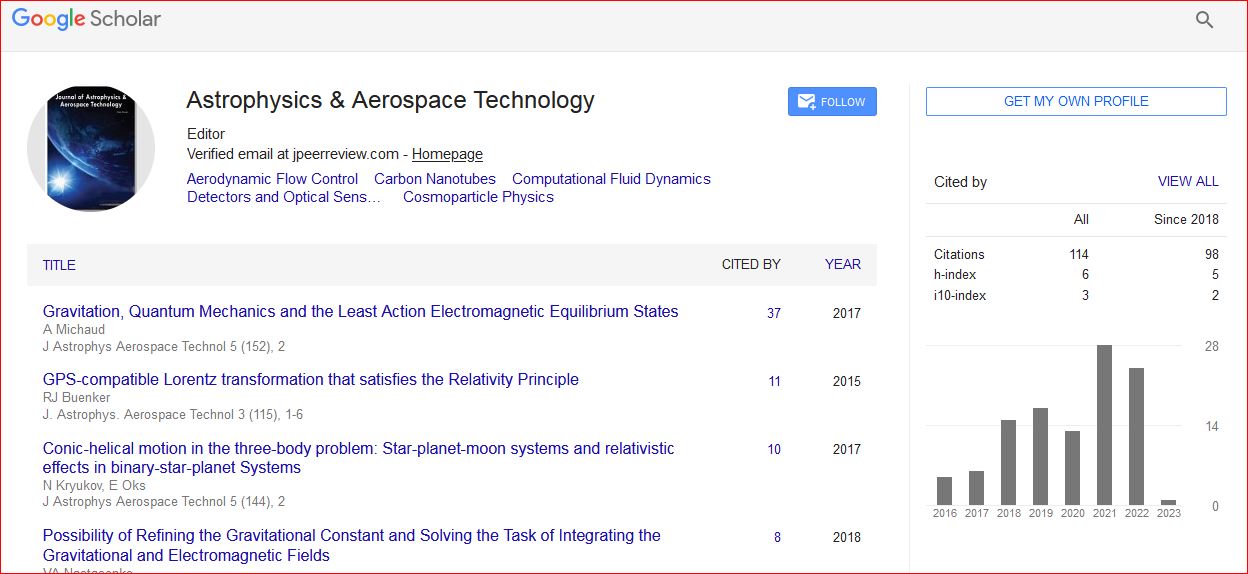
Astrophysics & Aerospace Technology received 114 citations as per Google Scholar report