Short Communication - (2025) Volume 13, Issue 2
Received: 01-Apr-2025, Manuscript No. jaat-26-183152;
Editor assigned: 03-Apr-2025, Pre QC No. P-183152;
Reviewed: 17-Apr-2025, QC No. Q-183152;
Revised: 22-Apr-2025, Manuscript No. R-183152;
Published:
29-Apr-2025
, DOI: 10.37421/2329-6542.2025.13.351
Citation: Pham, Nguyen T.. ”Space Telescope Technology: Advancements for Discovery.” J Astrophys Aerospace Technol 13 (2025):351.
Copyright: © 2025 Pham T. Nguyen This is an open-access article distributed under the terms of the Creative Commons Attribution License, which permits unrestricted use, distribution and reproduction in any medium, provided the original author and source are credited.
The realm of space telescope design is undergoing a profound transformation, driven by the relentless pursuit of deeper and more nuanced cosmic understanding. Recent advancements in optical systems, including the development of larger, segmented mirrors, are pushing the boundaries of observational power, promising to unveil previously unseen details of the universe [1].
These innovations are critical for enabling transformative science, allowing us to probe the cosmos with unprecedented clarity and detail. The sophistication of instrumentation aboard these future observatories is also seeing remarkable progress. Specifically, the development of highly sensitive infrared detectors and advanced spectrographs is paving the way for detailed atmospheric analysis of exoplanets, a crucial step in the search for biosignatures [2].
This focus on specialized instruments underscores a growing trend towards targeted, high-precision investigations of celestial bodies. Mirror technology, a cornerstone of telescope performance, is at the forefront of these advancements. The engineering of lightweight, large-aperture segmented mirrors, alongside the complex challenges of their on-orbit assembly and optical stability, is essential for achieving diffraction-limited performance in future missions [3].
These mirror systems are designed to capture the faintest light and resolve the finest details, crucial for astronomical breakthroughs. Furthermore, the active management of optical systems through wavefront sensing and control is becoming increasingly vital. Advancements in deformable mirrors and sophisticated control algorithms are necessary for maintaining high image quality and correcting for environmental disturbances in space, ensuring the integrity of scientific data [4].
This active feedback loop is key to achieving optimal observational outcomes. Direct imaging of exoplanets, a long-standing goal, is being brought closer to reality through innovations in coronagraph technology. The development of various coronagraph architectures, designed to effectively suppress starlight, is enabling the direct detection and characterization of faint planetary companions [5].
These instruments are designed to overcome the immense challenge of observing faint objects next to bright stars. Complementing these optical advancements is the ongoing evolution of detector technologies. The transition to novel materials and architectures is enhancing sensitivity and reducing noise in space-based instruments, particularly for infrared and submillimeter observations, crucial for capturing a wider spectrum of cosmic phenomena [6].
These detectors are the eyes of the telescope, capturing the light and converting it into usable data. Beyond hardware, the integration of artificial intelligence and machine learning is revolutionizing space telescope operations. AI is being employed for autonomous target selection, anomaly detection, and advanced data processing, maximizing the scientific yield from complex observational datasets [7].
This intelligent augmentation of telescope capabilities allows for more efficient and insightful scientific exploration. The very physical realization of these ambitious telescopes involves significant engineering feats. Innovations in deployable structures and thermal management systems are crucial for enabling the construction and operation of large space observatories in the harsh conditions of space [8].
These engineering solutions ensure the structural integrity and optimal thermal environment for sensitive instruments. The spectral analysis capabilities of future instruments are being enhanced through advancements in optical coatings and filters. Tailored coatings for specific wavelength ranges and enhanced durability are vital for achieving precise spectral measurements, from the extreme ultraviolet to the infrared [9].
These coatings act as filters, allowing specific wavelengths of light to pass through for analysis. Finally, the design of next-generation spectrographs is being driven by the need for high spectral resolution and broad wavelength coverage. Innovations such as integral field units and cross-dispersed echelle designs are enabling the study of transient phenomena and distant galaxies with unprecedented detail [10].
These spectrographs are the tools that break down light into its constituent wavelengths, revealing detailed information about celestial objects. These interconnected advancements in optics, instrumentation, engineering, and data processing collectively herald a new era in space-based astronomy, promising to deepen our understanding of the cosmos and its most elusive phenomena [1].
The synergy between these fields is critical for unlocking the full potential of future space observatories. The ongoing development of highly sensitive infrared detectors is fundamental to the success of exoplanet characterization missions, providing the necessary precision to analyze exoplanetary atmospheres and search for signs of life [2].
These detectors are designed to be extremely sensitive to infrared radiation, a key spectral window for atmospheric studies. The successful deployment and stable operation of large segmented mirrors are paramount for achieving the high-resolution imaging required for many cutting-edge astronomical investigations [3].
The mechanical precision and thermal stability of these mirrors are key to their performance. Effective wavefront sensing and control systems are indispensable for ensuring the quality and reliability of scientific data obtained from space telescopes, especially in challenging imaging scenarios [4].
These systems actively correct for optical aberrations to produce sharp images. The continuous refinement of coronagraph technology is directly contributing to the direct detection of exoplanets, a significant step towards characterizing potentially habitable worlds [5].
The ability to block out starlight is crucial for this technique. Advancements in detector technologies are not only increasing sensitivity but also reducing noise, thereby expanding the scientific capabilities of space observatories across various spectral bands [6].
Lower noise levels allow for the detection of fainter signals. The strategic implementation of artificial intelligence in telescope operations promises to optimize scientific return by enabling more efficient and autonomous data acquisition and processing [7].
AI can help astronomers make sense of vast amounts of data. Addressing the complex engineering challenges associated with deployable structures and thermal management is crucial for the feasibility and success of large-scale space telescope projects [8].
These engineering aspects are vital for the physical realization of the observatories. The development of sophisticated optical coatings and filters directly impacts the spectral purity and accuracy of astronomical measurements, enabling more precise scientific conclusions [9].
These components are essential for isolating specific wavelengths of light. The ongoing design and optimization of next-generation spectrographs are vital for pushing the frontiers of astrophysics, particularly in the study of distant and transient cosmic events [10].
High-resolution spectroscopy provides detailed insights into the composition and dynamics of celestial objects.
The field of space telescope design is currently experiencing a rapid evolution, characterized by significant breakthroughs in various technological domains. Advanced optical configurations, including the implementation of larger, segmented mirrors and sophisticated coronagraphs, are central to enhancing observational capabilities and enabling the detection of exoplanets [1].
These developments are crucial for pushing the frontiers of our understanding of the universe, from stellar nurseries to the most distant galaxies. The instrumentation aboard these next-generation telescopes is also undergoing a revolution. The research highlights the design and testing of highly sensitive infrared detectors and advanced spectrographs, which are pivotal for analyzing exoplanetary atmospheres with unparalleled precision. This capability is a critical enabler for the search for biosignatures, potentially transforming our perspective on life beyond Earth [2].
A significant focus of current research is on advanced mirror technologies. The development of lightweight, large-aperture segmented mirrors, alongside addressing the intricate challenges of on-orbit assembly and maintaining optical stability, is key to achieving diffraction-limited performance. This ensures that future missions can deliver exceptionally sharp and detailed images of the cosmos [3].
Complementing these mirror advancements, wavefront sensing and control technologies are being intensely investigated. Innovations in deformable mirrors and sophisticated control algorithms are essential for preserving high image quality and compensating for environmental disturbances in the space environment. This active correction is vital for obtaining scientifically valuable data [4].
Direct imaging of exoplanets, a long-sought-after capability, is becoming increasingly feasible due to progress in coronagraph technology. The paper discusses various coronagraph architectures, such as vortex and phase-mask designs, and their integration with advanced optics to effectively suppress starlight, thereby revealing faint exoplanetary companions [5].
The evolution of detector technologies is another cornerstone of progress. The adoption of novel materials and architectures is enhancing the sensitivity and reducing the noise levels of detectors used in space-based astronomical instruments. This is particularly important for infrared and submillimeter observations, which are critical for studying various cosmic phenomena [6].
Furthermore, the integration of artificial intelligence and machine learning is reshaping space telescope operations and data analysis. AI is being applied to autonomous target selection, anomaly detection, and sophisticated data processing techniques, thereby maximizing the scientific insights derived from complex observational datasets [7].
The engineering challenges associated with large space telescopes are also being addressed through innovative solutions. The development of deployable structures and robust thermal management systems, utilizing lightweight materials and efficient cooling technologies, is crucial for the successful construction and operation of these ambitious observatories in the harsh space environment [8].
Optical coatings and filters play a critical role in the performance of space-based instrumentation. Research in this area focuses on broadband anti-reflection coatings, narrow-band filters for specific spectral lines, and specialized coatings for extreme ultraviolet and infrared applications, emphasizing durability and spectral purity for accurate measurements [9].
Finally, the design of next-generation spectrographs is being driven by the demand for high spectral resolution and broad wavelength coverage. The use of integral field units and cross-dispersed echelle designs in these instruments is enabling detailed studies of transient phenomena and high-redshift galaxies, pushing the boundaries of astrophysical research [10].
These diverse technological advancements collectively form the foundation for a new generation of space telescopes, poised to revolutionize our understanding of the universe. The seamless integration of these innovations promises to unlock unprecedented scientific discoveries and address some of the most profound questions in cosmology and astrophysics. The development of highly sensitive infrared detectors is paramount for the direct characterization of exoplanet atmospheres, enabling the identification of atmospheric constituents and potential biosignatures, thereby advancing the search for extraterrestrial life [2].
Innovations in segmented mirror technology, including advanced manufacturing and assembly techniques, are critical for enabling the construction of extremely large aperture telescopes capable of unprecedented resolution and sensitivity [3].
Wavefront sensing and control systems are indispensable for achieving and maintaining the exquisite image quality required for cutting-edge space-based observations, particularly for high-contrast imaging applications [4].
The advancement of coronagraph designs is a key enabler for the direct detection and characterization of exoplanets, offering a path to discovering and studying worlds beyond our solar system [5].
Next-generation detector technologies are crucial for capturing faint signals and minimizing noise, thereby extending the observational capabilities of space observatories across a wide range of the electromagnetic spectrum [6].
The application of artificial intelligence and machine learning in telescope operations and data analysis is revolutionizing how scientific data is acquired and interpreted, leading to more efficient and insightful discoveries [7].
Addressing the complex engineering challenges of deployable structures and thermal management is vital for the successful realization and long-term operation of large and ambitious space telescope missions [8].
Advanced optical coatings and filters are essential for optimizing the spectral performance of astronomical instruments, ensuring high precision and purity in scientific measurements across various wavelength regimes [9].
The design of sophisticated spectrographs with high spectral resolution and broad wavelength coverage is fundamental to unlocking detailed information about the physical and chemical properties of celestial objects, especially distant and transient phenomena [10].
This collection of research highlights significant advancements in space telescope technology, focusing on optics, instrumentation, and engineering. Key developments include larger, segmented mirrors for enhanced observational power, and sophisticated coronagraphs for exoplanet detection. Innovations in infrared detectors and spectrographs are enabling detailed exoplanetary atmosphere analysis, while artificial intelligence is being integrated for improved operations and data processing. Engineering challenges related to deployable structures and thermal management are also being addressed. Overall, these technological strides are paving the way for next-generation space observatories capable of transformative scientific discoveries across a wide range of astronomical research.
None
None
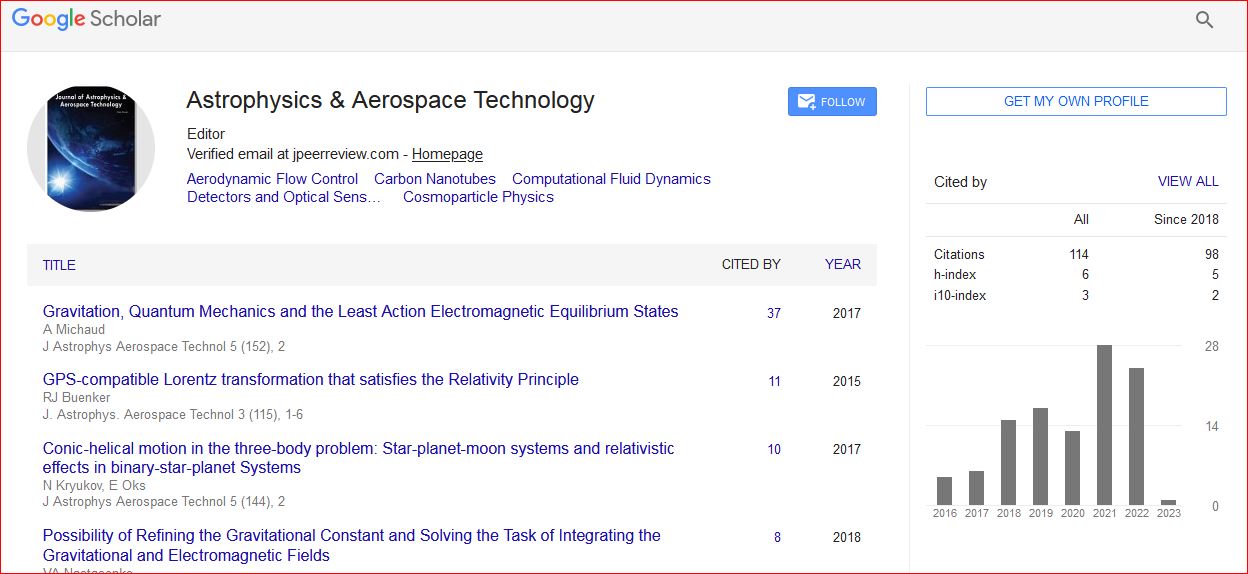
Astrophysics & Aerospace Technology received 114 citations as per Google Scholar report