Commentary - (2025) Volume 14, Issue 4
Received: 01-Aug-2025, Manuscript No. idse-26-182831;
Editor assigned: 04-Aug-2025, Pre QC No. P-182831;
Reviewed: 18-Aug-2025, QC No. Q-182831;
Revised: 22-Aug-2025, Manuscript No. R-182831;
Published:
29-Aug-2025
, DOI: 10.37421/2168-9768.2025.14.500
Citation: Nowak, Katarzyna. ”Smart Water Management for Sustainable
Agriculture.” Irrigat Drainage Sys Eng 14 (2025):500.
Copyright: © 2025 Nowak K. This is an open-access article distributed under the terms of the Creative Commons Attribution License, which permits unrestricted use,
distribution and reproduction in any medium, provided the original author and source are credited.
Effective agricultural water management, particularly through irrigation and drainage engineering, is paramount for ensuring food security and environmental sustainability. This involves optimizing water use efficiency, mitigating waterlogging and salinization, and integrating with broader hydrological and ecological systems. Recent advancements focus on smart irrigation technologies, precision drainage, and the use of renewable energy sources for water pumping, all while considering climate change impacts and socio-economic factors [1].
The application of remote sensing and GIS technologies has revolutionized agricultural water management by providing high-resolution data for monitoring crop water status, soil moisture, and irrigation performance. This enables more precise and timely decision-making, leading to reduced water wastage and improved crop yields. The integration of these technologies with field sensors and hydrological models offers a comprehensive approach to optimizing irrigation scheduling and drainage system design [2].
Climate change poses significant challenges to agricultural water management, with increased frequency of extreme weather events like droughts and floods. Developing climate-resilient irrigation and drainage strategies is crucial. This includes exploring drought-tolerant crop varieties, enhancing water storage capacities, and designing flexible drainage systems that can manage both excess water and water scarcity [3].
The design and operation of efficient drainage systems are critical for preventing waterlogging and salinity, which degrade soil health and reduce crop productivity. Modern approaches in drainage engineering emphasize integrated land and water management, considering groundwater dynamics, soil properties, and the ecological impact of drainage discharge. Subsurface drainage, controlled drainage, and the reuse of drainage water are key areas of research and implementation [4].
Smart irrigation systems, incorporating sensors, weather data, and AI algorithms, offer significant water savings and yield improvements. These systems adapt irrigation schedules based on real-time crop needs and environmental conditions, moving beyond traditional fixed schedules. The integration of IoT devices and cloud computing facilitates remote monitoring and control, making irrigation management more responsive and efficient [5].
The management of agricultural drainage water is crucial not only for preventing land degradation but also for water quality protection. Discharge of drainage water can carry nutrients and pesticides into surface water bodies, causing eutrophication and other environmental issues. Research focuses on best management practices, such as buffer strips, constructed wetlands, and controlled drainage, to reduce pollutant loads from agricultural catchments [6].
The economic and social aspects of agricultural water management are as important as the technical ones. Factors like water pricing, land tenure, farmer participation, and institutional support significantly influence the adoption of efficient irrigation and drainage practices. Participatory approaches and integrated water resource management frameworks are essential for equitable and sustainable water allocation [7].
Water-saving irrigation techniques, such as drip irrigation and micro-sprinklers, are vital for increasing water productivity in agriculture, especially in water-scarce regions. These methods deliver water directly to the plant roots, minimizing evaporation and runoff losses. Research continues to optimize the design and management of these systems for various crop types and soil conditions [8].
The integration of renewable energy sources, particularly solar power, with irrigation systems is a promising approach to reduce operational costs and environmental impact. Solar-powered pumps can provide a sustainable and cost-effective solution for water lifting, especially in remote agricultural areas. Challenges include intermittent power supply and initial investment costs, which are being addressed through technological advancements and policy support [9].
Water quality in agricultural drainage is increasingly scrutinized due to its impact on downstream ecosystems and human health. The development of effective treatment technologies for agricultural drainage water, such as constructed wetlands and bioreactors, is crucial. These systems aim to remove excess nutrients, pathogens, and other contaminants before water is discharged or reused [10].
Advancements in irrigation and drainage engineering are fundamental to achieving food security and environmental sustainability. Optimizing water use efficiency, mitigating issues like waterlogging and salinization, and integrating with natural hydrological and ecological systems are key focuses. Emerging technologies in smart irrigation and precision drainage, coupled with the use of renewable energy for water pumping, are gaining prominence, all while addressing the complexities of climate change and socio-economic factors [1].
Remote sensing and GIS technologies have transformed agricultural water management by providing detailed data for monitoring crop water status, soil moisture, and irrigation effectiveness. This technological integration allows for more precise and timely decisions, consequently reducing water wastage and enhancing crop yields. Combining these tools with field sensors and hydrological models facilitates a holistic approach to optimizing irrigation schedules and drainage system designs [2].
The agricultural sector faces substantial challenges from climate change, marked by an increase in extreme weather events such as droughts and floods. Consequently, developing robust and climate-resilient irrigation and drainage strategies is imperative. This involves identifying drought-tolerant crop varieties, improving water storage infrastructure, and designing adaptive drainage systems capable of managing both water surplus and scarcity [3].
Efficient drainage systems are indispensable for preventing land degradation caused by waterlogging and salinity, which directly impair soil health and reduce agricultural productivity. Contemporary drainage engineering practices advocate for integrated land and water management, with careful consideration of groundwater dynamics, soil characteristics, and the environmental consequences of drainage discharge. Subsurface drainage, controlled drainage, and the recycling of drainage water represent critical avenues for research and practical application [4].
Smart irrigation systems, leveraging sensors, weather data, and artificial intelligence, are demonstrating substantial water savings and yield improvements. These advanced systems dynamically adjust irrigation based on real-time crop needs and environmental conditions, moving beyond static irrigation plans. The incorporation of IoT devices and cloud computing further enables remote monitoring and control, resulting in more responsive and efficient irrigation management [5].
The quality of agricultural drainage water is a growing concern due to its potential impacts on downstream ecosystems and public health. Elevated levels of nutrients and pesticides in drainage water can lead to eutrophication and other detrimental environmental effects. Consequently, significant research efforts are directed towards implementing best management practices, including buffer strips, constructed wetlands, and controlled drainage techniques, to minimize pollutant runoff from agricultural areas [6].
Beyond technical considerations, the economic and social dimensions of agricultural water management play a vital role. Factors such as water pricing policies, land ownership structures, farmer involvement, and the availability of institutional support profoundly influence the adoption of efficient irrigation and drainage technologies. Employing participatory methods and adopting integrated water resource management frameworks are essential for ensuring equitable and sustainable water distribution [7].
Water-saving irrigation techniques, such as drip irrigation and micro-sprinklers, are crucial for enhancing water productivity in agriculture, particularly in regions experiencing water scarcity. These methods deliver water directly to plant roots, significantly reducing water loss through evaporation and surface runoff. Ongoing research aims to refine the design and management of these systems to suit a diverse range of crops and soil types [8].
The integration of renewable energy sources, primarily solar power, into irrigation systems presents a sustainable and economically viable solution for reducing operational expenses and environmental footprints. Solar-powered pumps offer an eco-friendly alternative for water lifting, especially in remote agricultural settings. While challenges like power intermittency and initial investment costs persist, ongoing technological advancements and supportive policies are actively addressing these issues [9].
The quality of water discharged from agricultural drainage systems is under increasing scrutiny due to its ecological and health implications. Developing effective technologies for treating agricultural drainage water, such as constructed wetlands and bioreactors, is paramount. These systems are designed to remove excess nutrients, pathogens, and other contaminants prior to water discharge or its subsequent reuse [10].
Effective agricultural water management is crucial for food security and sustainability, involving optimized water use, mitigation of waterlogging and salinization, and integration with broader systems. Advancements include smart irrigation, precision drainage, and renewable energy integration, alongside considerations for climate change impacts and socio-economic factors. Remote sensing and GIS technologies provide high-resolution data for precise decision-making, enhancing efficiency and crop yields. Climate change necessitates climate-resilient strategies, including drought-tolerant crops and adaptive drainage systems. Efficient drainage prevents land degradation and soil health decline. Smart irrigation systems utilize sensors and AI for dynamic water management. Managing drainage water quality is essential to prevent environmental pollution from nutrients and pesticides. Socio-economic factors like water pricing and farmer participation are vital for adopting efficient practices. Water-saving techniques like drip irrigation are key in water-scarce regions. Renewable energy integration, especially solar power, offers sustainable solutions for irrigation. Treatment technologies for agricultural drainage water are needed to remove contaminants and protect ecosystems.
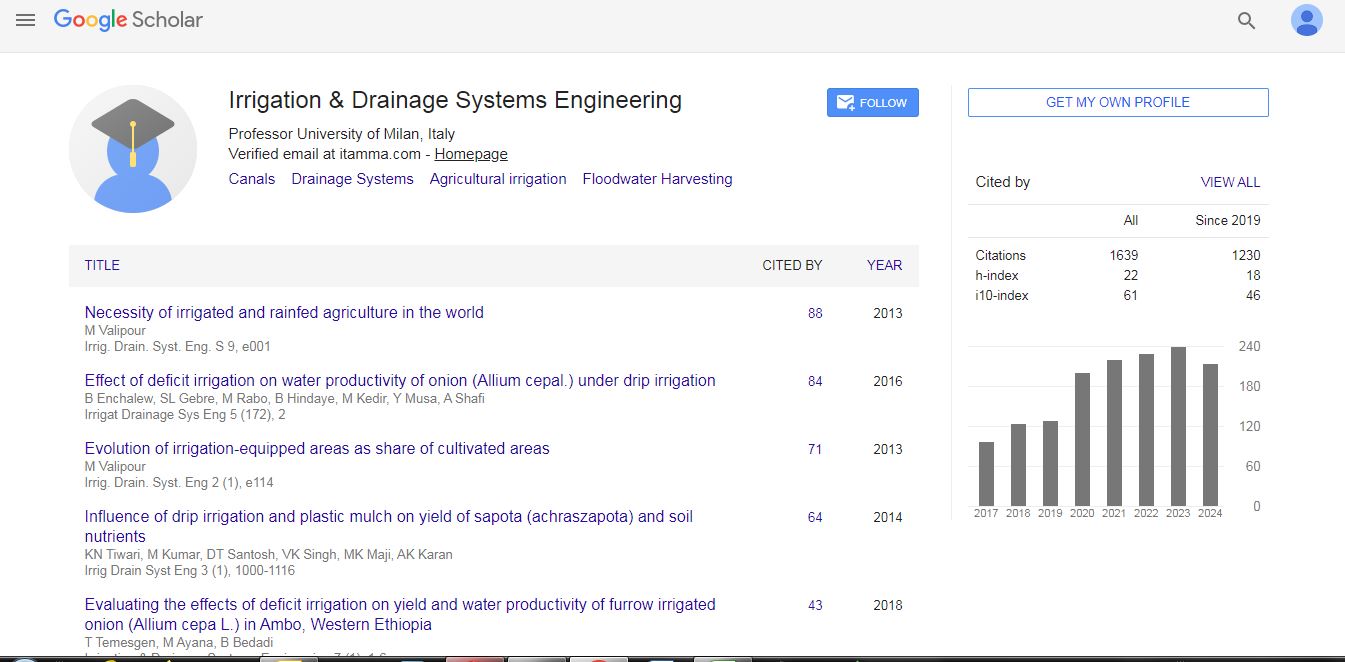
Irrigation & Drainage Systems Engineering received 835 citations as per Google Scholar report