Brief Report - (2025) Volume 15, Issue 6
Received: 31-Oct-2025, Manuscript No. jtese-26-184256;
Editor assigned: 03-Nov-2025, Pre QC No. P-184256;
Reviewed: 17-Nov-2025, QC No. Q-184256;
Revised: 21-Nov-2025, Manuscript No. R-184256;
Published:
28-Nov-2025
, DOI: 10.37421/2165-8064.2025.15.679
Citation: Clarke, Benjamin. ”Smart Textiles: Phase Change Materials for Thermal Comfort.” J Textile Sci Eng 15 (2025):679.
Copyright: © 2025 Clarke B. This is an open-access article distributed under the terms of the Creative Commons Attribution License, which permits unrestricted use, distribution and reproduction in any medium, provided the original author and source are credited.
Phase change materials (PCMs) are increasingly integrated into textiles to significantly enhance thermoregulation by absorbing and releasing latent heat during their phase transitions. This advanced technology promises to improve thermal comfort for individuals and boost energy efficiency in various applications, including buildings and vehicles. Its crucial role extends to specialized areas such as sportswear, medical textiles, and protective gear, where precise temperature control is paramount. Ongoing research efforts are dedicated to optimizing the encapsulation of PCMs, ensuring their uniform dispersion within textile fibers, and guaranteeing their durability through repeated washing and wear. The overarching development goal is to create cost-effective, sustainable, and scalable textile-based PCM solutions that meet diverse market needs. This study explores the synthesis and application of microencapsulated phase change materials (MEPCMs) specifically for thermoregulating textiles. It delves into detailed methods for creating stable MEPCMs possessing desirable thermal properties and discusses their effective incorporation into various textile structures, including coatings and yarn spinning. The research highlights the critical impact of factors such as PCM loading, particle size, and the choice of encapsulation shell material on the overall thermoregulation performance, as well as on essential fabric properties like washability and breathability. The integration of paraffin-based microencapsulated phase change materials (PCMs) into polyester fabrics is a key area of investigation aimed at achieving substantially enhanced thermal comfort. The study specifically focuses on the effectiveness of the coating technique employed and the resulting distribution of PCMs within the fabric structure. It rigorously evaluates the thermoregulating effectiveness, thermal stability, and overall durability of the treated fabrics, demonstrating significant improvements in their heat storage and release capabilities, which directly translate to better user comfort across varying ambient temperatures. This article comprehensively examines the functionalization of cotton fabrics with inorganic salt hydrate phase change materials (PCMs) for the purpose of achieving passive thermoregulation. The study meticulously details the impregnation process and the subsequent characterization of the treated fabrics, including their thermal energy storage capacity, thermal conductivity, and moisture management properties. The findings collectively indicate that these specially treated fabrics offer enhanced thermal comfort and superior breathability, making them highly suitable for a wide range of apparel applications. The research presented focuses on the development of a novel strategy for incorporating nano-encapsulated phase change materials (NEPCMs) into nonwoven fabrics to achieve advanced thermoregulation. The study elucidates the synthesis process of NEPCMs and their subsequent dispersion within the nonwoven matrix. Performance evaluations encompass thermal cycling stability, heat storage capacity, and subjective user comfort assessments, collectively demonstrating the considerable potential of these advanced materials in the realm of smart textiles. This paper meticulously investigates the effectiveness of integrating dodecane-based microencapsulated phase change materials (MEPCMs) into regenerated cellulosic fibers for improved thermal regulation. The study addresses the inherent challenges associated with achieving uniform dispersion and ensuring good adhesion between the MEPCMs and the fibers. It provides an in-depth analysis of the thermal properties, mechanical strength, and wash durability of the modified fibers and the resulting textiles, showcasing demonstrably improved thermal comfort. The study explores the intricate synthesis and characterization of microencapsulated paraffin, utilizing a polymethacrylate shell, for its application in thermoregulating textiles. It investigates the precise impact of the encapsulation process on the thermal properties of the PCM and its subsequent integration into polyester fabrics via a padding technique. The research quantifies the latent heat capacity and thermal conductivity of the modified fabrics, thereby demonstrating their significant potential for passive thermal management. This research presents the innovative development of bio-based phase change materials (PCMs) derived from fatty acids, specifically for application in thermoregulating textiles. The study concentrates on their practical application in cotton and polyester blended fabrics, utilizing a melt spinning technique. It thoroughly evaluates the thermal performance, durability, and overall comfort properties of the resulting fabrics, crucially highlighting the inherent sustainability aspect and the potential for active thermal regulation in next-generation smart apparel. This study rigorously investigates the use of encapsulated hydrated salt phase change materials (PCMs) for the specific application of thermoregulating sportswear. The research centers on the method of incorporation into polyester-based fabrics and the subsequent assessment of thermal comfort, moisture management, and washability. The findings conclusively demonstrate that these PCMs can significantly enhance the wearer's thermal sensation and effectively reduce heat stress experienced during periods of intense physical activity. This article provides a comprehensive review of the latest advancements in phase change materials (PCMs) for smart textiles, with a distinct focus on their thermoregulating capabilities. It systematically covers the different types of PCMs available, various encapsulation techniques employed, and diverse methods for their integration into textile structures. The review critically highlights existing challenges and outlines promising future research directions, including a strong emphasis on sustainability, cost-effectiveness, and the development of multifunctional smart textiles.
Phase change materials (PCMs) are being integrated into textiles to enhance thermoregulation by absorbing and releasing latent heat during phase transitions. This technology improves thermal comfort, energy efficiency in buildings and vehicles, and is crucial for applications in sportswear, medical textiles, and protective gear. Research focuses on optimizing PCM encapsulation, dispersion within fibers, and ensuring durability through washing and wear. The development aims for cost-effective, sustainable, and scalable textile-based PCM solutions [1].
This study explores the synthesis and application of microencapsulated phase change materials (MEPCMs) for thermoregulating textiles. It details methods for creating stable MEPCMs with desirable thermal properties and discusses their incorporation into various textile structures, such as coatings and yarn spinning. The research highlights the impact of PCM loading, particle size, and encapsulation shell material on the overall thermoregulation performance and fabric properties like washability and breathability [2].
The integration of paraffin-based microencapsulated phase change materials (PCMs) into polyester fabrics is investigated to achieve enhanced thermal comfort. The study focuses on the coating technique and the resulting distribution of PCMs within the fabric structure. It evaluates the thermoregulating effectiveness, thermal stability, and durability of the treated fabrics, demonstrating significant improvements in heat storage and release capabilities, which directly translate to better user comfort in varying ambient temperatures [3].
This article examines the functionalization of cotton fabrics with inorganic salt hydrate phase change materials (PCMs) for passive thermoregulation. The study details the impregnation process and the characterization of the treated fabrics, including their thermal energy storage capacity, thermal conductivity, and moisture management properties. The findings indicate that these treated fabrics offer enhanced thermal comfort and breathability, making them suitable for apparel applications [4].
The research focuses on developing a novel strategy for incorporating nano-encapsulated phase change materials (NEPCMs) into nonwoven fabrics for advanced thermoregulation. The study describes the synthesis of NEPCMs and their subsequent dispersion within the nonwoven matrix. Performance evaluation includes thermal cycling stability, heat storage capacity, and subjective user comfort assessments, demonstrating the potential for these advanced materials in smart textiles [5].
This paper investigates the effectiveness of incorporating dodecane-based microencapsulated phase change materials (MEPCMs) into regenerated cellulosic fibers for thermal regulation. The study addresses challenges in achieving uniform dispersion and good adhesion between the MEPCMs and the fibers. It provides an in-depth analysis of the thermal properties, mechanical strength, and wash durability of the modified fibers and resulting textiles, showcasing improved thermal comfort [6].
The study explores the synthesis and characterization of microencapsulated paraffin with a polymethacrylate shell for application in thermoregulating textiles. It investigates the impact of the encapsulation process on the thermal properties of the PCM and its integration into polyester fabrics via a padding technique. The research quantifies the latent heat capacity and thermal conductivity of the modified fabrics, demonstrating their potential for passive thermal management [7].
This research presents the development of bio-based phase change materials (PCMs) derived from fatty acids for thermoregulating textiles. The study focuses on their application in cotton and polyester blended fabrics using a melt spinning technique. It evaluates the thermal performance, durability, and comfort properties of the resulting fabrics, highlighting the sustainability aspect and potential for active thermal regulation in smart apparel [8].
This study investigates the use of encapsulated hydrated salt phase change materials (PCMs) for thermoregulating sportswear. The research focuses on the method of incorporation into polyester-based fabrics and the assessment of thermal comfort, moisture management, and washability. The findings demonstrate that these PCMs can significantly improve the wearer's thermal sensation and reduce heat stress during physical activity [9].
This article reviews the advancements in phase change materials (PCMs) for smart textiles with a focus on thermoregulation. It covers different types of PCMs, encapsulation techniques, and methods of integration into textile structures. The review highlights challenges and future research directions, including sustainability, cost-effectiveness, and the development of multifunctional smart textiles [10].
ConclusionPhase change materials (PCMs) are being incorporated into textiles to improve thermoregulation by managing heat through absorption and release. This technology enhances thermal comfort and energy efficiency across various applications, from apparel to buildings. Research is actively focused on optimizing PCM encapsulation and dispersion within fibers to ensure durability and performance. Various studies investigate different types of PCMs, including microencapsulated and nano-encapsulated forms, as well as bio-based alternatives. Integration methods like coating, yarn spinning, and melt spinning are explored for diverse fabric types such as cotton, polyester, and cellulosic fibers. Current efforts aim for sustainable, cost-effective, and scalable solutions for smart textiles, with ongoing research addressing challenges in dispersion, adhesion, and washability to maximize thermal comfort and functional performance.
None
None
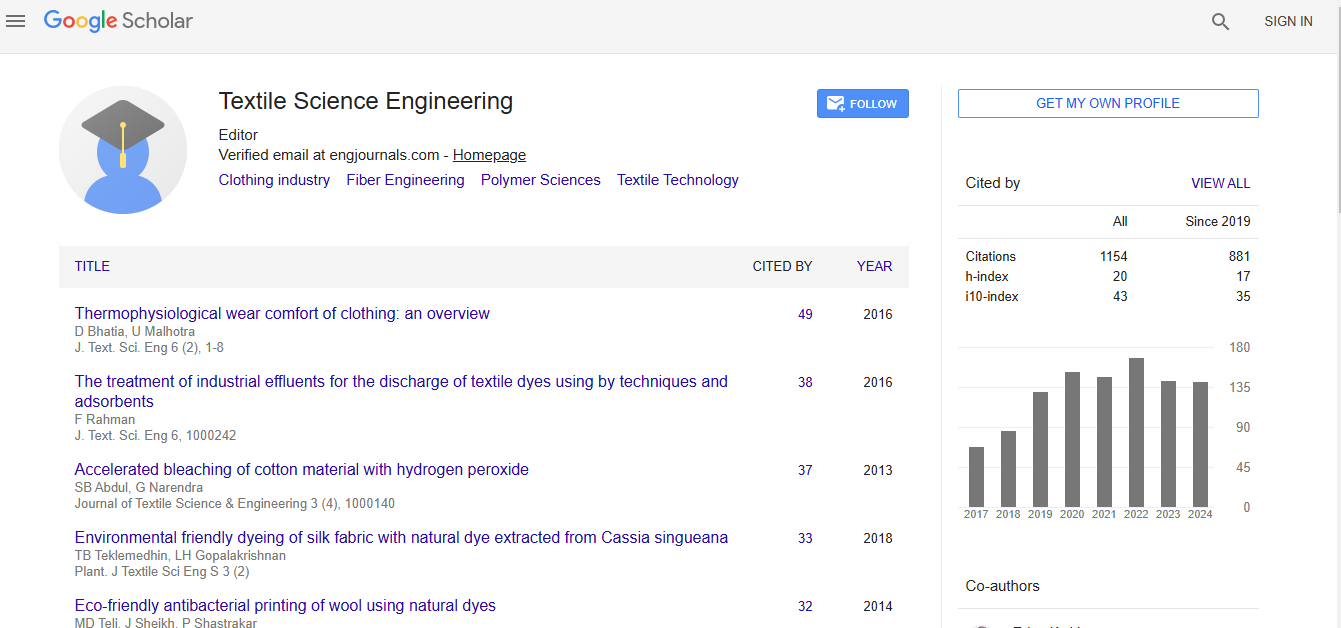
Journal of Textile Science & Engineering received 1008 citations as per Google Scholar report