Brief Report - (2025) Volume 14, Issue 4
Received: 01-Aug-2025, Manuscript No. idse-26-182824;
Editor assigned: 04-Aug-2025, Pre QC No. P-182824;
Reviewed: 18-Aug-2025, QC No. Q-182824;
Revised: 22-Aug-2025, Manuscript No. R-182824;
Published:
29-Apr-2025
, DOI: 10.37421/2168-9768.2025.14.497
Citation: Yuxin, Chen. ”Smart Irrigation and Drainage for Sustainable
Agriculture.” Irrigat Drainage Sys Eng 14 (2025):497.
Copyright: © 2025 Yuxin C. This is an open-access article distributed under the terms of the Creative Commons Attribution License, which permits unrestricted use, distribution
and reproduction in any medium, provided the original author and source are credited.
Modern irrigation and drainage systems are fundamental to advancing agricultural productivity and ensuring effective water resource management. These systems are evolving with cutting-edge technologies to meet the growing demands of global food production and the challenges posed by environmental changes.
Advancements in sensor technology, coupled with sophisticated data analytics and automation, are enabling precise water application. This not only reduces water wastage but also significantly mitigates detrimental environmental impacts associated with conventional irrigation methods. Integrated approaches to drainage are becoming increasingly crucial for preventing waterlogging and soil salinization. These strategies are vital for maintaining soil health and ensuring sustainable agricultural practices, especially in regions susceptible to adverse climatic conditions. Remote sensing and Geographic Information Systems (GIS) are proving invaluable for optimizing irrigation scheduling, particularly in arid and semi-arid environments where water scarcity is a persistent issue. These geospatial technologies facilitate real-time monitoring of crop water status, which directly translates to more efficient water utilization and subsequent improvements in crop yields. The integration of spatial data with robust hydrological models is essential for developing comprehensive and effective water management strategies in these water-stressed regions. Subsurface drainage systems are a key focus for addressing the pervasive problem of waterlogged soils. The design, installation, and ongoing maintenance of these systems are critical for their performance. Effective subsurface drainage positively impacts soil health, promotes robust crop growth, and plays a significant role in maintaining water quality by managing excess runoff. The economic and environmental benefits derived from well-implemented subsurface drainage systems are substantial, contributing to both farm profitability and ecological well-being. As climate change continues to exert pressure on agricultural water resources, the development and implementation of adaptive irrigation and drainage strategies are paramount for ensuring food security and the resilience of farming communities worldwide.The critical role of modern irrigation and drainage systems in agricultural productivity and water resource management is being redefined by technological advancements. Liu et al. (2023) explore how innovations in sensor technology, data analytics, and automation enable precise water application, thereby reducing waste and environmental harm. This integrated approach to smart agriculture is essential for sustainability. Furthermore, integrated drainage strategies are highlighted as crucial for preventing waterlogging and soil salinization, which are significant threats to agricultural land. These systems are indispensable for maintaining soil fertility and ensuring long-term crop production in diverse climatic conditions.
In arid and semi-arid regions, where water is a precious resource, remote sensing and GIS technologies are being deployed to optimize irrigation scheduling. Aburas et al. (2022) demonstrate how these tools enable real-time monitoring of crop water needs, leading to more efficient water use and better crop yields. The study by Aburas et al. (2022) also emphasizes the importance of combining spatial data with hydrological models for effective water management. This synergy allows for more informed decision-making regarding water allocation and irrigation timing. Managing waterlogged soils presents significant challenges, and Caiyun Zeng and colleagues (2021) examine the implementation of subsurface drainage systems. Their work provides valuable insights into the design, installation, and maintenance of these systems, which are vital for soil health. The performance and environmental implications of subsurface drainage are thoroughly analyzed by Zeng et al. (2021), who underscore the benefits for crop growth and water quality. These systems contribute to both agricultural output and environmental protection. Drip irrigation is another technology assessed for its potential to enhance water use efficiency and crop yield. Guanggang Li and his team (2023) evaluate the performance of drip irrigation systems, considering factors like emitter design and irrigation frequency. Their findings confirm that drip irrigation, when properly implemented, conserves water resources while maintaining or even improving agricultural productivity, making it a cornerstone of efficient farming. The integration of artificial intelligence (AI) and machine learning (ML) is revolutionizing irrigation management. Al-Ghobari et al. (2022) review how these advanced techniques predict crop water requirements and optimize schedules using weather and soil data. This intelligent approach to irrigation leads to more precise and responsive water application, ensuring that crops receive the exact amount of water they need, when they need it, thereby maximizing efficiency and minimizing waste.This collection of research highlights advancements in irrigation and drainage systems essential for sustainable agriculture. Studies showcase the integration of smart technologies like sensors, data analytics, and AI for precise water management, reducing waste and environmental impact. Remote sensing and GIS are employed to optimize irrigation scheduling in arid regions, while subsurface drainage systems address waterlogging and soil salinization. Drip irrigation proves effective in improving water use efficiency and crop yields. Furthermore, the impact of climate change necessitates adaptive strategies, and managing drainage water quality is crucial for protecting ecosystems. Research also covers IoT-enabled sensor networks for real-time monitoring and control, and comparative analyses of different drainage techniques for soil health. Integrated water management in river basins balances agricultural demands with environmental protection. The overarching theme is the application of technology and integrated approaches to enhance agricultural productivity and water resource sustainability.
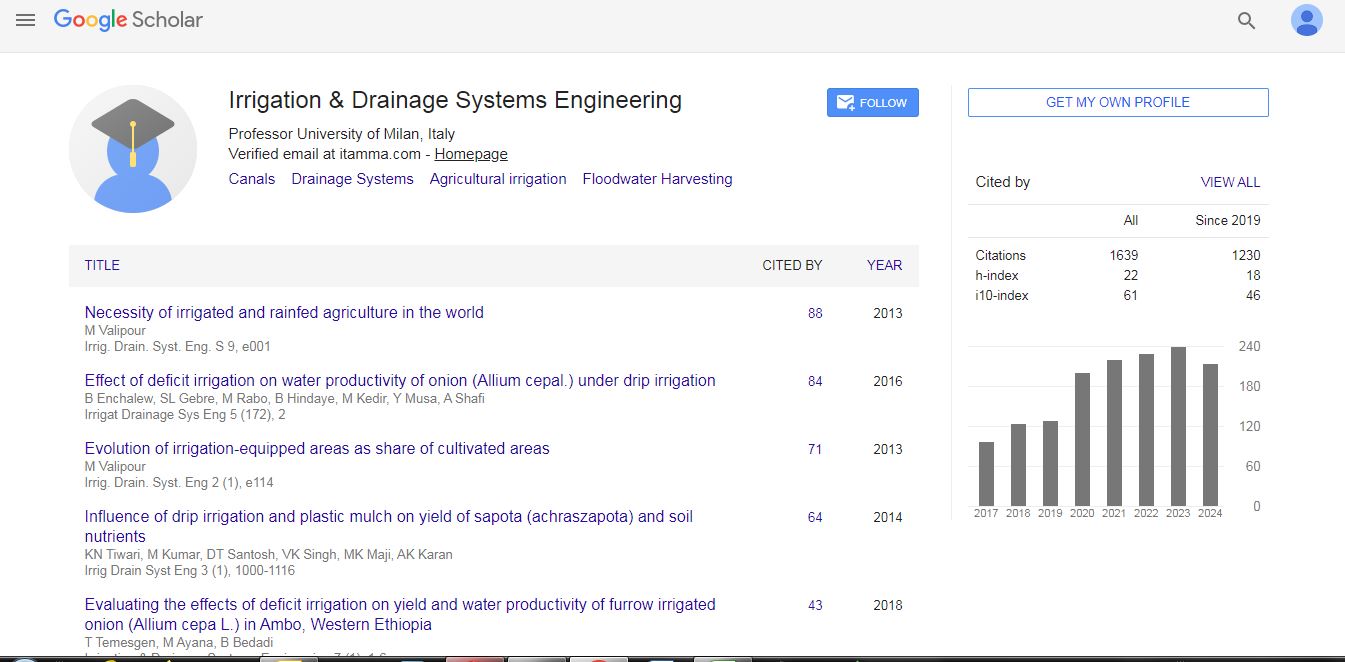
Irrigation & Drainage Systems Engineering received 835 citations as per Google Scholar report