Commentary - (2025) Volume 13, Issue 3
Received: 02-Jun-2025, Manuscript No. jaat-26-183153;
Editor assigned: 04-Jun-2025, Pre QC No. P-183153;
Reviewed: 18-Jun-2025, QC No. Q-183153;
Revised: 23-Jun-2025, Manuscript No. R-183153;
Published:
30-Jun-2025
, DOI: 10.37421/2329-6542.2025.13.352
Citation: Ivanova, Sofia. ”Small Satellites: Revolutionizing Astrophysical Observations.” J Astrophys Aerospace Technol 13 (2025):352.
Copyright: © 2025 Ivanova S. This is an open-access article distributed under the terms of the Creative Commons Attribution License, which permits unrestricted use, distribution and reproduction in any medium, provided the original author and source are credited.
The burgeoning field of small satellite technologies is revolutionizing astrophysical observations, democratizing access to space-based astronomy through miniaturization, cost-effectiveness, and rapid development cycles. These platforms, including CubeSats and nanosatellites, are enabling sophisticated scientific investigations across various wavelengths, from X-ray to optical and radio astronomy, with key applications in wide-field surveys, exoplanet characterization, and solar physics [1].
The development of advanced sensors and miniaturized optics is paramount for achieving high-performance astrophysical instruments on small satellites. Innovations in focal plane arrays and compact telescope designs are crucial for maintaining scientific rigor while adhering to stringent mass and power constraints, paving the way for missions that challenge the scientific output of larger observatories [2].
Onboard data processing presents a significant challenge for small satellites due to limited computational resources. Efficient algorithms and hardware architectures for real-time data analysis and reduction are essential, employing techniques for intelligent data compression and targeted data downlink to optimize scientific return and manage bandwidth limitations [3].
The application of CubeSats to solar physics research is rapidly expanding, with a focus on missions for observing solar flares and coronal mass ejections. These missions utilize compact payloads, such as soft X-ray spectrometers and wide-field imagers, to contribute to our understanding of solar activity and space weather [4].
Exoplanet detection and characterization are increasingly benefiting from small satellite platforms, particularly through constellations for transit photometry. These initiatives outline scientific objectives, instrument requirements, and mission architectures that enhance the precision and cadence of exoplanet light curves through coordinated observations [5].
The development of advanced propulsion systems for small satellites is vital for maneuverability, station-keeping, and orbital adjustments necessary for effective astrophysical observations. Reviews of state-of-the-art miniaturized propulsion technologies, including electric and cold-gas thrusters, discuss performance trade-offs, power consumption, and complexity [6].
Radio astronomy instruments for small satellites face challenges related to sensitive receivers, deployable antennas, and interference mitigation. Small satellite radio telescopes hold the potential to conduct sky surveys, study transient radio sources, and contribute to understanding the early universe [7].
The integration of artificial intelligence and machine learning within small satellite platforms offers significant advantages for autonomous operation and data analysis in astrophysics. Applications include target identification, anomaly detection, and adaptive observation planning, exploring the implementation of AI on resource-constrained systems [8].
X-ray astronomy, traditionally reliant on large observatories, is now being advanced by small satellites through innovations in detector technology and miniaturization. Nanosatellite missions for high-resolution X-ray spectroscopy are enabling the study of supernova remnants and active galactic nuclei [9].
The operational aspects of small satellite missions for astrophysics, encompassing ground segment support, mission planning, and data dissemination, are critical for scientific success. Current ground systems for small satellite constellations are reviewed, alongside strategies for efficient mission operations and data handling to maximize scientific return [10].
Small satellite technologies, encompassing CubeSats and nanosatellites, are democratizing space-based astronomy by offering miniaturization, cost-effectiveness, and rapid development. These platforms facilitate sophisticated scientific investigations across a broad spectrum of electromagnetic wavelengths, from X-ray to optical and radio astronomy, with significant applications in wide-field surveys, exoplanet characterization, and solar physics research [1].
Advancements in sensor and miniaturized optics technology are crucial for enabling high-performance astrophysical instruments on small satellites. The design and testing of novel focal plane arrays and compact telescope designs are critical for maintaining scientific rigor under stringent mass and power constraints, paving the way for small satellite missions with capabilities rivaling larger observatories [2].
Onboard data processing is a key challenge for small satellites due to computational limitations. The development of efficient algorithms and hardware architectures for real-time data analysis and reduction is essential. Techniques for intelligent data compression and targeted data downlink are employed to optimize scientific return and manage the communication bandwidth constraints inherent in these missions [3].
The use of CubeSats in solar physics research is rapidly expanding, particularly for missions designed to observe solar flares and coronal mass ejections. These missions incorporate compact payloads, such as soft X-ray spectrometers and wide-field imagers, to enhance our understanding of solar activity and its impact on space weather [4].
Small satellite platforms are increasingly utilized for exoplanet detection and characterization, notably through constellations designed for transit photometry. These studies outline the scientific objectives, instrument requirements, and mission architectures necessary to improve the precision and cadence of exoplanet light curve measurements through coordinated observations [5].
Advanced propulsion systems are critical for small satellite missions in astrophysics, enabling essential maneuverability, station-keeping, and orbital adjustments. Reviews of state-of-the-art miniaturized propulsion technologies, including electric and cold-gas thrusters, highlight the trade-offs in performance, power consumption, and complexity for these platforms [6].
Small satellites are finding applications in radio astronomy, requiring sensitive receivers, deployable antennas, and effective interference mitigation techniques. These platforms have the potential to conduct comprehensive sky surveys, study transient radio sources, and contribute significantly to our understanding of the early universe [7].
Artificial intelligence and machine learning are being integrated into small satellite platforms to enhance autonomous operation and data analysis in astrophysics. This includes applications for target identification, anomaly detection, and adaptive observation planning, focusing on the implementation of AI algorithms on resource-constrained systems [8].
Advancements in detector technology and miniaturization are enabling sophisticated X-ray instruments on small satellites, expanding the capabilities of X-ray astronomy. Nanosatellite missions are being developed for high-resolution X-ray spectroscopy, enabling detailed studies of astrophysical sources such as supernova remnants and active galactic nuclei [9].
The operational aspects of small satellite missions for astrophysics, including ground segment support, mission planning, and data dissemination, are fundamental to their scientific success. Current ground systems for small satellite constellations are reviewed, along with strategies for efficient mission operations and data handling, emphasizing agile operations to maximize scientific return [10].
Small satellite technologies, including CubeSats and nanosatellites, are revolutionizing astrophysical observations by providing cost-effective and rapid access to space. These platforms enable sophisticated scientific investigations across various wavelengths, from X-ray to radio astronomy. Key advancements include miniaturized optics and sensors, efficient onboard data processing, and integrated AI for autonomous operations. Specific applications focus on solar physics research, exoplanet characterization through transit photometry, and radio astronomy surveys. Furthermore, progress in propulsion systems and ground segment operations is crucial for maximizing the scientific return from these missions. The development of nanosatellites for high-resolution X-ray astronomy is also a significant area of growth, expanding the potential for detailed studies of cosmic phenomena.
None
None
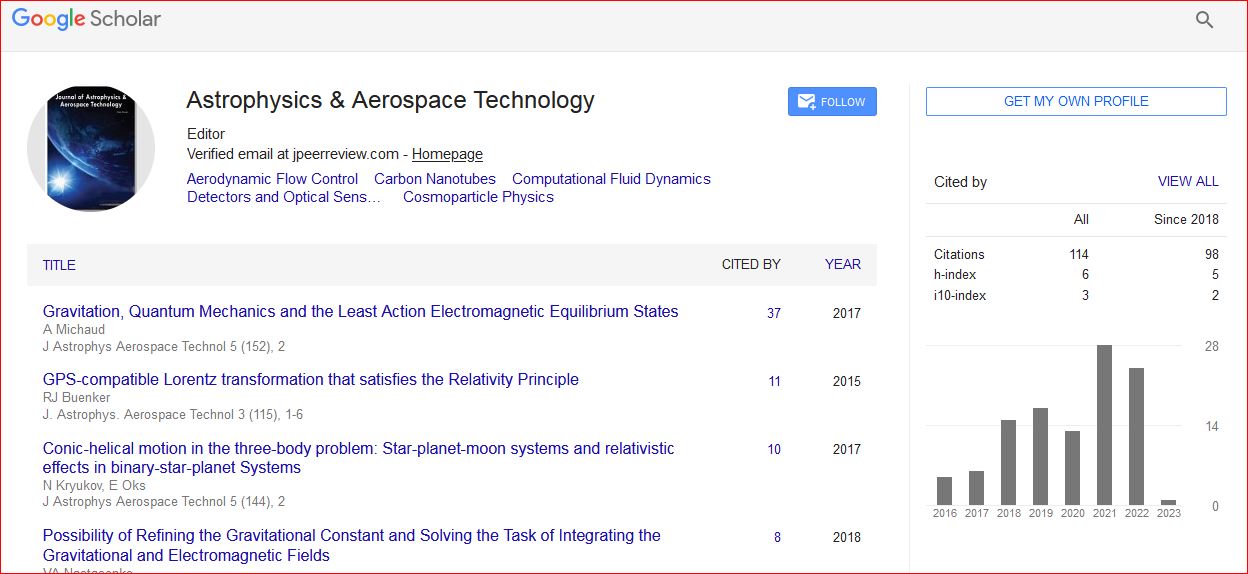
Astrophysics & Aerospace Technology received 114 citations as per Google Scholar report