Brief Report - (2025) Volume 17, Issue 4
Received: 01-Jul-2025, Manuscript No. jcst-25-174949;
Editor assigned: 03-Jul-2025, Pre QC No. P-174949;
Reviewed: 17-Jul-2025, QC No. Q-174949;
Revised: 22-Jul-2025, Manuscript No. R-174949;
Published:
29-Jul-2025
, DOI: 10.37421/1948-5956.2025.17.712
Citation: Kowalska, Anna. ”Small Molecules: Advancing Diverse
Targeted Therapies.” J Cancer Sci Ther 17 (2025):712.
Copyright: © 2025 Kowalska A. This is an open-access article distributed under the terms of the Creative Commons Attribution License, which permits unrestricted use,
distribution and reproduction in any medium, provided the original author and source are credited.
This review explores the therapeutic potential of targeting Myeloid Cell Leukemia 1 (MCL-1) with small molecule inhibitors in various cancers. It highlights MCL-1's role in cancer cell survival and resistance to therapy, discussing current inhibitors and strategies to overcome resistance, positioning them as promising agents for cancer treatment [1].
This article surveys recent advancements in small molecule inhibitors for treating autoimmune diseases. It covers diverse molecular targets and mechanisms, offering insights into their clinical efficacy and potential for developing more selective and potent therapies, highlighting a promising future for these compounds in managing chronic autoimmune conditions [2].
This review examines small-molecule inhibitors developed to combat SARS-CoV-2 and other human coronaviruses. It discusses various antiviral strategies, including targeting viral enzymes and host factors, offering a comprehensive overview of the inhibitors' mechanisms and their potential as therapeutic interventions for current and future coronavirus outbreaks [3].
This article discusses the dynamic field of kinase inhibitors, highlighting their significant role as small molecule therapeutics in various diseases, especially cancer. It covers current progress in drug development, addressing challenges like selectivity and resistance, and outlines future directions for designing more effective and safer kinase inhibitors [4].
This review focuses on the potential of small molecule inhibitors targeting the proteasome as therapeutic agents for neurodegenerative diseases. It delves into how proteasome dysfunction contributes to these conditions and explores the various inhibitors designed to modulate proteasome activity, presenting a promising avenue for novel treatment strategies [5].
This paper reviews a decade of progress in developing small molecule modulators for G protein-coupled receptors (GPCRs). It highlights how these inhibitors and activators have revolutionized our understanding of GPCR function and their therapeutic applications, emphasizing the advancements in targeting these crucial receptors for diverse pharmacological interventions [6].
This article introduces Bruton's Tyrosine Kinase (BTK) inhibitors as a new class of small molecule drugs reshaping the treatment landscape for autoimmune diseases. It details their mechanisms of action, clinical applications, and the promise they hold for managing various autoimmune conditions, marking a significant advancement in targeted therapies [7].
This study explores small molecule activators of AMP-activated protein kinase (AMPK) as a promising therapeutic approach for metabolic diseases. It elucidates AMPK's critical role in cellular energy homeostasis and how targeting this pathway with specific small molecules offers novel strategies for treating conditions like type 2 diabetes and obesity [8].
This article reviews the recent advancements in Histone Deacetylase (HDAC) inhibitors for cancer therapy. It discusses the diverse classes of small molecule HDAC inhibitors, their mechanisms of action in modulating gene expression and inducing cancer cell death, and their clinical efficacy, positioning them as key players in epigenetic cancer treatment [9].
This review highlights a paradigm shift in drug discovery: targeting RNA with small molecules. It explores how these small molecules can selectively bind to and modulate RNA structures and functions, opening new therapeutic avenues for diseases previously considered undruggable, showcasing the innovative potential of RNA-targeted small molecule inhibitors [10].
Small molecule inhibitors have emerged as pivotal agents in modern drug discovery, offering precise targeting capabilities across a vast landscape of diseases. Their ability to modulate specific molecular pathways has opened doors to innovative therapeutic strategies, addressing unmet needs in complex conditions ranging from various cancers to chronic autoimmune disorders, infectious diseases, and neurodegenerative conditions. The current landscape of research emphasizes not only the development of new compounds but also strategies to enhance their efficacy, selectivity, and safety profile, pointing to a dynamic and promising future for these compounds.
In oncology, the therapeutic potential of small molecule inhibitors is particularly evident. Targeting Myeloid Cell Leukemia 1 (MCL-1) with specific inhibitors is being explored to counteract cancer cell survival and overcome resistance to existing therapies, positioning these agents as crucial for cancer treatment [1]. The field of kinase inhibitors also represents a cornerstone of small molecule therapeutics, especially in cancer. Ongoing efforts focus on advancing drug development, tackling challenges like achieving greater selectivity and managing resistance, thereby guiding the design of more effective and safer compounds [4]. Additionally, Histone Deacetylase (HDAC) inhibitors are recognized for their role in epigenetic cancer treatment. These diverse classes of small molecules work by modulating gene expression and inducing cancer cell death, solidifying their importance in the therapeutic arsenal against various malignancies [9].
Beyond cancer, small molecule inhibitors are transforming the treatment paradigm for a range of other serious illnesses. In autoimmune diseases, recent advancements survey a spectrum of small molecule inhibitors targeting diverse molecular mechanisms, offering promising insights into their clinical efficacy and potential for highly selective and potent new therapies [2]. A notable breakthrough includes Bruton's Tyrosine Kinase (BTK) inhibitors, a new class of small molecule drugs specifically designed to manage various autoimmune conditions, marking a significant step forward in targeted autoimmune therapies [7]. For infectious diseases, particularly coronaviruses, small-molecule inhibitors have been rigorously developed to combat SARS-CoV-2 and other human coronaviruses. These compounds employ various antiviral strategies, including targeting viral enzymes and host factors, providing a comprehensive overview of their mechanisms and potential for both current and future outbreaks [3]. Furthermore, the investigation into small molecule inhibitors targeting the proteasome for neurodegenerative diseases highlights how modulating proteasome activity can address its dysfunction in these conditions, offering a novel avenue for treatment strategies [5].
The influence of small molecules extends significantly into metabolic health and fundamental biological processes. Small molecule activators of AMP-activated protein kinase (AMPK) are being explored as a promising therapeutic approach for metabolic diseases such as type 2 diabetes and obesity. This strategy capitalizes on AMPK's critical role in maintaining cellular energy homeostasis, paving the way for novel treatment modalities [8]. Concurrently, small molecule modulators for G protein-coupled receptors (GPCRs) have demonstrated a decade of remarkable progress, revolutionizing our comprehension of GPCR function and expanding their therapeutic applications across diverse pharmacological interventions [6]. In a paradigm shift for drug discovery, researchers are now targeting RNA with small molecules. These innovative compounds can selectively bind to and modulate RNA structures and functions, opening new therapeutic avenues for diseases previously deemed undruggable, underscoring the vast potential of RNA-targeted small molecule inhibitors [10].
The collective body of research underscores the profound impact of small molecule therapeutics in addressing complex health challenges. While significant strides have been made in identifying and developing these agents, continuous research is essential to overcome hurdles such as improving target specificity, reducing off-target effects, and circumventing resistance mechanisms. The ongoing commitment to exploring novel molecular targets and refining existing compounds promises to usher in an era of even more effective, safer, and personalized treatment options, solidifying the role of small molecules at the forefront of medicinal chemistry and clinical innovation.
Small molecule inhibitors represent a transformative class of therapeutics, driving significant advancements across numerous medical fields. In cancer, these compounds target mechanisms like Myeloid Cell Leukemia 1 (MCL-1) to combat cell survival and resistance, and kinase inhibitors are continually refined for enhanced selectivity and efficacy. Epigenetic approaches using Histone Deacetylase (HDAC) inhibitors also show promise in modulating gene expression to induce cancer cell death. Beyond oncology, small molecules are revolutionizing the treatment of autoimmune diseases, with recent progress in general inhibitors and specific agents like Bruton's Tyrosine Kinase (BTK) inhibitors offering more potent and selective therapies. These compounds have also been critical in developing antiviral strategies against SARS-CoV-2 and other human coronaviruses, targeting viral enzymes and host factors. For neurodegenerative diseases, proteasome inhibitors offer a novel therapeutic direction by addressing proteasome dysfunction. In metabolic disorders, small molecule activators of AMP-activated protein kinase (AMPK) are being explored for their role in energy homeostasis, promising new strategies for conditions like diabetes and obesity. Furthermore, modulators of G protein-coupled receptors (GPCRs) have deepened our understanding of receptor function and expanded therapeutic applications. A groundbreaking area involves targeting RNA directly with small molecules, opening up new avenues for previously undruggable diseases. This broad utility underscores the innovative potential of small molecules in developing highly effective and targeted therapies, facing challenges of selectivity and resistance, yet promising a future of personalized medicine.
Indexed at, Google Scholar, Crossref
Indexed at, Google Scholar, Crossref
Indexed at, Google Scholar, Crossref
Indexed at, Google Scholar, Crossref
Indexed at, Google Scholar, Crossref
Indexed at, Google Scholar, Crossref
Indexed at, Google Scholar, Crossref
Indexed at, Google Scholar, Crossref
Indexed at, Google Scholar, Crossref
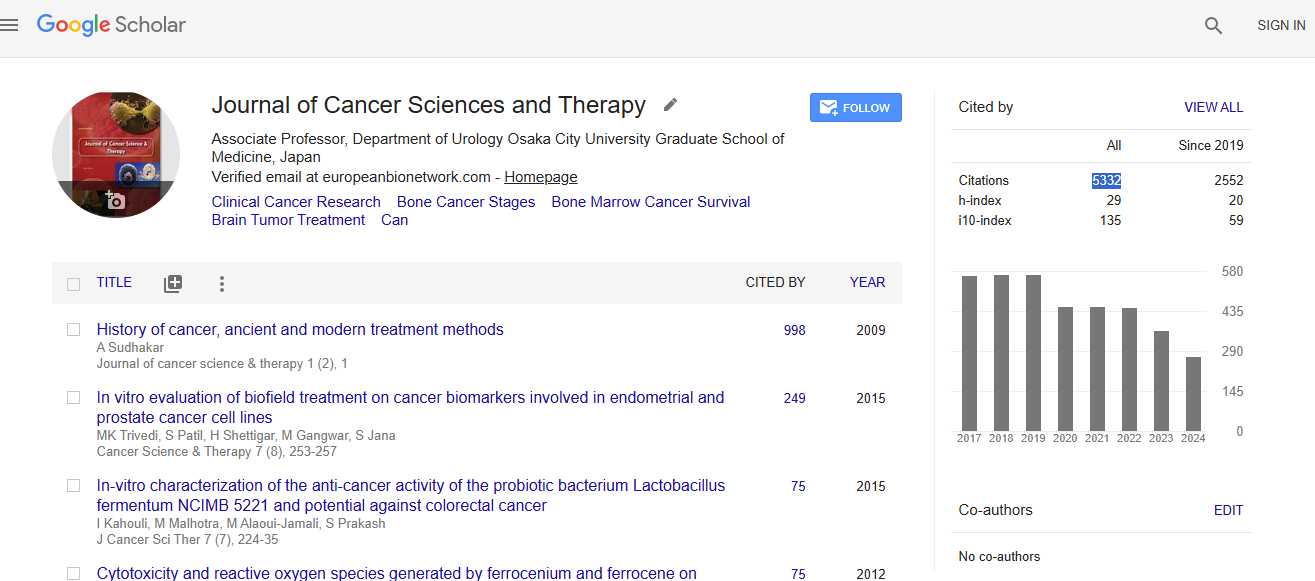
Cancer Science & Therapy received 5332 citations as per Google Scholar report