Short Communication - (2025) Volume 14, Issue 5
Received: 01-Sep-2025, Manuscript No. iem-26-179842;
Editor assigned: 03-Sep-2025, Pre QC No. P-26-179842;
Reviewed: 14-Sep-2025, QC No. Q-26-179842;
Revised: 22-Sep-2025, Manuscript No. R-26-179842;
Published:
29-Sep-2025
, DOI: 10.37421/2169- 0316.2025.14.326
Citation: Mendez, Carlos. âSix Sigma: Data-Driven Quality and Efficiency Enhancement.â J Ind Eng Manag 14 (2025):326.
Copyright: © 2025 Mendez C. This is an open-access article distributed under the terms of the Creative Commons Attribution License, which permits unrestricted use, distribution and reproduction in any medium, provided the original author and source are credited.
Six Sigma has emerged as a critical methodology for driving process excellence and operational efficiency across various industries. This approach, rooted in data-driven decision-making and a commitment to reducing variation, offers a structured framework for achieving significant improvements in quality and customer satisfaction. The foundational principles of Six Sigma are particularly well-suited for industrial engineering and management contexts, where the DMAIC (Define, Measure, Analyze, Improve, Control) methodology provides a systematic path to problem-solving and continuous improvement [1].
The adaptability of Six Sigma extends beyond traditional manufacturing environments, finding significant application in service-oriented sectors as well. For instance, its implementation in healthcare settings demonstrates the potential to enhance service quality, streamline patient care pathways, and minimize errors through the rigorous application of the DMAIC framework and robust data collection strategies, emphasizing stakeholder engagement [2].
Furthermore, the integration of Six Sigma with other improvement methodologies, such as Lean, has led to the development of Lean Six Sigma. This combined approach leverages the waste reduction capabilities of Lean and the variation reduction power of Six Sigma, yielding substantial gains in manufacturing productivity, cost reduction, and overall quality improvement through concurrent deployment [3].
The impact of Six Sigma is not limited to large corporations; it also holds considerable promise for small and medium-sized enterprises (SMEs). Research into Six Sigma implementation in SMEs highlights both the challenges and the significant benefits, suggesting that tailored approaches can lead to marked improvements in operational metrics and a stronger competitive advantage [4].
In the realm of supply chain management, Six Sigma plays a crucial role in fostering sustainability. By identifying and eliminating inefficiencies, reducing waste, and enhancing the reliability of operations, Six Sigma methodologies contribute to both the economic and environmental aspects of sustainable supply chain development [5].
The construction industry, known for its complex project dynamics, can also benefit immensely from Six Sigma. The application of the DMAIC methodology in this sector addresses common issues like project delays, cost overruns, and quality defects, paving the way for significant performance enhancements through systematic process improvement [6].
Successful Six Sigma implementation, particularly in diverse sectors like the Indian manufacturing industry, hinges on identifying critical success factors. These include strong top management commitment, comprehensive employee training, and meticulous project selection, all of which are vital for effective deployment and practical recommendations for adopting organizations [7].
Within the automotive industry, Six Sigma has proven effective in elevating product quality and customer satisfaction. The DMAIC methodology helps in systematically reducing manufacturing defects, leading to enhanced product reliability and a more positive customer perception, underscoring the value of a data-driven quality approach [8].
The banking sector also benefits from Six Sigma's systematic approach, particularly in improving operational efficiency and customer service. The DMAIC framework can be adapted to streamline banking processes, minimize transaction errors, and enrich the overall customer experience, showcasing Six Sigma's versatility beyond its manufacturing origins [9].
Beyond operational improvements, Six Sigma can also positively influence innovation and product development. Its rigorous, data-driven nature can accelerate development cycles, shorten time-to-market, and ensure the quality of new products, suggesting a direct correlation between Six Sigma adoption and enhanced innovation performance [10].
The core of Six Sigma lies in its structured approach to problem-solving and process improvement, fundamentally aimed at reducing defects and minimizing variation. In an industrial engineering and management context, the DMAIC framework (Define, Measure, Analyze, Improve, Control) serves as the guiding methodology. This systematic process allows organizations to identify root causes of problems, implement data-driven solutions, and establish controls to sustain improvements, ultimately leading to enhanced product quality, increased customer satisfaction, and greater operational efficiency [1].
Six Sigma's applicability is remarkably broad, extending into service industries with notable success. In healthcare, for instance, the DMAIC framework has been adapted to tackle complex service-related issues, leading to more efficient patient care pathways and a reduction in medical errors. This application underscores the importance of robust data collection and active stakeholder engagement in achieving tangible improvements in service quality [2].
A powerful evolution of Six Sigma is its integration with Lean principles, forming Lean Six Sigma. This hybrid approach capitalizes on Lean's focus on waste elimination and Six Sigma's expertise in variation reduction. The synergy between these methodologies yields substantial gains in manufacturing productivity, significant cost reductions, and marked improvements in product quality by enabling the concurrent deployment of their strengths [3].
The benefits of Six Sigma are accessible even to smaller organizations. For small and medium-sized enterprises (SMEs), implementing Six Sigma presents unique challenges and rewards. Studies indicate that with tailored approaches, Six Sigma can significantly enhance operational metrics, thereby boosting the competitive edge of SMEs in their respective markets [4].
Sustainability is increasingly a focus for businesses, and Six Sigma offers valuable tools for its achievement within supply chains. By diligently identifying and eliminating inefficiencies, reducing waste, and bolstering the reliability of supply chain operations, Six Sigma contributes positively to both the economic viability and environmental responsibility of supply chain management [5].
The construction industry, often characterized by its intricate project management, can also leverage Six Sigma for enhanced operational efficiency. The DMAIC methodology is instrumental in pinpointing and mitigating prevalent issues such as project delays, budget overruns, and quality deficiencies, thereby enabling significant performance enhancements through systematic process improvements [6].
Understanding the critical success factors is paramount for effective Six Sigma implementation, especially in diverse industrial landscapes like the Indian manufacturing sector. Key elements such as unwavering top management commitment, comprehensive employee training programs, and a well-defined process for selecting projects are vital for successful adoption and sustainable results [7].
In the high-stakes automotive industry, Six Sigma has demonstrably improved product quality and customer satisfaction. The structured application of the DMAIC methodology directly addresses manufacturing defects, leading to more reliable products and fostering a stronger connection with customers through demonstrable improvements in quality metrics [8].
Beyond traditional manufacturing, the banking sector has embraced Six Sigma to refine its operations and elevate customer service. The DMAIC framework provides a robust mechanism for streamlining banking processes, reducing errors in financial transactions, and ultimately enhancing the customer experience, showcasing Six Sigma's versatility across different service environments [9].
Furthermore, Six Sigma's influence extends to the critical area of innovation and product development. Its inherent rigor and data-centric approach can significantly accelerate product development cycles, reduce the time it takes to bring new products to market, and ensure superior quality for these new offerings, thereby demonstrating a positive impact on innovation performance [10].
Six Sigma, employing the DMAIC methodology, is a data-driven approach focused on reducing defects and variation to enhance quality and efficiency. Its applications span industrial engineering, healthcare services, manufacturing through Lean Six Sigma integration, and support for SMEs. Six Sigma also contributes to sustainable supply chains and improves operational efficiency in construction. Critical success factors include management commitment and training. The methodology has proven effective in the automotive industry for product quality and customer satisfaction, and in banking for operational efficiency and service enhancement. It also positively impacts innovation and product development by accelerating cycles and ensuring quality.
None
None
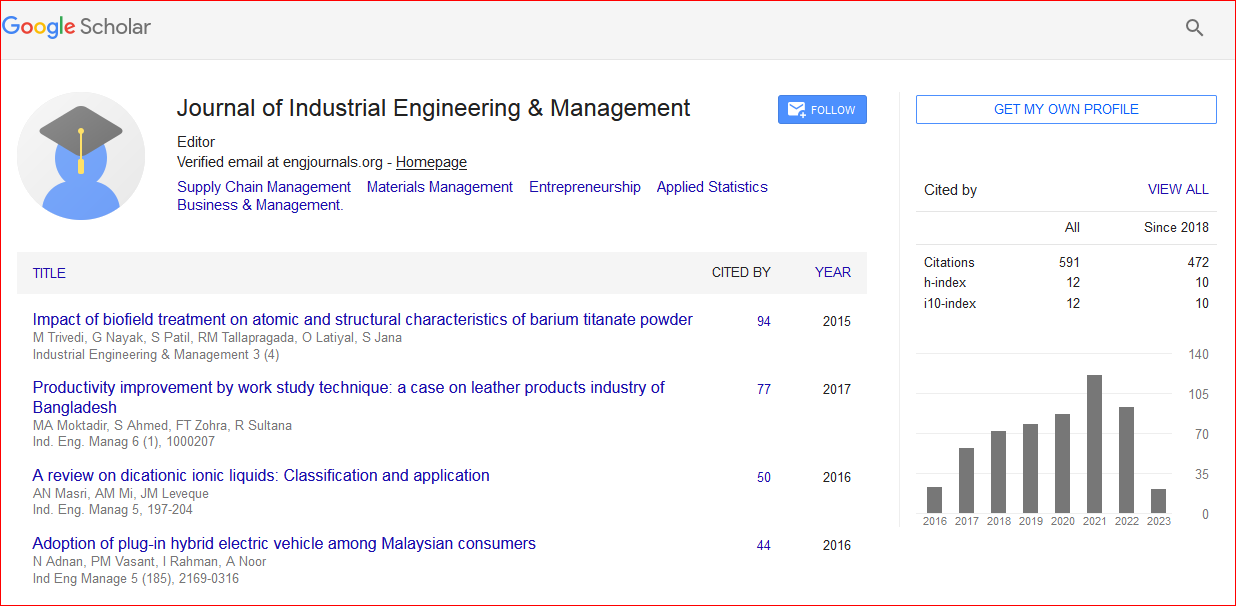
Industrial Engineering & Management received 739 citations as per Google Scholar report