Brief Report - (2025) Volume 19, Issue 2
Received: 01-Apr-2025, Manuscript No. jmgm-26-185644;
Editor assigned: 03-Apr-2025, Pre QC No. P-185644;
Reviewed: 17-Apr-2025, QC No. Q-185644;
Revised: 22-Apr-2025, Manuscript No. R-185644;
Published:
29-Apr-2025
, DOI: 10.37421/1747-0862.2025.19.714
Citation: Costa, Rafael M.. ”Single-Gene Disorders: Diagnosis, Editing, and Personalized Medicine.” J Mol Genet Med 19 (2025):714.
Copyright: © 2025 Costa M. Rafael This is an open-access article distributed under the terms of the Creative Commons Attribution License, which permits unrestricted use, distribution and reproduction in any medium, provided the original author and source are credited.
Single-gene disorders, such as cystic fibrosis and sickle cell disease, arise from mutations in a single gene. These conditions highlight the critical role of specific genes in human health and disease pathogenesis. Understanding their molecular basis, including the underlying genetic defects and their impact on protein function, is fundamental to developing targeted therapies. Advances in gene editing and personalized medicine offer promising avenues for treating these inherited conditions [1].
Cystic fibrosis (CF) is a classic example of an autosomal recessive disorder caused by mutations in the CFTR gene, leading to defective chloride ion transport. This dysfunction affects multiple organ systems, particularly the lungs and digestive tract. Research continues to unravel the complex genotype-phenotype correlations and to develop more effective modulator therapies that address the underlying protein defect [2].
Sickle cell disease (SCD) is an inherited blood disorder characterized by abnormal hemoglobin (HbS) due to a point mutation in the beta-globin gene. This mutation causes red blood cells to become sickle-shaped, leading to vaso-occlusion, pain crises, and organ damage. Current treatments focus on symptom management, but gene therapy and hematopoietic stem cell transplantation hold significant promise for a functional cure [3].
The advent of next-generation sequencing (NGS) has revolutionized the diagnosis of single-gene disorders. NGS allows for rapid and comprehensive analysis of the entire genome or exome, enabling the identification of causative mutations even in complex cases or when symptoms are atypical. This has profound implications for early diagnosis, genetic counseling, and the development of personalized treatment plans [4].
Gene editing technologies, particularly CRISPR-Cas9, offer unprecedented potential for correcting the genetic defects underlying single-gene disorders. While still in its early stages for therapeutic applications, gene editing holds the promise of a permanent correction at the DNA level. Ethical considerations and delivery challenges remain key areas of ongoing research and development [5].
The spectrum of single-gene disorders is vast, encompassing a wide range of conditions affecting various physiological systems. From neurological disorders like Huntington's disease to metabolic conditions such as phenylketonuria, each disorder presents unique challenges in diagnosis, management, and research. Understanding the specific gene involved and its function is paramount for therapeutic development [6].
Personalized medicine approaches are transforming the management of single-gene disorders. By tailoring treatments based on an individual's genetic makeup, clinicians can optimize therapeutic efficacy and minimize adverse effects. This includes pharmacogenomics to guide drug selection and dosing, as well as the development of therapies targeted at specific genetic mutations [7].
Understanding the molecular mechanisms of disease progression in single-gene disorders is crucial for developing effective interventions. For instance, research into the protein misfolding and aggregation in conditions like Alzheimer's disease, which can have genetic predispositions, provides insights into disease pathways. Similarly, studying the cellular consequences of CFTR dysfunction aids in designing more precise therapies [8].
The global impact of single-gene disorders is significant, affecting millions worldwide. Public health initiatives and increased awareness are vital for early detection, genetic screening, and providing access to care. Collaborative research efforts across institutions and countries are accelerating the discovery of new treatments and cures for these debilitating conditions [9].
The Department of Microbial Genetics at the University of Lisbon's Institute of Biosciences plays a crucial role in advancing our understanding of genetic mechanisms. Research from this department contributes to the broader field of molecular and genetic medicine, including studies relevant to single-gene disorders. Their work often focuses on fundamental genetic processes and their implications for human health [10].
Single-gene disorders, exemplified by cystic fibrosis and sickle cell disease, are rooted in alterations within a single gene. These conditions underscore the crucial influence of specific genes on human health and the mechanisms by which diseases develop. A thorough comprehension of their molecular underpinnings, encompassing the precise genetic defects and their consequential impact on protein activity, is indispensable for the creation of targeted therapeutic strategies. Emerging advancements in gene editing techniques and personalized medicine present significant prospects for the treatment of these inherited ailments [1].
Cystic fibrosis (CF) stands as a prominent instance of an autosomal recessive disorder, stemming from mutations in the CFTR gene that disrupt chloride ion transport. This functional impairment affects numerous organ systems, most notably the lungs and the digestive tract. Ongoing research endeavors are dedicated to elucidating the intricate genotype-phenotype relationships and to formulating more potent modulator therapies that directly address the underlying protein defect [2].
Sickle cell disease (SCD) is an inherited hematological disorder characterized by the presence of abnormal hemoglobin (HbS), a consequence of a point mutation in the beta-globin gene. This genetic alteration induces a sickle shape in red blood cells, precipitating vaso-occlusion, painful episodes, and damage to various organs. While current therapeutic approaches concentrate on managing symptoms, gene therapy and hematopoietic stem cell transplantation offer considerable hope for achieving a functional cure [3].
The emergence of next-generation sequencing (NGS) has profoundly transformed the diagnostic landscape for single-gene disorders. NGS facilitates rapid and extensive analysis of the entire genome or exome, thereby enabling the identification of causal mutations, even in cases with complex presentations or atypical symptoms. This capability has far-reaching implications for timely diagnosis, genetic counseling, and the formulation of individualized treatment regimens [4].
Gene editing technologies, with CRISPR-Cas9 at the forefront, present unparalleled opportunities for rectifying the genetic errors that underlie single-gene disorders. Despite being in the nascent stages of therapeutic application, gene editing holds the potential for permanent genetic correction at the DNA level. Significant research and development efforts continue to address the associated ethical considerations and delivery challenges [5].
The array of single-gene disorders is exceptionally broad, encompassing a diverse spectrum of conditions that impact various physiological systems. Ranging from neurological ailments like Huntington's disease to metabolic disorders such as phenylketonuria, each condition poses distinct challenges in terms of diagnosis, management, and research. A deep understanding of the specific gene involved and its normal function is paramount for the successful development of effective therapies [6].
Personalized medicine strategies are revolutionizing the approach to managing single-gene disorders. By customizing treatments based on an individual's unique genetic profile, healthcare providers can optimize therapeutic effectiveness and minimize the occurrence of adverse reactions. This encompasses the application of pharmacogenomics to guide drug selection and dosage, as well as the development of therapies specifically designed to target particular genetic mutations [7].
Elucidating the molecular mechanisms that drive disease progression in single-gene disorders is essential for the development of efficacious interventions. For example, investigations into protein misfolding and aggregation, observed in conditions with genetic predispositions like Alzheimer's disease, offer valuable insights into disease pathways. Likewise, studying the cellular ramifications of CFTR dysfunction aids in the design of more precise therapeutic interventions [8].
The global health burden imposed by single-gene disorders is substantial, affecting millions of individuals worldwide. Public health initiatives and heightened awareness campaigns are crucial for promoting early detection, facilitating genetic screening, and ensuring access to necessary care. Furthermore, collaborative research endeavors spanning multiple institutions and nations are instrumental in accelerating the discovery of novel treatments and potential cures for these often debilitating conditions [9].
Research conducted within the Department of Microbial Genetics at the University of Lisbon's Institute of Biosciences significantly contributes to the advancement of our understanding of genetic mechanisms. The work emerging from this department is relevant to the broader field of molecular and genetic medicine, including studies pertaining to single-gene disorders. Their research frequently centers on fundamental genetic processes and their potential implications for human health [10].
Single-gene disorders, such as cystic fibrosis and sickle cell disease, result from mutations in a single gene and are crucial for understanding human health and disease. Next-generation sequencing (NGS) has revolutionized their diagnosis, enabling rapid and comprehensive genetic analysis. Gene editing technologies like CRISPR-Cas9 offer potential for correcting genetic defects, while personalized medicine tailors treatments to individual genetic profiles for improved efficacy and reduced side effects. Understanding the molecular pathogenesis is key to developing interventions. Public health initiatives and collaborative research are vital for addressing the global impact of these disorders and accelerating the discovery of new treatments.
None
None
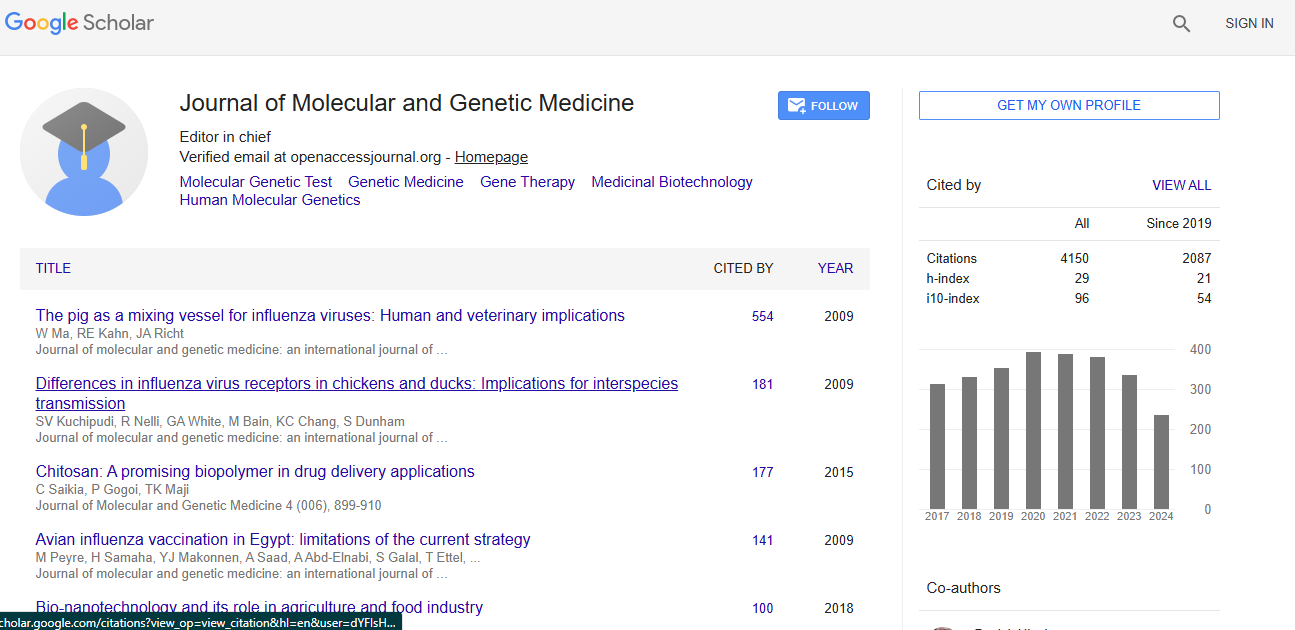
Molecular and Genetic Medicine received 3919 citations as per Google Scholar report