Perspective - (127) Volume 14, Issue 4
Received: 01-Dec-2025, Manuscript No. ara-25-999999;
Editor assigned: 03-Dec-2025, Pre QC No. P-999999;
Reviewed: 17-Dec-2025, QC No. Q-999999;
Revised: 22-Dec-2025, Manuscript No. R-999999;
Published:
29-Dec-2025
, DOI: 10.37421/2168-9695.2025.14.350
Citation: Santini, Marco. ”Simulation: The Cornerstone of Robotics Advancement.” Adv Robot Autom 14 (2025):350.
Copyright: © 2025 Santini M. This is an open-access article distributed under the terms of the Creative Commons Attribution License, which permits unrestricted use, distribution and reproduction in any medium, provided the original author and source are credited.
The field of robotics is undergoing rapid transformation, with advancements continuously pushing the boundaries of what automated systems can achieve. Central to this progress is the indispensable role of simulation, a powerful tool that allows for the safe, efficient, and cost-effective development, testing, and refinement of robotic systems before deployment in the physical world. This collection of reviews explores the multifaceted applications and critical importance of simulation, alongside related technologies like digital twins, across various specialized domains within robotics. It highlights how these virtual environments are not just supplementary tools but fundamental pillars supporting innovation from basic research to complex industrial and medical implementations. Digital twin technology, for instance, offers a sophisticated approach to managing robotic systems. It provides capabilities for real-time monitoring, predictive maintenance, and optimized control, effectively bridging the divide between virtual simulations and actual robot behavior. This integration enhances system reliability and overall performance in industrial contexts [1].
In the realm of Artificial Intelligence, specifically Reinforcement Learning (RL), robotic simulation environments are crucial. They provide essential platforms for training complex robot behaviors without risking damage to expensive physical hardware. These simulations facilitate the advancement of RL in robotics by offering diverse scenarios and repeatable training grounds. A significant challenge here is the "sim-to-real" transfer, where techniques are continually refined to ensure that behaviors learned in simulation translate effectively to the physical world [2].
Similarly, Deep Reinforcement Learning (DRL) agents greatly benefit from simulation, which offers infinite data, safe training environments, and rapid iteration cycles. Strategies like domain randomization are key to mitigating the sim-to-real gap, enabling the successful deployment of DRL controllers on actual robots [9].
Human-Robot Interaction (HRI) research also leans heavily on simulation. Simulators are instrumental in designing, testing, and evaluating HRI systems by allowing researchers to model human behavior, robot kinematics, and various environmental factors. This helps in creating more realistic and immersive HRI simulations, thereby refining how humans and robots can effectively collaborate and interact [3].
For specialized robotic tasks, simulation proves equally vital. Evaluating and comparing different motion planning algorithms for robotic manipulators benefits immensely from a simulated environment. Such environments offer a controlled and repeatable setting to test algorithm efficiency, collision avoidance, and path smoothness, which are all critical aspects before implementing these algorithms on physical robots [4].
This ensures that robotic movements are precise and safe, especially in dynamic or constrained workspaces. The development of modern robotics toolchains heavily integrates simulation. Platforms like ROS 2 and Gazebo exemplify this, providing robust environments for complex robotic system design, testing, and validation. These tools support advanced features such as distributed computing, real-time performance, and multi-robot coordination, serving as essential resources for contemporary robotics research and industrial applications [5].
Beyond general robotics, simulation holds critical importance in highly specialized fields such as surgical robotics. Dedicated simulation environments for surgical robots are vital for training surgeons, validating new robotic surgical procedures, and developing advanced control algorithms. These systems incorporate various simulation modalities, from haptic feedback to virtual reality interfaces, emphasizing the necessity of high-fidelity models for safe and effective surgical practice [6].
Another area where simulation excels is in the design and control of collaborative robots (cobots). Simulation helps optimize cobot workspace layouts, validate safety protocols, and develop intuitive human-robot interaction strategies, leading to more efficient and safer collaborative industrial environments [7].
Complex systems, like swarm robotics, pose unique simulation challenges. Modeling large numbers of interacting robots, developing scalable and distributed simulation environments, and accurately representing physical constraints and communication delays are crucial for effective swarm behavior design and validation [8].
Moreover, the fidelity of sensor data significantly impacts robot learning. Realistic sensor simulation is paramount for advancing robot perception and navigation. This involves developing accurate sensor models and methods for generating synthetic data, all while accurately replicating real-world sensor noise and environmental effects to enhance the sim-to-real transferability of learned policies [10].
In conclusion, simulation is a cornerstone of modern robotics, facilitating everything from foundational algorithmic development to advanced system deployment. The diverse applications highlighted underscore its essential role in pushing the boundaries of what robots can achieve, making the journey from concept to physical reality safer, faster, and more effective.
The application of digital twin technology in robotics represents a significant step forward, providing capabilities for real-time monitoring, predictive maintenance, and optimized control. This technology actively bridges the gap between virtual simulations and physical robot behavior, enhancing system reliability and overall performance in industrial settings [1]. It allows for a comprehensive, virtual representation of a physical robot, enabling engineers to test scenarios and make adjustments without direct intervention on the costly hardware.
Robotic simulation environments are also critical for advancing Reinforcement Learning (RL) in robotics. These platforms are indispensable for training complex robot behaviors, offering a safe space to experiment and iterate without damaging physical hardware. The primary challenge often involves the "sim-to-real" transfer, which refers to making sure behaviors learned in simulation perform reliably in the real world. Researchers are continuously developing techniques to overcome this gap, underscoring the necessity of realistic and efficient simulations [2]. This extends to Deep Reinforcement Learning (DRL) agents, where simulation provides an endless supply of training data, safe environments for experimentation, and rapid iteration cycles. Various techniques, including domain randomization, are employed to bridge the sim-to-real gap, ultimately enabling the successful deployment of DRL controllers on physical robots [9].
Simulation plays a transformative role in Human-Robot Interaction (HRI) research. It allows for the detailed design, testing, and evaluation of HRI systems by modeling intricate aspects like human behavior, robot kinematics, and diverse environmental factors. Existing simulation tools are categorized by their capabilities, helping researchers identify challenges and future directions for creating more realistic and immersive HRI simulations. This iterative process in a virtual space is essential for refining how humans and robots can interact safely and intuitively [3]. Moreover, in motion planning, simulation provides an invaluable environment for evaluating and comparing different algorithms for robotic manipulators. Its advantages lie in offering a controlled and repeatable setting to rigorously test algorithm efficiency, collision avoidance, and path smoothness. This critical step ensures that any algorithm is thoroughly validated before being deployed on physical robots, minimizing risks and maximizing operational effectiveness [4].
For advanced robotics development, the integration of ROS 2 and Gazebo serves as a foundational toolchain. This survey explores how these platforms facilitate complex robotic system design, testing, and validation. They support advanced features such as distributed computing, real-time performance, and multi-robot coordination. This synergy makes ROS 2 and Gazebo vital for pushing the boundaries in modern robotics research and diverse industrial applications [5]. Specialized applications further demonstrate simulationâ??s breadth, such as in surgical robotics, where in-depth simulation environments are crucial. They support surgeon training, validate new robotic surgical procedures, and aid in developing advanced control algorithms. These environments leverage modalities like haptic feedback and virtual reality, emphasizing the need for high-fidelity models to ensure safe and effective surgical practice [6].
Collaborative robots (cobots) also benefit extensively from simulation-based design and control. Simulation helps optimize cobot workspace layouts, validate safety protocols, and develop intuitive human-robot interaction strategies. The ultimate goal is to create more efficient and safer collaborative industrial environments where humans and robots can work together seamlessly [7]. Furthermore, simulating swarm robotics systems presents unique challenges due to the complexities of modeling large numbers of interacting robots. It requires scalable and distributed simulation environments, alongside accurate representation of physical constraints and communication delays, to effectively design and validate swarm behavior [8]. Finally, the importance of realistic sensor simulation for robot learning, especially in perception and navigation, cannot be overstated. This involves discussing different types of sensor models, methods for generating synthetic data, and the challenges of accurately replicating real-world sensor noise and environmental effects to improve the sim-to-real transferability of learned policies [10]. These varied applications collectively underscore simulationâ??s pervasive and indispensable role in contemporary robotics.
Robotics research heavily relies on simulation to overcome physical limitations and accelerate development. Digital twin technology offers real-time monitoring, predictive maintenance, and optimized control for robots, bridging virtual and physical domains. Simulation environments are vital for advancing Reinforcement Learning (RL) in robotics, providing platforms to train complex robot behaviors while avoiding damage to hardware. Key challenges include the "sim-to-real" transfer, which techniques like domain randomization aim to address for deploying learned policies on physical robots. Simulation plays a crucial role in Human-Robot Interaction (HRI), facilitating the design and evaluation of HRI systems by modeling human behavior and robot kinematics. It also provides a controlled and repeatable environment for evaluating and comparing different motion planning algorithms for robotic manipulators, ensuring efficiency, collision avoidance, and path smoothness before physical deployment. Modern toolchains like ROS 2 and Gazebo enable complex robotic system design, testing, and validation, including distributed computing and multi-robot coordination. Specialized simulation environments are essential for surgical robots, supporting surgeon training, validating new procedures, and developing advanced control algorithms with high-fidelity models. Similarly, simulation is indispensable for designing and controlling collaborative robots (cobots), optimizing workspace layout, validating safety protocols, and developing intuitive interaction strategies. Simulating swarm robotics systems presents unique challenges, requiring scalable environments to model numerous interacting robots and accurately represent physical constraints and communication delays. Realistic sensor simulation is also critical for robot learning, especially in perception and navigation, by generating synthetic data and replicating real-world sensor noise to improve sim-to-real transferability. Overall, simulation is a foundational tool across diverse robotics applications, from fundamental research to complex industrial and medical deployments.
None
None
Qingzhe P, Weibo L, Di L. "A Comprehensive Review on Digital Twin in Robotics".Sensors 23 (2023):6965.
Indexed at, Google Scholar, Crossref
Chunli T, Shuhui L, Tiantian W. "Robotics simulation for reinforcement learning: a comprehensive review".Artificial Intelligence Review 55 (2022):2821-2856.
Indexed at, Google Scholar, Crossref
Chiraag K, Anji S, Hanlin Z. "Simulation for Human-Robot Interaction: A Survey".IEEE Robotics and Automation Letters 6 (2021):2963-2970.
Indexed at, Google Scholar, Crossref
Sungjoon H, Hanseul L, Hyoungyoon K. "Simulation-Based Evaluation of Motion Planning Algorithms for Robotic Manipulators".International Journal of Advanced Robotic Systems 17 (2020):1729881420958742.
Indexed at, Google Scholar, Crossref
Muhammad IK, Zeeshan H, Osama F. "Advanced Robotics Development with ROS 2 and Gazebo: A Survey".Sensors 24 (2024):173.
Indexed at, Google Scholar, Crossref
Hao H, Tao L, Kai W. "A comprehensive review of simulation environments for surgical robots".Journal of Medical Robotics Research 8 (2023):2350002.
Indexed at, Google Scholar, Crossref
Jianfeng P, Chunyang Z, Shilei W. "Simulation-based design and control of collaborative robots".Robotics and Computer-Integrated Manufacturing 73 (2022):102237.
Indexed at, Google Scholar, Crossref
Jia ST, Yong KL, Yu ST. "A Review on Swarm Robotics Simulation and Its Challenges".IEEE Access 9 (2021):36000-36015.
Indexed at, Google Scholar, Crossref
Junhyeok H, Joon L, Jihwan P. "The Role of Simulation in Deep Reinforcement Learning for Robotics: A Review".Journal of Intelligent & Robotic Systems 99 (2020):585-601.
Indexed at, Google Scholar, Crossref
Yuan G, Mingli T, Shiqi Y. "Realistic Sensor Simulation for Robot Learning: A Review".Sensors 19 (2019):4642.
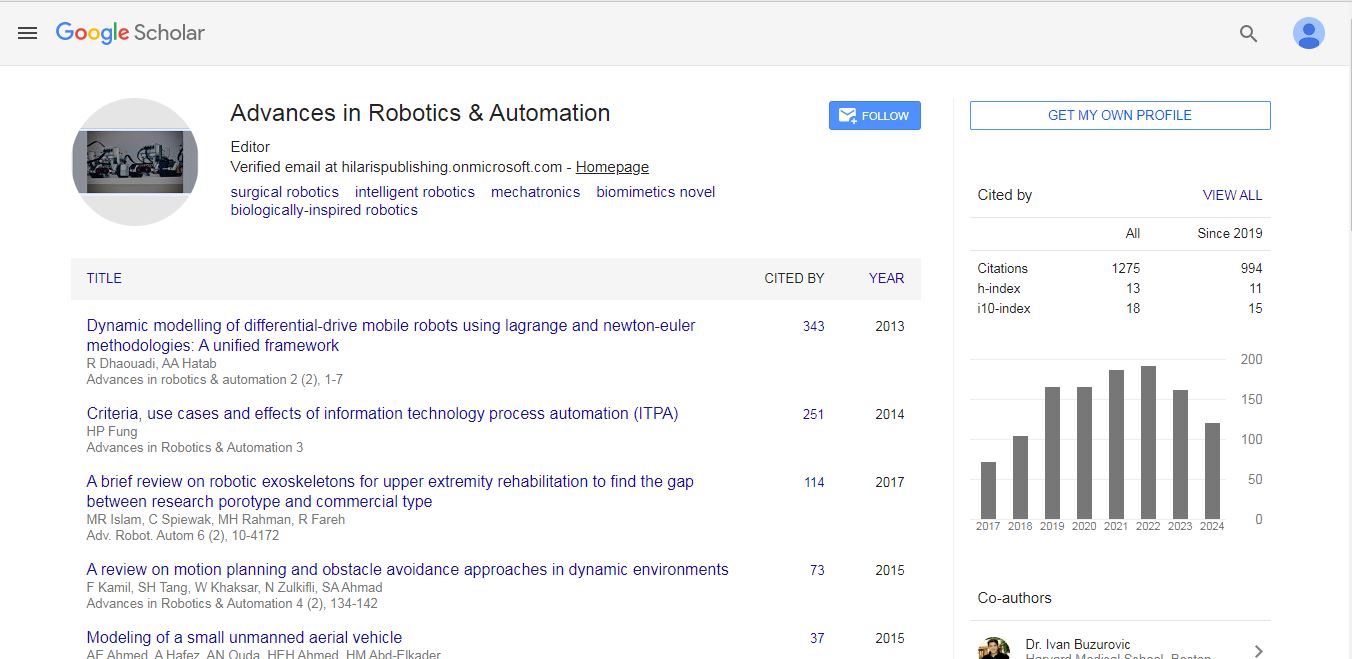
Advances in Robotics & Automation received 1275 citations as per Google Scholar report