Short Communication - (2025) Volume 14, Issue 5
Received: 02-Nov-2025, Manuscript No. iem-26-179853;
Editor assigned: 04-Nov-2025, Pre QC No. P-179853;
Reviewed: 16-Nov-2025, QC No. Q-179853;
Revised: 23-Nov-2025, Manuscript No. R-179853;
Published:
30-Nov-2025
, DOI: 10.37421/2169- 0316.2025.14.336
Citation: Romero, Natalia. ”Simulation Modeling: Essential for Modern Manufacturing.” J Ind Eng Manag 14 (2025):336.
Copyright: © 2025 Romero N. This is an open-access article distributed under the terms of the Creative Commons Attribution License, which permits unrestricted use, distribution and reproduction in any medium, provided the original author and source are credited.
The field of manufacturing has witnessed a significant evolution, driven by the need for increased efficiency, flexibility, and resilience. Simulation modeling has emerged as a cornerstone technology, offering powerful tools to analyze, design, and optimize complex manufacturing systems. Discrete-event simulation, in particular, allows for the in-depth examination of production lines, identifying critical bottlenecks and evaluating the impact of various operational adjustments on key performance indicators like throughput, resource utilization, and work-in-progress levels. The reliability of these insights is intrinsically linked to the accuracy of the input data and the rigor of model validation [1].
Complementing discrete-event simulation, agent-based modeling provides a granular perspective by simulating the emergent behavior of individual system components and their intricate interactions. This approach is particularly adept at understanding the dynamics of flexible manufacturing systems and assessing their responsiveness to dynamic changes and disruptions, thereby fostering enhanced agility and resilience in production [2].
The integration of simulation modeling with real-time data streams represents a paradigm shift towards advanced manufacturing control. By continuously updating simulation models with live production data, manufacturers can achieve proactive decision-making and dynamic adjustments to optimize scheduling and resource allocation, leading to substantial improvements in operational efficiency and throughput [3].
Beyond operational processes, simulation plays a crucial role in the strategic design of manufacturing facilities. By enabling the evaluation of different layout configurations, it helps optimize material flow, space utilization, and overall productivity, leading to reduced operational costs and improved workflow through the selection of the most efficient layout alternatives [4].
Capacity planning is another critical area where simulation modeling proves invaluable. It enables manufacturers to forecast future demand, accurately assess production capacity requirements, and identify potential under- or over-capacity scenarios. This methodological approach enhances the precision of capacity planning and mitigates associated risks [5].
In complex manufacturing environments, production scheduling is a persistent challenge. Simulation offers a robust solution by allowing for the evaluation of diverse scheduling policies to identify optimal strategies for minimizing makespan, tardiness, and work-in-progress, ultimately improving the efficiency and responsiveness of scheduling operations [6].
Analyzing supply chain performance within manufacturing ecosystems benefits immensely from simulation modeling. It provides a means to model the intricate flow of goods, information, and finances, identify vulnerabilities, and test strategies for enhancing resilience and efficiency, offering a holistic view of supply chain operations [7].
The convergence of simulation and artificial intelligence, particularly machine learning, is revolutionizing predictive maintenance. By using simulation to generate data for training AI algorithms, manufacturers can predict equipment failures and optimize maintenance schedules, thereby reducing downtime and associated costs [8].
As manufacturing embraces more sophisticated human-robot collaboration, simulation modeling becomes essential for designing effective work cells. It allows for the modeling of interactions between human workers and robotic systems to optimize safety, efficiency, and ergonomic conditions, facilitating the testing of various interaction strategies [9].
Furthermore, simulation is instrumental in modeling advanced manufacturing technologies like additive manufacturing. It addresses the challenges of simulating complex processes such as 3D printing, enabling optimization of build parameters, prediction of part quality, and analysis of production throughput, thereby accelerating the adoption of new manufacturing paradigms [10].
The application of simulation modeling in optimizing manufacturing systems is a widely explored area, with discrete-event simulation standing out for its ability to analyze complex production lines. This technique is instrumental in identifying bottlenecks, assessing throughput, managing resource utilization, and controlling work-in-progress levels. Crucially, the accuracy of insights derived from discrete-event simulation is directly proportional to the quality of input data and the thoroughness of model validation [1].
Agent-based modeling offers a distinct advantage in simulating flexible manufacturing systems by capturing the emergent behaviors of individual components and their interactions. This approach provides a more detailed understanding of system dynamics and is particularly effective in evaluating the responsiveness of manufacturing systems to dynamic changes and disruptions, thereby enhancing their agility and resilience [2].
The integration of simulation models with real-time production data marks a significant advancement in manufacturing control. This framework allows for continuous model updates, enabling proactive decision-making and dynamic adjustments to optimize scheduling and resource allocation, leading to considerable improvements in operational efficiency and overall throughput [3].
Simulation's role extends to the strategic planning of manufacturing facility layouts. By evaluating different configurations, it aids in optimizing material flow, maximizing space utilization, and boosting productivity. This simulation-driven approach allows for the selection of the most efficient layout, consequently reducing operational costs and streamlining workflow [4].
Capacity planning in manufacturing systems is substantially enhanced through discrete-event simulation. This method facilitates forecasting future demand, determining necessary production capacity, and identifying potential issues related to under or over-capacity. It provides a structured approach to improve the accuracy of capacity planning and mitigate inherent risks [5].
In the context of complex manufacturing environments, simulation-based optimization of production scheduling is critical. It enables the evaluation of various scheduling policies to determine the most effective strategy for minimizing metrics such as makespan, tardiness, and work-in-progress, thereby improving the efficiency and responsiveness of scheduling processes [6].
Simulation modeling is a powerful tool for analyzing the performance of supply chains within manufacturing operations. It allows for the modeling of complex flows of goods, information, and finances, identification of systemic vulnerabilities, and testing of strategies aimed at improving resilience and efficiency, providing a comprehensive view of supply chain dynamics [7].
The synergistic integration of simulation and machine learning is at the forefront of predictive maintenance in manufacturing. Simulation models generate synthetic data that trains AI algorithms, enabling accurate prediction of equipment failures and optimization of maintenance schedules, which in turn reduces downtime and maintenance expenses [8].
Simulation modeling is increasingly utilized to understand and optimize human-robot collaboration in manufacturing. By modeling the interactions between human workers and robotic systems, it helps enhance safety, efficiency, and ergonomic conditions, guiding the design of more effective collaborative work cells through the testing of different interaction strategies [9].
Finally, simulation modeling is crucial for the advancement of new manufacturing technologies, such as additive manufacturing. It addresses the complexities of modeling processes like 3D printing to optimize build parameters, predict part quality, and analyze production throughput, thereby facilitating the broader adoption and integration of these innovative manufacturing paradigms [10].
This collection of research explores the multifaceted applications of simulation modeling in the manufacturing sector. Key areas addressed include optimizing manufacturing systems using discrete-event and agent-based simulations, which help identify bottlenecks, enhance flexibility, and improve responsiveness to dynamic changes. The integration of simulation with real-time data enables advanced control and dynamic adjustments for increased efficiency. Furthermore, simulation is vital for facility layout design, capacity planning, and production scheduling, leading to cost reductions and improved workflow. The research also highlights simulation's role in supply chain analysis, predictive maintenance through AI integration, optimizing human-robot collaboration, and modeling advanced technologies like additive manufacturing. Collectively, these studies underscore simulation's indispensable contribution to modern manufacturing.
None
None
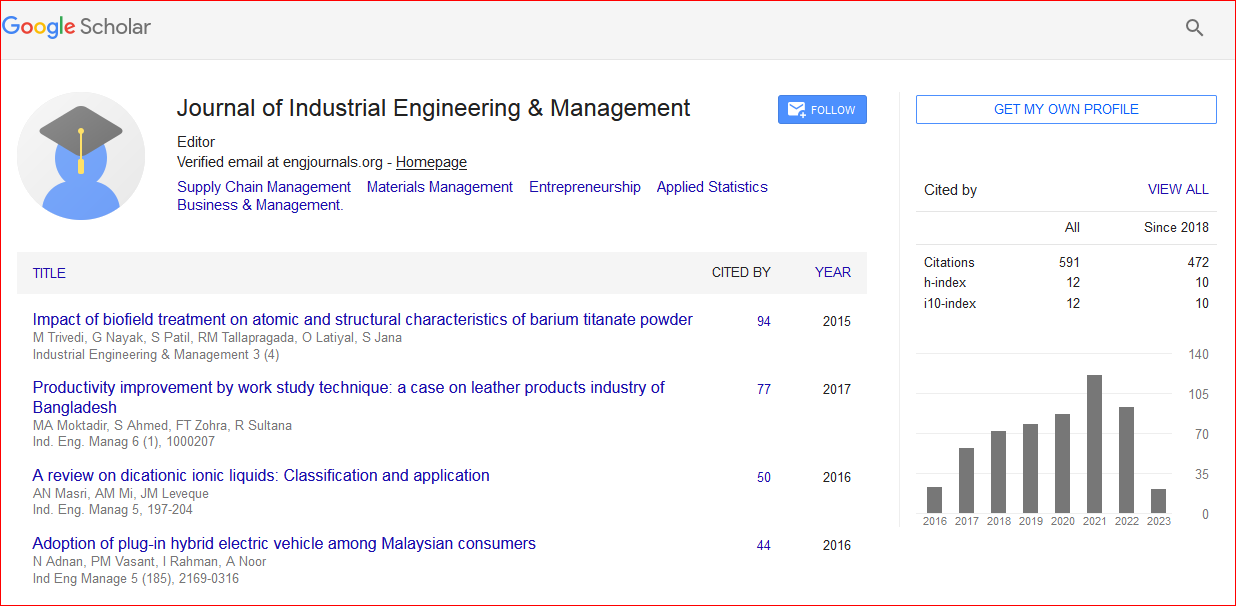
Industrial Engineering & Management received 739 citations as per Google Scholar report