Brief Report - (2025) Volume 9, Issue 5
Received: 01-Sep-2025, Manuscript No. jma-26-184612;
Editor assigned: 03-Sep-2025, Pre QC No. P-184612;
Reviewed: 17-Sep-2025, QC No. Q-184612;
Revised: 22-Sep-2025, Manuscript No. R-184612;
Published:
29-Sep-2025
, DOI: 10.37421/2684-4265.2025.09.398
Citation: Zahra, Farah. ”Seed Coat’s Role In Germination And Crop Yield.” J Morphol Anat 09 (2025):398.
Copyright: © 2025 Zahra F. This is an open-access article distributed under the terms of the Creative Commons Attribution License, which permits unrestricted use, distribution and reproduction in any medium, provided the original author and source are credited.
The seed coat serves as a fundamental component dictating the success of germination and subsequent plant development, acting as an indispensable physical barrier that meticulously regulates vital exchanges of water and gases essential for embryonic emergence. Its sophisticated internal architecture, comprising distinct layers such as the testa and tegmen, profoundly influences seed dormancy mechanisms and modulates the susceptibility of the seed to a myriad of environmental factors, thereby shaping its germination fate. A comprehensive understanding of these structure-dependent physiological and developmental mechanisms holds immense potential for significant advancements in improving crop yields and ensuring robust seedling establishment across diverse agricultural landscapes. The intricate process of water uptake, a critical prerequisite for initiating germination, is largely governed by the permeability characteristics of the seed coat, with specific anatomical structures like the micropyle and the outer testa layer playing pivotal roles in facilitating imbibition and the reactivation of dormant metabolic pathways within the embryo. The diverse biochemical compositions found within seed coats, including the presence of mucilaginous substances or the development of exceptionally hardened integuments, directly correlate with distinct hydration responses, impacting the speed and success of germination. Furthermore, the inherent mechanical properties exhibited by the seed coat are of paramount importance in regulating the timing of germination, particularly when seeds encounter challenging environmental conditions or periods of significant stress, acting as a crucial determinant in preventing premature germination and seedling emergence in unfavorable circumstances. A robust and impermeable seed coat can effectively prevent germination until the prevailing environmental conditions become optimally conducive for seedling establishment, thereby serving as an adaptive mechanism to mitigate the risks associated with survival in unsuitable habitats and ensuring developmental continuity. Detailed analysis of seed coat anatomy, encompassing the presence, organization, and precise chemical composition of its constituent layers, such as the epidermis, parenchyma, and sclerenchyma, directly impacts the efficacy of gas exchange necessary for sustaining the respiratory demands of the embryo during the critical germination phase. Specialized anatomical features embedded within the seed coat structure can either actively facilitate or significantly impede the diffusion of essential gases like oxygen and carbon dioxide, thereby fine-tuning the metabolic environment required for germination. The intricate interplay between phytohormones and seed coat-mediated germination responses is a subject of growing interest, with key plant hormones like abscisic acid (ABA) frequently implicated in establishing and maintaining dormancy imposed by the seed coat, while others, such as gibberellins (GAs), can actively promote dormancy release by modulating coat permeability or weakening its structural integrity. The seed coat's microstructure, characterized by the presence or absence of a protective cuticle or the differentiation of specialized epidermal cells, can significantly influence its susceptibility to microbial pathogens and mechanical damage, thereby safeguarding the viability of the embryo and promoting successful germination and subsequent establishment. In certain plant species, seed coat dormancy, often referred to as physical dormancy, manifests as an impediment to water and gas penetration, a common trait observed in legumes that necessitates specific environmental triggers or physical scarification processes for germination to occur, thus establishing a direct and unequivocal link between seed coat properties and overall germination success. The testa, which constitutes the outermost protective layer of the seed coat, is frequently composed of highly lignified sclerenchyma cells that impart substantial mechanical strength and robust protection against external threats, with its thickness and degree of lignification directly influencing the seed's resilience to environmental pressures and its capacity to preserve viability until germination conditions become favorable. The tegmen, representing the inner layer of the seed coat, also exerts influence over germination by potentially secreting endogenous inhibitory compounds or providing a specialized matrix that facilitates the absorption of water and essential nutrients, thereby playing a vital role in coordinating the complex germination process through its interaction with the developing embryo. Specialized structures integrated within the seed coat, such as elaiosomes or strophiole, have evolved to play crucial roles in either promoting seed dispersal by attracting specific animal vectors or actively regulating the rate of water uptake, adaptations intricately linked to the seed's overall reproductive strategy and its probability of successful germination and propagation. Consequently, a comprehensive investigation into these varied roles and structural contributions of the seed coat is indispensable for unlocking the full potential of agricultural productivity and advancing our understanding of plant reproductive biology.
The seed coat plays a critically important role in germination success by functioning as a physical barrier that precisely controls the exchange of water and gases, thereby influencing the initiation and progression of embryonic development. Its complex layered structure, specifically the testa and tegmen, dictates the degree of dormancy and sensitivity to external environmental influences, making it a key factor in determining successful seedling establishment and overall crop yield. Understanding the mechanisms by which the seed coat's structure influences these processes is essential for agricultural innovation. The permeability of the seed coat is a primary factor that governs the rate at which water enters the seed, a process vital for imbibition and the activation of metabolic processes necessary for germination. Structures like the micropyle and the testa are critical pathways for water uptake, and variations in seed coat composition, such as the presence of mucilage or a hard seed coat, lead to diverse hydration dynamics. This differential hydration directly impacts germination timing and success. The mechanical characteristics of the seed coat are also significantly important in regulating germination, especially under stressful environmental conditions where a tough or impermeable seed coat can prevent premature germination until favorable conditions prevail, thus ensuring seedling survival. This acts as a crucial adaptive mechanism to avoid establishment in unsuitable environments. The intricate anatomical features of the seed coat, including its various layers like the epidermis, parenchyma, and sclerenchyma, directly influence the diffusion of gases essential for respiration during germination. Specialized structures within the seed coat can either enhance or hinder the movement of oxygen and carbon dioxide, thereby modulating the metabolic environment for the embryo. Phytohormones play a pivotal role in mediating the effects of the seed coat on germination, with abscisic acid (ABA) often contributing to seed coat-induced dormancy, while gibberellins (GAs) can facilitate dormancy breaking by altering the coat's permeability or structural integrity. This hormonal crosstalk highlights the complex regulatory network governing germination. The microstructure of the seed coat, such as the presence of a cuticle or specialized epidermal cells, significantly affects its resistance to pathogens and mechanical damage, thereby contributing to the overall protection of the embryo and ensuring successful germination and establishment. These protective functions are vital for seed survival. Seed coat dormancy, also known as physical dormancy, is a condition where the seed coat obstructs the entry of water and gases, a common trait observed in many legumes. This type of dormancy requires specific environmental cues or mechanical scarification for germination to proceed, demonstrating a direct relationship between seed coat properties and the ability to germinate. The testa, the outermost layer of the seed coat, is often composed of sclerenchyma cells that provide mechanical strength and protection, with its thickness and lignification level directly influencing the seed's ability to withstand environmental stresses and maintain viability until favorable conditions arise for germination. This structural integrity is crucial for long-term seed survival. The tegmen, the inner layer of the seed coat, can also influence germination by potentially secreting inhibitory substances or serving as a matrix for water and nutrient absorption, critically interacting with the embryo to coordinate the entire germination process and regulate developmental progression. Some seed coats possess specialized structures like elaiosomes or strophiole, which are adaptations that facilitate seed dispersal by attracting animals or regulate water uptake, thereby intricately linking seed coat morphology to successful reproduction and germination strategies. These diverse adaptations underscore the multifaceted importance of the seed coat in plant life cycles.
The seed coat is a critical determinant of germination success, acting as a physical barrier that regulates water and gas exchange. Its structure, including layers like the testa and tegmen, influences dormancy and environmental susceptibility, impacting crop yields. Seed coat permeability is key for water uptake, with variations in composition affecting hydration. Mechanical properties also regulate germination timing, especially under stress. Seed coat anatomy directly influences gas exchange necessary for respiration. Phytohormones, such as ABA and GAs, mediate seed coat effects on dormancy. Microstructure provides protection against pathogens and damage. Physical dormancy, where the seed coat prevents water entry, requires specific cues for germination. The testa offers mechanical strength, while the tegmen can interact with the embryo and influence nutrient absorption. Specialized structures aid in dispersal or water regulation. Understanding these roles is vital for improving agriculture and plant reproduction.
None
None
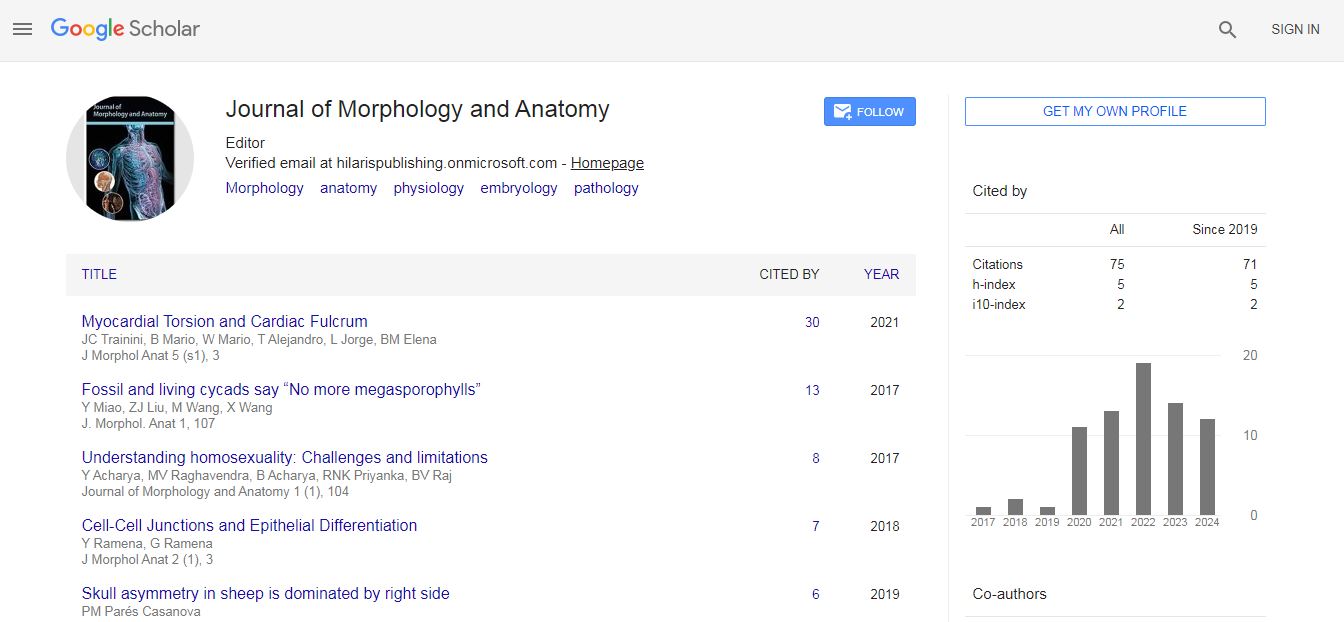
Journal of Morphology and Anatomy received 63 citations as per Google Scholar report