Perspective - (2025) Volume 9, Issue 3
Received: 01-May-2025, Manuscript No. hps-26-184442;
Editor assigned: 05-May-2025, Pre QC No. P-184442;
Reviewed: 19-May-2025, QC No. Q-184442;
Revised: 22-May-2025, Manuscript No. R-184442;
Published:
29-May-2025
, DOI: 10.37421/2573-4563.2025.9.349
Citation: Thompson, Lucas J.. ”Advancements In Liver Transplant: Tolerance, Biomarkers, And AI.” J Hepatol Pancreat Sci 09 (2025):349.
Copyright: © 2025 Thompson J. Lucas This is an open-access article distributed under the terms of the Creative Commons Attribution License, which permits unrestricted use, distribution and reproduction in any medium, provided the original author and source are credited.
Recent advancements in liver transplantation have significantly improved patient survival and graft longevity, marking a substantial leap forward in transplant medicine. These improvements are a testament to the ongoing research and development in surgical techniques and post-operative care, leading to better outcomes for recipients. However, despite these successes, significant immunological challenges persist, demanding continuous attention and innovation within the field. These challenges directly impact the long-term success of transplanted organs and the overall well-being of patients. [1] The landscape of immunosuppression in liver transplantation is undergoing a dynamic evolution, with a strong emphasis on optimizing treatment strategies. The primary goal is to strike a delicate balance between maintaining sufficient immune suppression to prevent rejection and minimizing the toxic side effects associated with these powerful medications. This continuous refinement aims to enhance patient quality of life and reduce the incidence of treatment-related complications. [2] De novo donor-specific antibodies (DSA) represent a formidable threat to the long-term survival of liver allografts, posing a critical obstacle in achieving sustained graft function. The development of these antibodies can lead to accelerated graft damage and eventual failure, underscoring the importance of understanding their pathogenesis and effective management strategies. Timely detection and intervention are paramount in mitigating their detrimental effects. [3] Achieving graft tolerance, the ultimate goal in transplantation, remains an aspirational yet challenging endeavor in the realm of liver transplantation. Tolerance signifies a state where the recipient's immune system accepts the donor organ without the need for chronic immunosuppression. Research efforts are actively exploring various immunomodulatory approaches to induce and maintain this state. [4] The intricate role of the gut microbiome in modulating the immune system and influencing the trajectory of liver transplant outcomes is a rapidly expanding area of investigation. Disruptions in the microbial balance, known as dysbiosis, have been linked to increased inflammation, heightened susceptibility to infections, and a potential negative impact on graft acceptance and survival. [5] Cell-free DNA (cfDNA), particularly when derived from the donor organ, is emerging as a highly promising non-invasive biomarker for the early detection and monitoring of liver transplant rejection. Its presence and quantification in circulation can provide critical insights into impending graft injury, thereby facilitating prompt therapeutic interventions and potentially enhancing graft survival rates. [6] Understanding the genetic underpinnings that influence an individual's immune response to transplantation and their reaction to immunosuppressive therapies is fundamental to the advancement of personalized medicine. Pharmacogenomics offers a powerful tool to tailor immunosuppressive regimens, predict an individual's risk profile for rejection or adverse drug reactions, and ultimately optimize post-transplant management for each patient. [7] Beyond the immediate concern of acute rejection episodes, long-term outcomes in liver transplantation are increasingly shaped by a complex interplay of factors. These include the gradual development of chronic liver allograft dysfunction and the emergence of non-liver-related comorbidities that can significantly impact a patient's quality of life and overall prognosis. [8] The integration of advanced imaging modalities, such as magnetic resonance imaging (MRI) and positron emission tomography (PET) scans, is revolutionizing the way liver allograft health is assessed. These sophisticated non-invasive techniques complement traditional diagnostic methods, offering a more comprehensive and detailed evaluation of graft status and the early identification of potential complications. [9] The application of artificial intelligence (AI) and machine learning algorithms in liver transplantation presents a transformative opportunity to enhance clinical decision-making and personalize patient care. By analyzing complex datasets, AI can identify subtle patterns and risk factors that may elude conventional methods, thereby improving outcome prediction and optimizing treatment strategies. [10]
Recent advancements in liver transplantation have substantially elevated patient survival rates and prolonged graft longevity, representing a significant triumph in medical science. These strides are directly attributable to continuous innovation in surgical procedures and post-transplant management protocols, leading to demonstrably better outcomes for individuals receiving liver transplants. Nevertheless, the persistent existence of formidable immunological challenges necessitates ongoing vigilance and inventive solutions within the transplant community. These hurdles critically affect the sustained viability of transplanted organs and the overall health of transplant recipients. [1] The domain of immunosuppression in liver transplantation is currently experiencing a period of profound transformation, characterized by an intense focus on refining therapeutic approaches. The paramount objective is to achieve an optimal equilibrium between ensuring adequate immune suppression to avert rejection and minimizing the adverse effects associated with these potent pharmacological agents. This ongoing process of refinement is dedicated to enhancing the quality of life for patients and reducing the prevalence of treatment-related complications. [2] De novo donor-specific antibodies (DSA) constitute a significant and persistent menace to the enduring survival of liver allografts, presenting a major impediment to the achievement of stable and long-term graft function. The emergence of these antibodies can precipitate accelerated damage to the graft, ultimately leading to its failure. This underscores the critical importance of a comprehensive understanding of their underlying mechanisms and the development of effective strategies for their management. Prompt diagnosis and intervention are absolutely essential to counteract their damaging impact. [3] The aspiration of achieving graft tolerance, which represents the ideal scenario in organ transplantation, remains a formidable yet actively pursued objective within the field of liver transplantation. Graft tolerance is defined as the state in which the recipient's immune system willingly accepts the donor organ without the requirement for ongoing immunosuppressive therapy. Current research endeavors are diligently investigating a diverse array of immunomodulatory techniques aimed at inducing and sustaining this highly desirable state. [4] The increasingly recognized influence of the gut microbiome on the modulation of the immune system and its subsequent impact on the clinical outcomes observed in liver transplant recipients constitutes a rapidly advancing frontier of research. Disturbances in the delicate balance of microbial communities, a condition known as dysbiosis, have been implicated in exacerbating inflammation, increasing susceptibility to infections, and potentially compromising the acceptance of the transplanted liver allograft and its long-term survival. [5] Circulating cell-free DNA (cfDNA), particularly when it originates from the donor organ, is rapidly emerging as a highly valuable non-invasive biomarker for the crucial task of monitoring liver transplant recipients for signs of rejection. The detection and precise quantification of this circulating DNA can furnish early indicators of impending graft injury, thereby enabling the timely implementation of targeted therapeutic interventions and ultimately contributing to improved rates of graft survival. [6] An in-depth comprehension of the genetic factors that exert an influence on the host's immune response to transplanted organs and their specific reactions to immunosuppressive medications is indispensable for the realization of personalized medicine in transplantation. Pharmacogenomics provides a potent methodology for customizing immunosuppressive regimens, predicting an individual's susceptibility to rejection or adverse drug effects, and consequently optimizing the long-term management strategies for each unique patient. [7] In the context of liver transplantation, long-term post-transplant outcomes are being increasingly shaped by a constellation of factors that extend beyond the immediate concern of acute rejection episodes. These factors encompass the gradual progression of chronic liver allograft dysfunction and the subsequent development of comorbidities unrelated to the liver itself, which can collectively exert a significant influence on a patient's overall health status and prognosis. [8] The integration of cutting-edge imaging technologies, including advanced magnetic resonance imaging (MRI) and positron emission tomography (PET) scans, is ushering in a new era of assessment for the health of liver allografts. These sophisticated non-invasive techniques serve as valuable complements to traditional diagnostic methods such as biopsy, offering a more comprehensive and detailed perspective on the graft's condition and facilitating the early detection of potential complications. [9] The application of sophisticated analytical tools such as artificial intelligence (AI) and machine learning algorithms within the intricate field of liver transplantation holds immense promise for revolutionizing key aspects of patient care. These technologies offer the potential to significantly improve the accuracy of predicting patient outcomes, optimize the selection of suitable donors, and facilitate the development of highly personalized immunosuppressive treatment plans, thereby leading to more effective and individualized management. [10]
Liver transplantation has seen significant progress in patient survival and graft longevity. However, immunological challenges like rejection and de novo donor-specific antibodies (DSA) remain critical. Advances focus on evolving immunosuppression strategies to minimize toxicity while maintaining efficacy, exploring options like steroid avoidance and targeted therapies. Addressing DSA requires improved diagnostics and targeted B-cell therapies. The pursuit of graft tolerance through methods like donor cell infusion and regulatory T-cell manipulation is ongoing. The microbiome's influence on immune response and graft survival is a growing area, with potential for microbiome modulation therapies. Cell-free DNA is emerging as a non-invasive biomarker for early rejection detection. Pharmacogenomics is key to personalizing immunosuppression and predicting risks. Long-term outcomes are also influenced by chronic dysfunction and non-liver comorbidities, requiring a holistic care approach. Advanced imaging techniques aid in graft assessment and complication detection. Artificial intelligence holds promise for predicting outcomes, optimizing donor selection, and personalizing immunosuppression regimens.
None
None
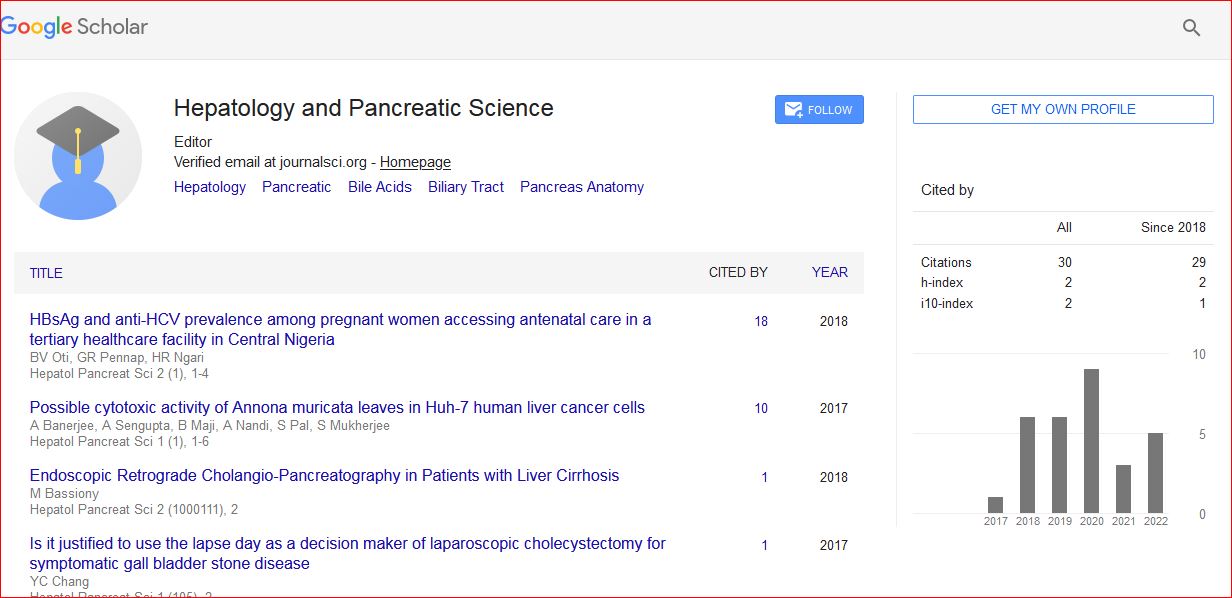
Hepatology and Pancreatic Science received 34 citations as per Google Scholar report