Brief Report - (2025) Volume 10, Issue 2
Received: 01-Apr-2025, Manuscript No. arwm-26-182704;
Editor assigned: 03-Apr-2025, Pre QC No. P-182704;
Reviewed: 17-Apr-2025, QC No. Q-182704;
Revised: 22-Apr-2025, Manuscript No. R-182704;
Published:
29-Apr-2025
Citation: Gonzalez, Maria. ”Waste-to-Energy: A Sustainable Resource Recovery Solution.” Advances in Recycling & Waste Management 10 (2025):394.
Copyright: © 2025 Gonzalez M. This is an open-access article distributed under the terms of the Creative Commons Attribution License, which permits unrestricted use, distribution and reproduction in any medium, provided the original author and source are credited.
Waste-to-energy (WTE) technologies represent a significant advancement in the comprehensive management of municipal solid waste (MSW), offering a dual approach that addresses both waste disposal challenges and the generation of renewable energy sources. These technologies provide substantial environmental benefits, primarily through the reduction of reliance on landfilling and the mitigation of greenhouse gas emissions, while also presenting economic advantages through energy recovery [1].
Advanced WTE methodologies, encompassing processes such as incineration with energy recovery, gasification, and pyrolysis, are critical for optimizing resource recovery and aligning with the principles of a circular economy. These advanced techniques facilitate the extraction of valuable materials and energy from waste streams, thereby minimizing waste sent to landfills and maximizing resource utilization [1].
The economic viability of WTE projects is intrinsically linked to a variety of factors, including the specific composition of the waste stream, the overall operational efficiency of the facility, prevailing energy prices, and the presence of supportive policy frameworks. While the initial capital investment for WTE facilities can be considerable, the long-term operational savings and the revenue generated from energy sales can render these projects economically attractive [1].
Environmental considerations are paramount in the successful implementation of WTE technologies. This necessitates careful management of air emissions, the responsible disposal of ash byproducts, and efficient water usage to minimize any potential negative impacts on the surrounding environment and ecosystems [1].
Research into the environmental performance of WTE plants has focused on evaluating air pollutant emissions, with particular attention given to substances like dioxins, furans, and heavy metals, especially from advanced thermal treatment processes. The deployment of modern pollution control technologies is emphasized as crucial for adhering to stringent environmental regulations [2].
A significant environmental benefit derived from WTE is the quantifiable reduction in greenhouse gas (GHG) emissions, achieved by substituting fossil fuels with energy generated from waste. This contribution is vital for global climate change mitigation efforts, making WTE a key component of sustainable energy strategies [2].
To comprehensively assess the environmental footprint of WTE systems, Life Cycle Assessment (LCA) has been identified as an invaluable tool. LCA enables a holistic evaluation of environmental impacts across the entire lifecycle of WTE, from waste input to energy output and byproduct management [2].
The economic dimension of WTE facilities involves a detailed analysis of financial feasibility, considering diverse revenue streams and cost components. Key economic drivers include tipping fees charged for waste disposal, revenue from the sale of electricity and heat, and the potential to earn carbon credits, all of which contribute to project profitability [3].
Plasma gasification stands out as an advanced WTE technology with a remarkable ability to process a wide spectrum of waste streams, including hazardous materials, while achieving high conversion efficiencies and minimizing the formation of pollutants. Its potential for efficient energy recovery and economic benefits, particularly in syngas production, makes it a compelling alternative to conventional incineration [4].
The integration of WTE technologies within the broader framework of a circular economy is a critical aspect of modern waste management. This approach emphasizes resource recovery and waste valorization, moving away from linear economic models towards more sustainable, closed-loop systems that minimize waste and maximize the value derived from materials [5].
Waste-to-energy (WTE) technologies offer a multifaceted solution for managing municipal solid waste (MSW), simultaneously tackling the growing issue of waste disposal and contributing to the generation of renewable energy. The dual environmental and economic benefits are significant, primarily through reducing the dependence on landfills and lowering greenhouse gas emissions. Advanced WTE methods such as incineration with energy recovery, gasification, and pyrolysis are instrumental in resource recovery and supporting circular economy principles. The economic feasibility of these projects is influenced by factors like waste stream composition, operational efficiency, energy prices, and policy support. Although initial capital costs can be high, long-term operational savings and revenue from energy sales can make WTE projects economically attractive. Careful management of air emissions, ash disposal, and water usage is essential to minimize negative environmental impacts [1].
Examining the environmental performance of WTE plants is crucial, with a focus on air pollutant emissions, particularly dioxins, furans, and heavy metals, from advanced thermal treatment processes. The implementation of modern pollution control technologies is vital for meeting stringent environmental regulations. WTE's role in reducing greenhouse gas (GHG) emissions by displacing fossil fuels with WTE-derived energy contributes significantly to climate change mitigation. Life cycle assessment (LCA) is a valuable tool for a comprehensive evaluation of the environmental footprint of WTE systems [2].
An economic analysis of WTE facilities delves into their financial feasibility, considering various revenue streams and cost components. This includes the impact of tipping fees, electricity and heat sales, and potential carbon credits on project profitability. Different WTE technologies, such as incineration, gasification, and anaerobic digestion, have varying impacts on capital and operational expenditures. Policy incentives and regulatory frameworks are identified as key drivers for attracting investment and ensuring the long-term economic sustainability of WTE projects [3].
Plasma gasification represents an advanced WTE technology capable of handling diverse waste streams, including hazardous materials, with high conversion efficiency and minimal pollutant formation. It offers significant energy recovery potential and economic benefits compared to conventional incineration, particularly through syngas production for power generation or fuel synthesis. Environmental advantages include the inert nature of the slag byproduct and reduced emissions [4].
The circular economy framework strongly supports WTE technologies by emphasizing resource recovery and waste valorization, moving away from linear 'take-make-dispose' models. WTE can be integrated with other waste management strategies like recycling and composting to optimize material and energy recovery. The economic implications of a circular economy approach, including job creation and reduced reliance on virgin resources, are significant. Environmental benefits are evident in reduced landfill burden and minimized resource depletion [5].
Advanced pyrolysis for WTE applications, specifically for municipal solid waste (MSW), involves a techno-economic analysis evaluating energy output, bio-oil quality, and syngas composition. Economic feasibility is assessed by considering capital investment, operating costs, and revenue from the sale of pyrolysis products and energy. Environmental aspects such as reduced greenhouse gas emissions and the potential for waste material valorization highlight pyrolysis's advantages over traditional waste management methods [6].
Anaerobic digestion (AD) plays a crucial role in WTE systems for organic waste valorization, focusing on the production of biogas (primarily methane) and digestate. Environmental benefits include GHG emission reduction and nutrient recycling through digestate application. Economic aspects involve revenue from biogas sales, potential digestate valorization, and overall cost-effectiveness, especially in decentralized settings [7].
A comparative analysis of different WTE technologies, including incineration, gasification, and anaerobic digestion, reveals their environmental and economic trade-offs. This evaluation assesses energy recovery efficiency, GHG emission profiles, and air quality impacts. The economic assessment covers capital costs, operational and maintenance expenses, and revenue generation potential, indicating that the optimal technology choice depends on local waste characteristics, policy support, and market conditions [8].
Policy and regulatory frameworks significantly influence the adoption and performance of WTE technologies. Incentives like feed-in tariffs, tax credits, and renewable portfolio standards can enhance the economic viability of WTE projects. Environmental regulations, particularly concerning emissions control and landfill diversion targets, are crucial drivers for WTE implementation. Stable and supportive policies are essential for fostering investment and ensuring the long-term success of WTE initiatives [9].
Lifecycle assessment (LCA) of WTE systems evaluates environmental impacts from waste collection to energy generation and ash disposal. It quantifies GHG emissions, acidification potential, and eutrophication potential for various WTE technologies. The economic implications of different waste management pathways, including landfilling, recycling, and WTE, are considered to inform decision-making for sustainable waste management. A comprehensive lifecycle perspective is vital for accurately assessing WTE's environmental performance [10].
Waste-to-energy (WTE) technologies offer a dual benefit of managing municipal solid waste while generating renewable energy. Advanced methods like incineration, gasification, and pyrolysis are key to resource recovery and circular economy principles. Economic viability depends on factors such as waste composition, operational efficiency, energy prices, and policy support, with potential long-term attractiveness despite initial high capital costs. Environmental considerations include careful management of emissions and byproducts. WTE contributes to greenhouse gas emission reduction by displacing fossil fuels. Life Cycle Assessment (LCA) is a crucial tool for evaluating WTE's environmental footprint. Plasma gasification and pyrolysis show promise for efficient waste conversion and energy generation. Anaerobic digestion is important for organic waste valorization. Policy and regulatory frameworks play a vital role in the successful adoption and performance of WTE projects. Ultimately, the choice of WTE technology depends on local conditions and market factors.
None
None
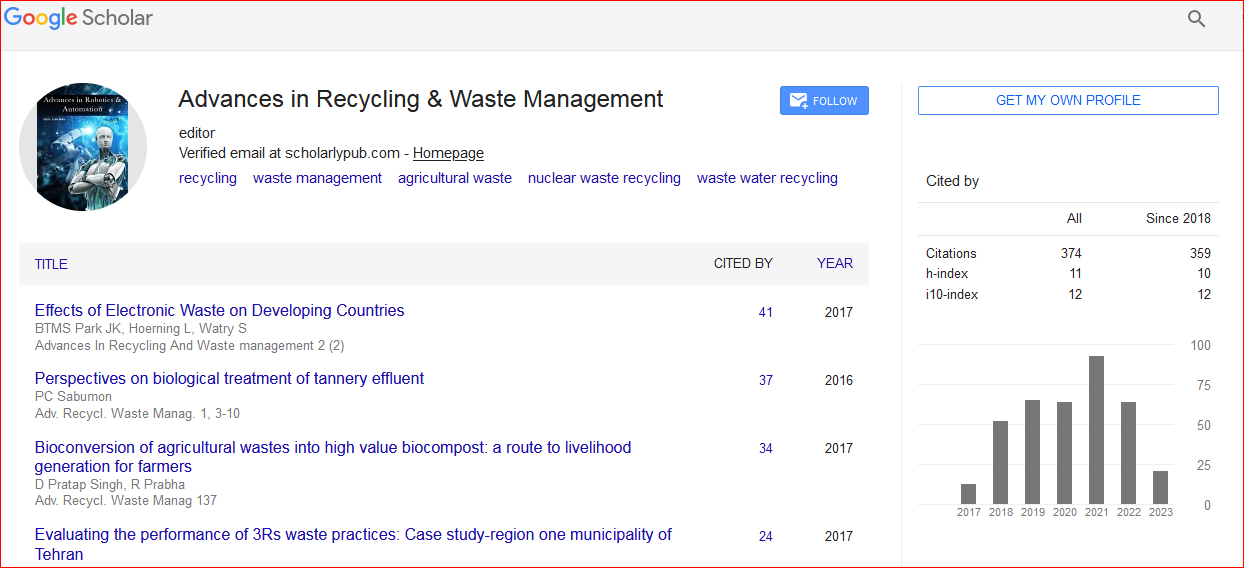
Advances in Recycling & Waste Management received 438 citations as per Google Scholar report