Brief Report - (2025) Volume 16, Issue 6
Received: 01-Dec-2025, Manuscript No. jfr-26-184129;
Editor assigned: 03-Dec-2025, Pre QC No. P-184129;
Reviewed: 17-Dec-2025, QC No. Q-184129;
Revised: 22-Dec-2025, Manuscript No. R-184129;
Published:
29-Dec-2025
, DOI: 10.37421/2157-7145.2025.16.690
Citation: Santis, Marco De. ”Science Combats Wildlife Crime
Through Forensic Analysis.” J Forensic Res 16 (2025):690.
Copyright: © 2025 Santis D. Marco This is an open-access article distributed under the terms of the Creative Commons Attribution License, which permits unrestricted use,
distribution and reproduction in any medium, provided the original author and source are credited.
Animal forensics has emerged as an indispensable discipline in the global effort to combat wildlife crime, providing the scientific backbone for linking illicit activities to concrete evidence. The field leverages a diverse array of scientific disciplines to meticulously identify species, pinpoint their geographical origins, and establish definitive causal links in a wide spectrum of cases, including poaching, illegal wildlife trade, and environmental contamination. Advanced methodologies, such as sophisticated DNA analysis, stable isotope analysis, and trace element profiling, are pivotal in furnishing irrefutable evidence that is essential for successful prosecution, thereby significantly bolstering conservation initiatives worldwide.
DNA barcoding and the development of species-specific polymerase chain reaction (PCR) assays represent fundamental molecular tools for the accurate identification of animal species from various biological samples. These samples can range from minute hair strands and blood traces to larger tissue fragments. The ability of these molecular methods to unambiguously identify species involved in illegal trade or consumption is critical for providing vital evidence in legal proceedings and for strengthening enforcement actions against the pervasive threat of biodiversity crime. Stable isotope analysis (SIA), focusing on isotopes of carbon, nitrogen, oxygen, and hydrogen within animal tissues, offers profound insights into an animal's geographical origin and its dietary habits. This analytical technique proves invaluable in tracing the provenance of illegally harvested wildlife products, such as ivory or timber. By comparing the isotopic ratios found in seized samples with established geographic reference databases, the origin can be precisely determined. Trace element analysis, frequently conducted using advanced techniques like Inductively Coupled Plasma Mass Spectrometry (ICP-MS), serves as a powerful method for fingerprinting the environmental origin of wildlife samples. Subtle variations in soil and water composition are directly reflected in the trace element profiles of animals. This allows for the crucial discrimination between animals originating from different geographical regions, thereby facilitating their link to specific crime scenes or trafficking routes. Forensic entomology, a specialized branch of entomology dedicated to legal investigations, can yield crucial information in cases involving animal carcasses or remains. The identification of specific insect species found on a carcass, along with an assessment of their developmental stages, can provide vital estimations of the post-mortem interval. Furthermore, this can potentially link suspects directly to the crime scene. The comprehensive analysis of both morphometric and molecular data derived from seized wildlife products plays a crucial role in identifying the species involved and assessing the scale of illegal trade. Combining detailed morphological examination with precise DNA analysis offers a more robust and reliable approach to confirming species identity, particularly when dealing with processed or fragmented materials where visual identification may be challenging. Environmental DNA (eDNA) analysis is rapidly emerging as a potent and innovative tool within the realm of wildlife forensics. This technique enables the detection of species from non-invasive samples, such as water or soil collected from a location. It can be effectively employed to identify species present at a crime scene or to confirm the origin of wildlife products by detecting residual DNA traces. The application of forensic chemistry within the context of wildlife crime investigations is vital for analyzing chemical residues. These residues, which may include pesticides or various pollutants, can often be directly linked to illegal activities such as the deliberate poisoning of wildlife or the destruction of natural habitats. Identifying and quantifying these substances provides direct evidence of criminal intent and the perpetration of illegal acts. Forensic analysis of digital evidence is becoming increasingly paramount in effective wildlife crime investigations. This encompasses the meticulous examination of metadata from digital photographs, GPS data embedded in devices, and online communications. Such analysis is crucial for tracking illegal activities, identifying perpetrators, and compiling compelling evidence of trafficking operations. The integration of multiple forensic disciplines, including genetics, stable isotope analysis, and trace element analysis, offers a holistic and comprehensive strategy for tackling wildlife crime. This multi-faceted approach significantly strengthens the evidence presented in legal proceedings, leading to more effective prosecutions and contributing substantially to the protection of endangered species globally.Animal forensics represents a critical scientific domain dedicated to the investigation of wildlife crime, utilizing scientific principles to connect illegal activities with tangible evidence. This field synthesizes a broad spectrum of scientific disciplines to accurately identify animal species, ascertain their geographical origins, and establish causal relationships in cases involving poaching, illicit trade, and environmental contamination. Sophisticated techniques such as DNA analysis, stable isotope analysis, and trace element profiling are instrumental in providing irrefutable evidence for legal proceedings, thereby supporting vital conservation efforts.
Molecular biology techniques, specifically DNA barcoding and the development of species-specific PCR assays, are fundamental for the precise identification of animal species from biological samples like hair, blood, and tissue. These molecular methods allow for the unambiguous identification of species involved in illegal trade or consumption, providing critical evidence for legal cases and bolstering enforcement actions against biodiversity crime. Stable isotope analysis (SIA) of carbon, nitrogen, oxygen, and hydrogen isotopes in animal tissues provides valuable information about an animal's geographical origin and dietary patterns. This technique is exceptionally useful in tracing the provenance of illegally harvested wildlife products, such as ivory or timber, by comparing the isotopic signatures of seized samples with established geographical reference data. Trace element analysis, often performed using advanced instrumentation like Inductively Coupled Plasma Mass Spectrometry (ICP-MS), is employed to fingerprint the environmental origin of wildlife samples. Variations in local soil and water chemistry are reflected in the trace element composition of animals, enabling the differentiation of animals from various geographical regions and thus linking them to specific crime scenes or trafficking routes. Forensic entomology, the study of insects in legal investigations, can provide crucial temporal and spatial information in cases involving animal carcasses or remains. The identification of insect species present on a carcass, along with their developmental stages, can aid in estimating the time since death and potentially connecting suspects to the crime scene. The examination of morphometric characteristics and molecular data from seized wildlife products is vital for species identification and for assessing the scope of illegal trade. Combining detailed morphological analysis with DNA sequencing offers a more comprehensive and reliable method for confirming species identity, especially when dealing with processed or fragmented specimens. Environmental DNA (eDNA) analysis is an emerging and powerful tool in wildlife forensics, capable of detecting species from non-invasive samples like water or soil. This technique can be used to identify species present at a particular location, such as a crime scene, or to confirm the origin of wildlife products by detecting residual DNA. Forensic chemistry plays a significant role in wildlife crime investigations by analyzing chemical residues, such as pesticides or pollutants, that may be associated with illegal activities like wildlife poisoning or habitat destruction. The identification and quantification of these substances can provide direct evidence of criminal intent and actions. The forensic analysis of digital evidence has become increasingly important in investigating wildlife crimes. This involves examining metadata from photographs, GPS data from devices, and online communications to trace illegal activities, identify perpetrators, and gather evidence related to trafficking networks. The integration of multiple forensic disciplines, including genetics, stable isotopes, and trace element analysis, provides a robust and multifaceted approach to wildlife crime investigations. This synergistic approach strengthens the evidence presented in court, leading to more effective prosecutions and contributing to enhanced protection of endangered species.Animal forensics employs diverse scientific disciplines to combat wildlife crime by scientifically linking illegal activities to tangible evidence. Key techniques include DNA analysis for species identification, stable isotope analysis for geographical origin and diet, and trace element analysis for environmental fingerprinting. Forensic entomology aids in estimating post-mortem intervals, while morphometric and molecular data confirm species identity. Emerging tools like environmental DNA (eDNA) analysis offer non-invasive detection, and forensic chemistry analyzes chemical residues linked to illegal acts. Digital forensics is also crucial for tracking activities and identifying perpetrators. Integrating these multiple disciplines provides a comprehensive approach to strengthen evidence for prosecutions and conservation efforts.
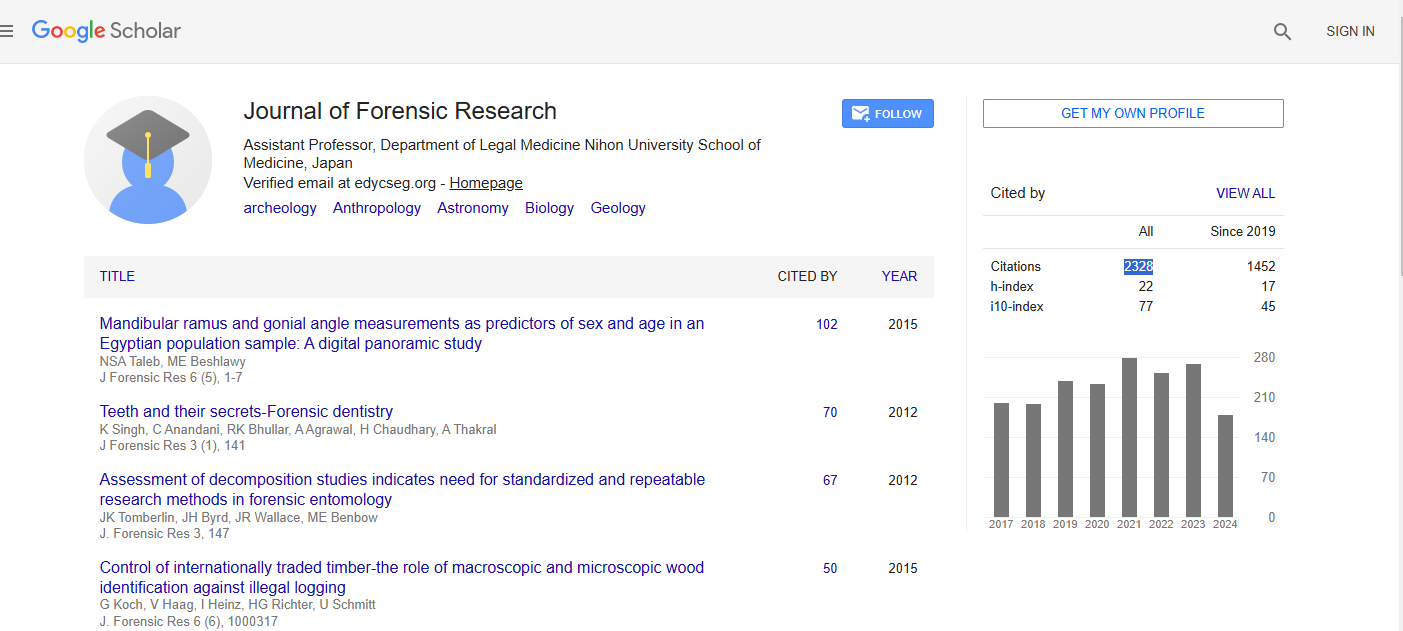
Journal of Forensic Research received 2328 citations as per Google Scholar report