Perspective - (127) Volume 14, Issue 2
Received: 02-Jun-2025, Manuscript No. ara-25-175574;
Editor assigned: 04-Jun-2025, Pre QC No. P-175574;
Reviewed: 18-Jun-2025, QC No. Q-175574;
Revised: 23-Jun-2025, Manuscript No. R-175574;
Published:
30-Jun-2025
, DOI: 10.37421/2168-9695.2025.14.329
Citation: Al-Khalidi, Victor. ”Robotic Manipulator Control, Learning, Safe Operation.” Adv Robot Autom 14 (2025):329.
Copyright: © 2025 Al-Khalidi V. This is an open-access article distributed under the terms of the Creative Commons Attribution License, which permits unrestricted use, distribution and reproduction in any medium, provided the original author and source are credited.
The advancement of robotic manipulators is crucial for various industries, necessitating sophisticated control strategies and intelligent behaviors for complex tasks and dynamic environments. A key focus involves achieving precise motion control under challenging conditions. For instance, an adaptive trajectory tracking approach tackles the complexities of controlling redundant robotic manipulators. This method effectively addresses unknown system dynamics and input constraints, ensuring precise motion while keeping control signals within practical limits, which is vital for real-world robot operations [1].
Beyond basic control, enabling robots to operate safely in unpredictable settings is paramount. Learning-based methods offer a solution for robotic manipulators to avoid collisions in dynamic environments. These smart algorithms allow robots to learn from experience, adapting their movements in real-time to prevent contact with moving obstacles, significantly improving both safety and operational flexibility [2].
Maintaining stable and precise performance, especially in the presence of external disturbances, is another critical area. Robust control strategies have been developed for robotic manipulators operating in task-space. These strategies integrate impedance shaping for compliant interaction and gravity compensation, creating a system capable of handling external disturbances and maintaining stability during precise and adaptive robot tasks [3].
The ability for robots to acquire complex skills efficiently often involves leveraging human expertise. Imitation learning plays a central role in transferring skills from humans to robotic manipulators. A survey on this topic covers various techniques that enable robots to learn intricate tasks by observing human demonstrations, which is fundamental for progressing human-robot collaboration and autonomous skill acquisition [4].
For more complex scenarios involving multiple robots, coordination and learning are essential. Reinforcement learning has been extensively applied to multi-robot manipulation tasks. This review explores how multiple robotic manipulators can cooperatively learn to perform complex actions, highlighting key methods and challenges in achieving coordinated, intelligent behavior across several robots [5].
Addressing the unique challenges of specific robot designs, such as flexible link manipulators, is also an important research direction. Kinematic control of flexible link manipulators with bounded input torque ensures precise motion control for these compliant robots. This is crucial for operations in delicate or constrained environments, preventing the system from exceeding actuator capabilities [6].
To enhance autonomy and adaptability in dynamic and unstructured environments, robots need to perceive their surroundings effectively. Vision-based control for robotic manipulators utilizes camera feedback to guide robot movements. This survey covers diverse techniques that employ visual information, enabling robots to perform tasks with greater independence and adaptability [7].
The broader application of intelligent techniques like Machine Learning continues to transform robotics. Machine Learning techniques are applied to understand and control the kinematics and dynamics of robotic manipulators. This overview explores various algorithms that enhance a robot's ability to model, predict, and execute complex motions more efficiently and intelligently [8].
Further refining control for specific mechanical properties, robust task-space impedance control methods are proposed for redundant manipulators with flexible joints. This offers a way to precisely control robot interaction with its environment while accounting for inherent structural flexibility, which is key for safe and compliant human-robot collaboration [9].
Finally, ensuring safe and efficient operation in dynamic, cluttered workspaces requires sophisticated planning and execution. Real-time trajectory planning and tracking for robotic manipulators, incorporating robust obstacle avoidance, describes methods that allow robots to dynamically plan collision-free paths and execute them precisely. This is fundamental for safe and efficient operation in complex environments [10].
These advancements collectively push the boundaries of robotic capabilities, enabling them to perform more intricate, safer, and autonomous tasks across a wide array of applications.
The field of robotic manipulators is undergoing rapid evolution, driven by the demand for greater autonomy, precision, and adaptability in diverse operational contexts. This body of research highlights critical advancements across control theory, Machine Learning, and human-robot interaction. Central to this progress are innovative control strategies designed to address the inherent complexities of robotic systems. One such strategy involves adaptive trajectory tracking for redundant manipulators, which adeptly handles unknown system dynamics and input constraints. This ensures that robots can execute precise movements while adhering to operational limits, a fundamental requirement for practical applications [1].
Developing robust task-space control has been crucial for managing external disturbances. By integrating impedance shaping and gravity compensation, these systems maintain stable performance, enabling robots to undertake precise and adaptive tasks effectively [3]. The specialized area of kinematic control for flexible link manipulators also sees progress, with methods tailored to manage bounded input torque. This is vital for controlling compliant robots in delicate or constrained settings without over-stressing actuators [6]. Lastly, robust task-space impedance control for redundant manipulators with flexible joints marks another significant step, providing precise interaction control while accommodating structural flexibility, which is key for safe and compliant human-robot collaboration [9].
A parallel and equally vital area of development centers on incorporating Artificial Intelligence and learning capabilities into robotic manipulators. Learning-based methods, for example, are proving highly effective for collision avoidance in dynamic environments. These intelligent algorithms allow robots to learn and adapt their movements in real-time, proactively preventing contact with moving obstacles and thereby enhancing both safety and operational fluidity [2]. Expanding on this, the transfer of skills from humans to robots through imitation learning is gaining traction. This approach involves robots learning complex tasks by observing human demonstrations, laying the groundwork for more intuitive human-robot collaboration and accelerating autonomous skill acquisition [4]. When multiple robots are involved, coordination becomes a major challenge. Reinforcement Learning is actively explored for cooperative multi-robot manipulation tasks, where several manipulators learn to perform complex actions together, leading to more coordinated and intelligent multi-robot behaviors [5]. A broader look at how Machine Learning influences robotics reveals its application across kinematics and dynamics. Various algorithms are enhancing a robot's ability to model, predict, and execute complex motions more efficiently and intelligently [8].
To enable robots to perceive and interact intelligently with their surroundings, vision-based control has emerged as a powerful tool. This domain encompasses diverse techniques that leverage camera feedback to guide robot movements. By processing visual information, robots gain enhanced autonomy and adaptability, particularly in dynamic and unstructured environments where direct programming of every scenario is impractical [7]. This visual intelligence, combined with sophisticated planning, underpins a new generation of robotic capabilities.
Real-time trajectory planning and tracking, coupled with robust obstacle avoidance, forms the bedrock of safe and efficient robot operation in complex workspaces. These methods allow robotic manipulators to dynamically compute and execute collision-free paths with precision. Such capabilities are fundamental for deploying robots in cluttered, unpredictable environments, ensuring both safety and task completion [10]. The culmination of these research effortsâ??spanning adaptive control, Machine Learning, sensory perception, and intelligent planningâ??is creating robotic manipulators that are not only more capable but also safer, more reliable, and better equipped to collaborate with humans and operate autonomously in increasingly complex scenarios.
Recent research in robotic manipulators highlights significant progress in achieving precise control, adaptability, and safe operation in complex environments. One area focuses on advanced control strategies, including adaptive trajectory tracking for redundant manipulators to handle unknown dynamics and input constraints, ensuring precise motion within limits. Robust task-space control methods, incorporating impedance shaping and gravity compensation, enhance stability and manage external disturbances. For flexible link manipulators, kinematic control with bounded input torque is crucial for delicate operations. Further, robust task-space impedance control addresses redundant manipulators with flexible joints, vital for safe human-robot collaboration. Another major theme involves learning-based approaches. Learning-based methods are explored for collision avoidance in dynamic environments, enabling robots to adapt movements in real-time. Imitation learning facilitates human-robot skill transfer, allowing robots to learn complex tasks from human demonstrations. Reinforcement Learning is applied to cooperative multi-robot manipulation, fostering coordinated, intelligent behavior across multiple units. Machine Learning broadly enhances understanding and control of robot kinematics and dynamics, improving modeling, prediction, and execution of complex motions. Vision-based control techniques use camera feedback to guide robot movements, promoting greater autonomy and adaptability in unstructured settings. Real-time trajectory planning and tracking with robust obstacle avoidance are also fundamental for safe and efficient operation in cluttered workspaces. Collectively, these studies advance robotic capabilities across various domains, from individual robot precision to multi-robot collaboration and interaction with dynamic surroundings.
None
None
Long L, Haipeng R, Huanyu L. "Adaptive Trajectory Tracking Control for Redundant Manipulators with Unknown Dynamics and Input Constraints".IEEE Trans Cybern 53 (2023):7087-7098.
Indexed at, Google Scholar, Crossref
Wenjie S, Guohua Z, Yuchao W. "Learning-Based Collision Avoidance for Robotic Manipulators in Dynamic Environments".IEEE/ASME Trans Mechatron 27 (2022):4429-4439.
Indexed at, Google Scholar, Crossref
Min H, Zhenhua L, Xiaojun S. "Robust Task-Space Control of Robotic Manipulators with Impedance Shaping and Gravity Compensation".Mech Mach Theory 155 (2021):104212.
Indexed at, Google Scholar, Crossref
Jiaqi L, Yuwei F, Shuguo W. "Towards Human-Robot Skill Transfer: A Survey on Imitation Learning for Robotic Manipulators".IEEE Trans Human-Machine Syst 53 (2023):742-756.
Indexed at, Google Scholar, Crossref
Zhenqi C, Zhicheng L, Qingsong W. "Reinforcement Learning for Cooperative Multi-Robot Manipulation: A Review".Robot Comput Integr Manuf 74 (2022):102425.
Indexed at, Google Scholar, Crossref
Jian Y, Li Y, Yamin L. "Kinematic Control of Flexible Link Manipulators With Bounded Input Torque".IEEE Trans Robot 39 (2023):1308-1320.
Indexed at, Google Scholar, Crossref
Bo X, Weihai M, Qiyuan S. "A Survey on Vision-Based Control for Robotic Manipulators".Sensors 22 (2022):5799.
Indexed at, Google Scholar, Crossref
Mohamed EM, Amr S, Ahmed G. "Review of Machine Learning in Kinematics and Dynamics of Robotic Manipulators".Machines 9 (2021):164.
Indexed at, Google Scholar, Crossref
Tao L, Yun-hui L, Kai-bo Y. "Robust Task-Space Impedance Control for Redundant Manipulators With Flexible Joints".IEEE/ASME Trans Mechatron 25 (2020):44-55.
Indexed at, Google Scholar, Crossref
Ming C, Kai Z, Wenyan Z. "Real-Time Trajectory Planning and Tracking for Robotic Manipulators with Obstacle Avoidance".Eng Appl Artif Intell 128 (2024):107025.
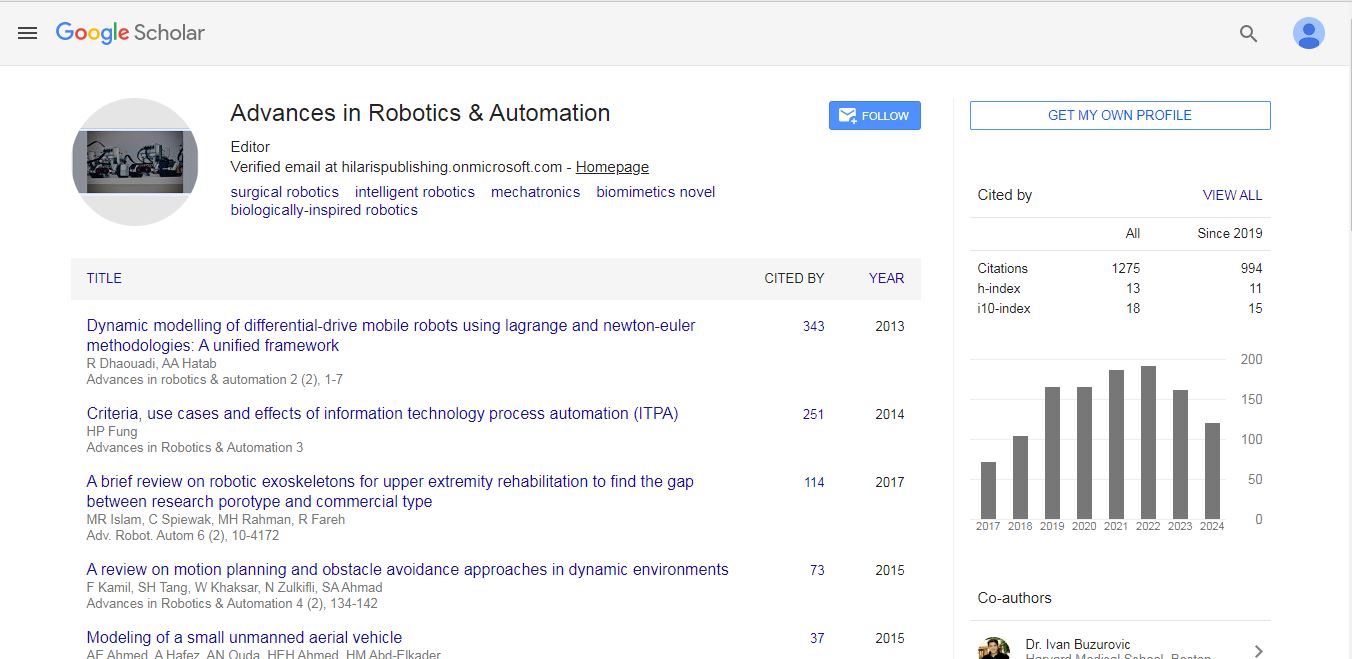
Advances in Robotics & Automation received 1275 citations as per Google Scholar report