Commentary - (127) Volume 14, Issue 4
Received: 01-Dec-2025, Manuscript No. ara-25-175629;
Editor assigned: 03-Dec-2025, Pre QC No. P-175629;
Reviewed: 17-Dec-2025, QC No. Q-175629;
Revised: 22-Dec-2025, Manuscript No. R-175629;
Published:
29-Dec-2025
, DOI: 10.37421/2168-9695.2025.14.347
Citation: Amezawa, Ryo. ”Robot Dynamics: Learning, Control, Collaboration.” Adv Robot Autom 14 (2025):347.
Copyright: © 2025 A. Ryo This is an open-access article distributed under the terms of the Creative Commons Attribution License, which permits unrestricted use, distribution and reproduction in any medium, provided the original author and source are credited.
Robotic systems are increasingly complex, demanding advanced control strategies that integrate human intelligence for better performance and adaptability. Human-in-the-loop control is one such area, thoroughly examining how human decision-making can be seamlessly integrated with autonomous control to enhance system capabilities. This approach is particularly valuable in tasks needing nuanced interaction or when unexpected problems arise, covering everything from shared autonomy to full human-robot collaboration paradigms [1].
Beyond human integration, improving the robustness of robot dynamics is fundamental. Learning-based adaptive control methods address this by leveraging Machine Learning to adapt to uncertainties and disturbances. These techniques provide stable and precise control, making robots reliable across varied operational conditions, which is essential for sophisticated robotic applications [2].
Real-time identification of robot dynamics is another critical area, especially for high-performance control. One method involves integrating force/torque sensor data with Machine Learning algorithms. This allows for accurate and rapid updates of dynamic models, a crucial capability for robots interacting with unpredictable environments [3].
For robotic manipulators, maintaining accurate trajectory tracking amidst significant uncertainties is a constant challenge. Researchers have introduced novel robust adaptive control strategies specifically designed for this purpose. These strategies enhance tracking accuracy and system stability, ensuring dependable operation in complex and dynamic industrial settings [4].
The ability of robots to learn their dynamics in real-time, especially in unknown environments, is transforming their operational flexibility. A data-driven model approach allows robots to quickly adapt their dynamic models to changing conditions. This enables more intelligent behavior without requiring prior knowledge of the environment [5].
As robots become more prevalent in shared workspaces, understanding human-robot interaction dynamics is vital for effective collaboration. Studies investigate learning these dynamics to improve collaborative manipulation tasks. The goal is to develop methods for robots to predict and adapt to human intentions and actions, fostering natural partnerships while enhancing safety and efficiency [6].
Advancements in robotic manipulation are also being made by combining Model Predictive Control with Deep Learning for dynamics estimation. This integration leads to more accurate and proactive control decisions, particularly in dynamic and uncertain environments, ultimately improving task performance and adaptability [7].
Furthermore, robotic systems often operate under specific state and input constraints. Hybrid Model Predictive Control strategies have been developed to manage complex system dynamics effectively while adhering to these operational limits. This ensures safe and efficient robot operation, especially in scenarios with various physical restrictions [8].
A broader understanding of how robots handle unknown dynamics is provided by surveys that review data-driven learning control methods. These methods enable robots to learn and adapt their control strategies directly from data. Such techniques are invaluable for tasks in unstructured environments where precise models are difficult to obtain or simply unavailable [9].
Finally, the unique challenges of soft robots, with their complex and highly deformable dynamics, are being addressed through Deep Reinforcement Learning. This advanced learning technique opens up new possibilities for adaptive and compliant behaviors in challenging applications, pushing the boundaries of what soft robots can achieve [10].
The evolution of robotic systems continues to demand sophisticated control mechanisms capable of handling intricate tasks, interacting with humans, and operating effectively in unpredictable environments. A central theme across recent research is the integration of advanced learning techniques and intelligent control strategies to address these complexities. Traditional control methods often struggle with dynamic uncertainties or the lack of complete environmental models, which is where modern approaches, especially those drawing from Artificial Intelligence (AI) and Machine Learning (ML), offer significant advantages. These methodologies are crucial for pushing the boundaries of robotic capabilities, enabling them to perform with greater autonomy, precision, and adaptability. The field explores everything from human integration to specialized control for novel robot morphologies, all contributing to a more capable generation of robots.
A core focus involves learning and identifying robot dynamics in real-time. For instance, methods have been developed to identify robot dynamics by integrating force/torque sensor data with Machine Learning algorithms, enabling accurate and rapid dynamic model updates essential for high-performance robot control, particularly in unpredictable environments [3]. Further enhancing this, research introduces learning-based adaptive control methods designed to improve the robustness of robot dynamics, utilizing Machine Learning to adapt to uncertainties and disturbances, thereby providing stable and precise control across varied operational conditions [2]. This robustness is further emphasized by novel adaptive control strategies for trajectory tracking in robotic manipulators, which aim to maintain accuracy and system stability even under significant uncertainties, ensuring reliable operation in complex industrial settings [4]. Real-time learning of robot dynamics using data-driven models is also explored for unknown environments, fostering flexible and intelligent robot behavior without requiring prior environmental knowledge [5]. These contributions collectively underscore the importance of dynamic model adaptation for superior robot performance.
The integration of humans into robotic control loops is also gaining prominence. Human-in-the-loop control is thoroughly examined for intricate robotic systems, highlighting how integrating human decision-making with autonomous control enhances system performance and adaptability, especially in tasks demanding nuanced interaction or unforeseen problem-solving [1]. This includes exploring various aspects, from shared autonomy to full human-robot collaboration paradigms. Complementing this, research investigates learning the dynamics of human-robot interaction to improve collaborative manipulation tasks. This involves developing methods for robots to predict and adapt to human intentions and actions, fostering more natural and effective partnerships in shared workspaces while enhancing safety and efficiency [6]. Such developments are vital for future applications where humans and robots must work closely and intuitively.
Advanced control techniques, particularly those leveraging Model Predictive Control (MPC) and Deep Learning, are significantly improving robotic manipulation and control. For example, methods propose enhancing robotic manipulation by combining Model Predictive Control with Deep Learning for dynamics estimation, allowing for more accurate and proactive control decisions, especially in dynamic and uncertain environments, leading to better task performance and adaptability [7]. Furthermore, hybrid Model Predictive Control strategies are introduced for robotic systems, specifically addressing state and input constraints, effectively managing complex system dynamics while adhering to operational limits to ensure safe and efficient operation [8]. Beyond this, data-driven learning control methods for robotic systems with unknown dynamics are being surveyed, covering techniques that enable robots to learn and adapt their control strategies from data, proving invaluable for tasks in unstructured environments where precise models are unavailable [9]. This extends to specialized applications such as Deep Reinforcement Learning for the dynamic control of soft robots, which tackles their complex, highly deformable dynamics to enable new possibilities for adaptive and compliant behaviors in challenging applications [10]. These diverse control strategies collectively pave the way for highly adaptive and intelligent robotic systems.
Current research in robotics focuses heavily on enhancing control, dynamics, and adaptability through advanced learning techniques and human integration. One significant area involves human-in-the-loop control, which merges human decision-making with autonomous systems to boost performance and handle complex tasks or unforeseen problems. This approach is vital for systems requiring nuanced interaction and shared autonomy. Complementing this is the development of learning-based adaptive control methods that improve the robustness of robot dynamics, allowing robots to maintain stability and precision despite uncertainties and disturbances. Real-time identification of robot dynamics is another crucial aspect, often achieved by integrating force/torque sensor data with Machine Learning. This enables quick and accurate model updates, essential for robots operating in unpredictable environments. Building on this, novel robust adaptive control strategies are emerging for trajectory tracking in robotic manipulators, specifically designed to handle uncertainties and ensure reliability in industrial settings. Data-driven models are also central to real-time learning of robot dynamics in unknown environments, promoting flexible and intelligent behavior without prior knowledge. The field also explores learning human-robot interaction dynamics, crucial for improving collaborative manipulation tasks. The aim is for robots to predict and adapt to human intentions and actions, fostering more natural and effective partnerships in shared workspaces and enhancing safety and efficiency. Furthermore, Model Predictive Control, combined with Deep Learning, is enhancing robotic manipulation by providing accurate dynamics estimation and proactive control decisions. Hybrid Model Predictive Control strategies specifically address state and input constraints, ensuring safe operation within physical limits. Finally, advanced techniques like Deep Reinforcement Learning are being applied to dynamic control of soft robots, enabling them to manage complex, deformable dynamics for adaptive and compliant behaviors in challenging applications. This collective work points to a future of more intelligent, adaptable, and collaborative robotic systems.
None
None
Peigen L, Jian X, Hao C. "Human-in-the-loop control for complex robotic systems: A comprehensive review".Eng. Appl. Artif. Intell. 127 (2024):107297.
Indexed at, Google Scholar, Crossref
P. AA, H. AKA, M. HA. "Learning-based adaptive control for robust robot dynamics".Robot. Auton. Syst. 167 (2023):104473.
Indexed at, Google Scholar, Crossref
J. MSM, J. ABMO, P. CTATSP. "Real-time identification of robot dynamics with force/torque sensors and machine learning techniques".Measurement 200 (2022):111624.
Indexed at, Google Scholar, Crossref
S. AGOA, H. FA, M. HA. "A novel robust adaptive control strategy for trajectory tracking of robotic manipulators under uncertainties".J. Intell. Robot. Syst. 106 (2022):1-19.
Indexed at, Google Scholar, Crossref
A. MHA, H. AKA, M. HA. "Real-time learning of robot dynamics using a data-driven model for unknown environments".J. King Saud Univ. Eng. Sci. 33 (2021):440-449.
Indexed at, Google Scholar, Crossref
Siyang L, Yifan Z, Hsiu-Fan L. "Learning human-robot interaction dynamics for collaborative manipulation".IEEE Trans. Robot. 37 (2021):1334-1349.
Indexed at, Google Scholar, Crossref
M. RHA, A. FTKA, H. AKA. "Enhancing robotic manipulation through model predictive control and deep learning for dynamics estimation".ISA Trans. 144 (2024):20-30.
Indexed at, Google Scholar, Crossref
J. MC, L. RS, G. RR. "Hybrid Model Predictive Control for Robotic Systems with State and Input Constraints".IFAC-PapersOnLine 56 (2023):5641-5646.
Indexed at, Google Scholar, Crossref
T. SKA, F. A, M. HA. "Data-driven learning control for robotic systems with unknown dynamics: A survey".Robot. Biomimetics 10 (2023):10.
Indexed at, Google Scholar, Crossref
Yuxin S, Jia Y, Mengfei Y. "Deep Reinforcement Learning for Dynamic Control of Soft Robots: A Review".Soft Robot. 9 (2022):1113-1126.
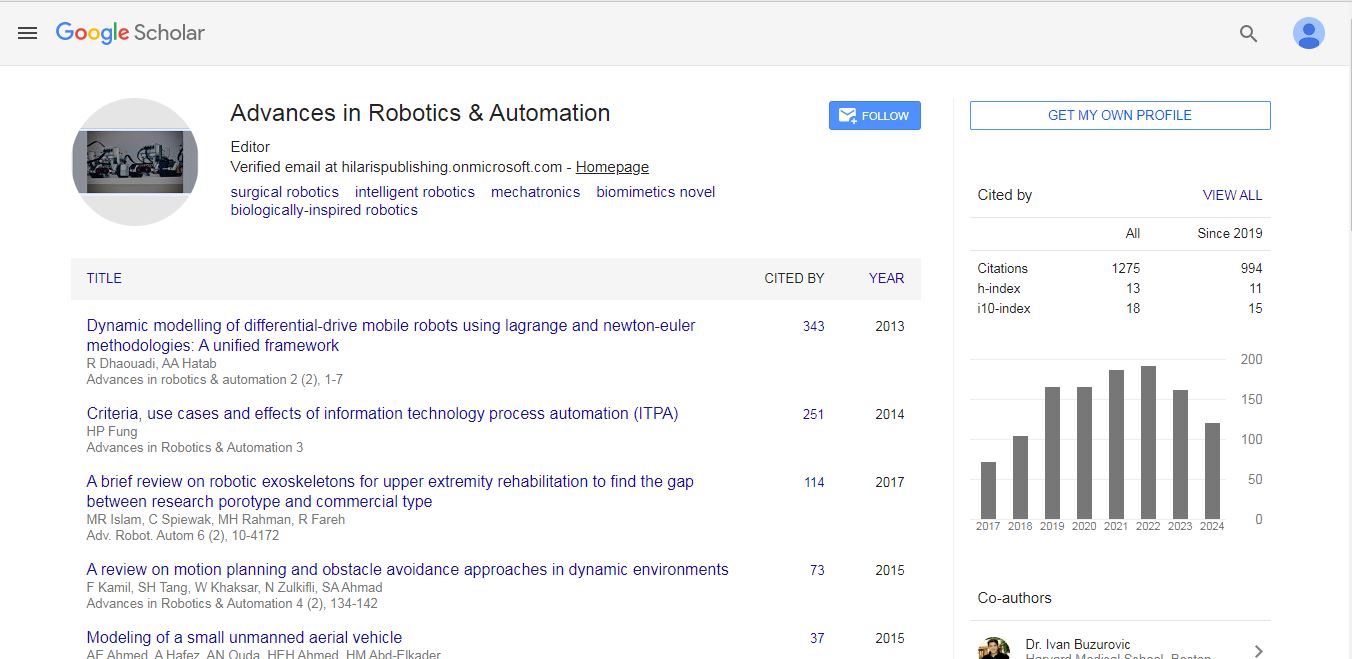
Advances in Robotics & Automation received 1275 citations as per Google Scholar report