Commentary - (2025) Volume 14, Issue 2
Received: 01-Apr-2025, Manuscript No. jbfa-25-174132;
Editor assigned: 03-Apr-2025, Pre QC No. P-174132;
Reviewed: 17-Apr-2025, QC No. Q-174132;
Revised: 22-Apr-2025, Manuscript No. R-174132;
Published:
29-Apr-2025
, DOI: 10.37421/2167-0234.2025.14.522
Citation: Johansson, David. ”Risk Management: Facets, Strategies, Resilience.” J Bus Fin Aff 14 (2025):522.
Copyright: © 2025 Johansson D. This is an open-access article distributed under the terms of the Creative Commons Attribution License, which permits unrestricted use, distribution and reproduction in any medium, provided the original author and source are credited.
This study explores strategies that build resilience in humanitarian supply chains, focusing on operational risks. It highlights how proactive measures and adaptive capacities are crucial for mitigating disruptions and ensuring effective aid delivery in crisis situations, emphasizing the importance of collaboration and robust information flow for managing unforeseen challenges[1].
This survey reviews the application of Machine Learning (ML) techniques in credit risk assessment. It synthesizes current research, highlighting various models and their performance in predicting credit defaults, and discusses challenges and future directions for integrating Artificial Intelligence (AI) into financial risk management to improve decision-making accuracy[2].
This meta-analysis investigates the relationship between Enterprise Risk Management (ERM) implementation and firm performance. It consolidates findings from numerous studies, indicating a generally positive association, and identifies key factors that mediate this relationship, providing insights for organizations aiming to enhance their risk management practices for better outcomes[3].
This systematic review provides a comprehensive overview of existing cybersecurity risk management frameworks. It analyzes their components, methodologies, and applicability across different organizational contexts, offering a guide for practitioners to select and implement appropriate frameworks to protect critical information assets effectively[4].
This systematic review synthesizes research on managing climate-related financial risks, highlighting emerging strategies and tools. It covers topics like scenario analysis, disclosure practices, and integration of climate factors into investment decisions, showing how financial institutions adapt to both physical and transitional risks associated with climate change[5].
This systematic review examines project risk management practices within the construction industry. It identifies prevalent methodologies, tools, and challenges encountered, emphasizing the need for robust risk identification, assessment, and mitigation strategies to improve project success rates and minimize cost overruns and delays[6].
This systematic review and meta-analysis explores the relationship between patient safety culture and the occurrence of adverse events in healthcare settings. It demonstrates that a strong safety culture significantly reduces incidents, highlighting the critical role of organizational values, leadership commitment, and staff engagement in effective healthcare risk management[7].
This article examines the evolving landscape of operational risk management for financial institutions in the digital age. It identifies new challenges posed by technological advancements and digitalization, such as cyber threats and data privacy concerns, and discusses innovative strategies and tools to enhance operational resilience and maintain regulatory compliance[8].
This review provides an overview of recent advancements in supply chain risk analytics. It discusses various analytical techniques, from predictive modeling to prescriptive optimization, and their application in identifying, assessing, and mitigating supply chain disruptions, emphasizing the role of Big Data and AI in enhancing risk visibility and decision-making[9].
This systematic literature review investigates Environmental, Social, and Governance (ESG) risk management practices within financial institutions. It identifies key frameworks, challenges, and opportunities, highlighting how integrating ESG factors into risk assessments can enhance long-term resilience, meet stakeholder expectations, and contribute to sustainable financial growth[10].
This body of research explores various dimensions of risk management, starting with strategies for building resilience in humanitarian supply chains to tackle operational risks. Proactive measures, adaptive capacities, collaboration, and robust information flow are crucial for mitigating disruptions and ensuring effective aid delivery in crisis situations[1]. The application of Machine Learning (ML) techniques in credit risk assessment is surveyed, synthesizing current research on models that predict credit defaults. It also discusses challenges and future directions for integrating Artificial Intelligence (AI) into financial risk management to improve decision-making accuracy[2]. Furthermore, a meta-analysis investigates the impact of Enterprise Risk Management (ERM) implementation on firm performance, consolidating findings that generally indicate a positive association and identifying key factors mediating this relationship. These insights are valuable for organizations aiming to enhance risk management practices for better outcomes[3].
A systematic review offers a comprehensive overview of existing cybersecurity risk management frameworks. It meticulously analyzes their components, methodologies, and applicability across diverse organizational contexts. This serves as a guide for practitioners to select and implement appropriate frameworks for effectively protecting critical information assets[4]. Another systematic review synthesizes research on managing climate-related financial risks, bringing to light emerging strategies and tools. The review covers essential topics such as scenario analysis, disclosure practices, and the integration of climate factors into investment decisions, demonstrating how financial institutions are adapting to both physical and transitional risks associated with climate change[5].
The construction industry's project risk management practices are examined through a systematic review. This study identifies prevalent methodologies, tools, and challenges encountered in the sector. It strongly emphasizes the need for robust risk identification, assessment, and mitigation strategies to improve project success rates and minimize cost overruns and delays[6]. Additionally, a systematic review and meta-analysis explores the connection between patient safety culture and the occurrence of adverse events in healthcare settings. It clearly demonstrates that a strong safety culture significantly reduces incidents, underscoring the critical role of organizational values, leadership commitment, and staff engagement in effective healthcare risk management[7].
An article addresses the evolving landscape of operational risk management for financial institutions in the digital age. It identifies new challenges stemming from technological advancements and digitalization, including cyber threats and data privacy concerns. The discussion covers innovative strategies and tools designed to enhance operational resilience and maintain regulatory compliance in this dynamic environment[8]. Parallel to this, a review provides an overview of recent advancements in supply chain risk analytics. It discusses various analytical techniques, ranging from predictive modeling to prescriptive optimization, and their application in identifying, assessing, and mitigating supply chain disruptions, highlighting the crucial role of Big Data and AI in enhancing risk visibility and decision-making[9].
Finally, a systematic literature review investigates Environmental, Social, and Governance (ESG) risk management practices within financial institutions. It identifies key frameworks, current challenges, and opportunities presented by ESG factors. The review highlights how integrating ESG considerations into risk assessments can enhance long-term organizational resilience, meet evolving stakeholder expectations, and contribute significantly to sustainable financial growth[10].
None
None
Indexed at, Google Scholar, Crossref
Indexed at, Google Scholar, Crossref
Indexed at, Google Scholar, Crossref
Indexed at, Google Scholar, Crossref
Indexed at, Google Scholar, Crossref
Indexed at, Google Scholar, Crossref
Indexed at, Google Scholar, Crossref
Indexed at, Google Scholar, Crossref
Indexed at, Google Scholar, Crossref
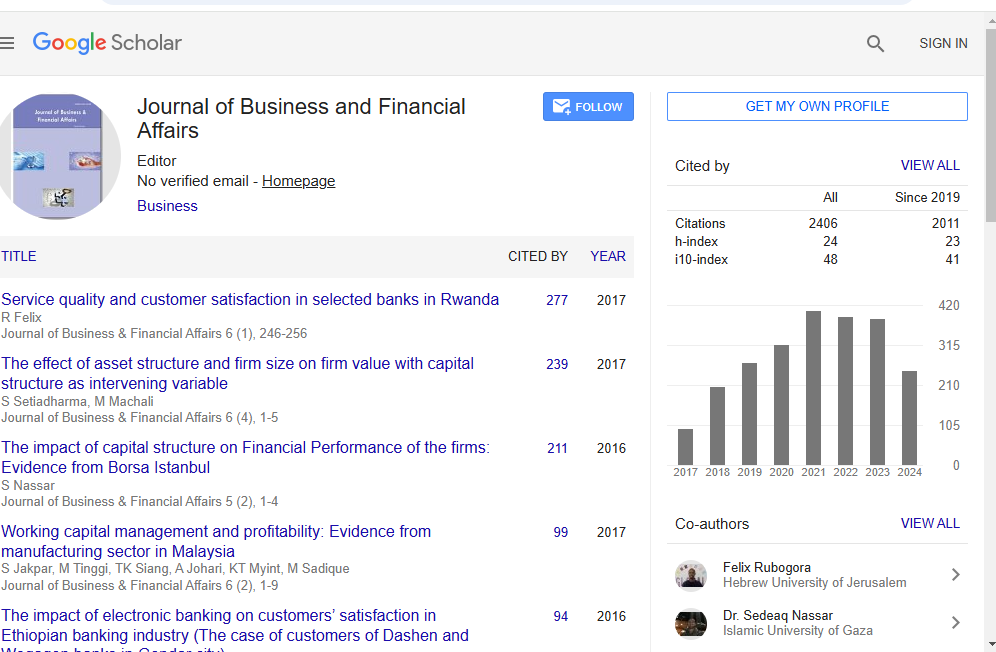
Journal of Business & Financial Affairs received 1726 citations as per Google Scholar report