Short Communication - (2025) Volume 16, Issue 6
Received: 01-Dec-2025, Manuscript No. jmbd-26-179562;
Editor assigned: 03-Dec-2025, Pre QC No. P-179562;
Reviewed: 15-Dec-2025, QC No. Q-179562;
Revised: 22-Dec-2025, Manuscript No. R-179562;
Published:
29-Dec-2025
, DOI: 10.37421/2155-9929.2025.16.729
Citation: Clark, Benjamin. ”Revolutionizing Healthcare: Next- Gen Molecular Diagnostics.” J Mol Biomark Diagn 16 (2025):729.
Copyright: © 2025 Clark B. This is an open-access article distributed under the terms of the Creative Commons Attribution License, which permits unrestricted use, distribution
and reproduction in any medium, provided the original author and source are credited.
Next-generation molecular diagnostics are revolutionizing healthcare through advanced technologies like NGS and liquid biopsies, enabling early disease detection and personalized treatments. Liquid biopsies offer non-invasive monitoring, while NGS provides comprehensive genomic profiling for oncology and rare diseases. The discovery and validation of new biomarkers, including epigenetic and proteomic markers, are essential for clinical diagnostics. Biomarkers are critical for targeted therapies, improving treatment efficacy and reducing side effects. Artificial intelligence and machine learning enhance the analysis of biomarker data for more accurate predictions. Point-of-care diagnostics are expanding access to testing, particularly in underserved areas. Dynamic biomarker monitoring helps manage disease progression and treatment response. Genomic biomarkers are crucial for diagnosing rare genetic diseases and developing tailored therapies. Innovations in assay technologies, such as microfluidics and CRISPR, are vital for creating reliable diagnostic tools.
Next-generation molecular diagnostics are profoundly transforming the landscape of healthcare by enabling the identification of specific biomarkers for the early detection of diseases, the selection of personalized treatment strategies, and the monitoring of therapeutic responses. This evolutionary phase is propelled by advanced technologies such as next-generation sequencing (NGS), liquid biopsies, and sophisticated bioinformatics, collectively offering unprecedented insights into the intricate mechanisms of diseases. The "Journal of Molecular Biomarkers & Diagnosis" serves as a crucial platform for disseminating cutting-edge research within this rapidly advancing field, particularly as it pertains to oncology, infectious diseases, and genetic disorders [1].
Liquid biopsies are emerging as a cornerstone of next-generation molecular diagnostics, facilitating the non-invasive detection and monitoring of diseases through the analysis of circulating tumor DNA (ctDNA), RNA, or exosomes. Current research in this domain is primarily focused on enhancing the sensitivity and specificity of these methods for early cancer detection, guiding treatment decisions, and tracking minimal residual disease, thereby presenting a powerful alternative to conventional tissue biopsies. This approach holds significant promise for personalized oncology and is expected to substantially impact patient outcomes [2].
Next-generation sequencing (NGS) has revolutionized molecular diagnostics by enabling comprehensive genomic profiling of both tumors and inherited diseases. The application of NGS allows for the identification of an extensive range of genetic mutations, rearrangements, and expression patterns that function as critical biomarkers. This technology is instrumental in discovering novel therapeutic targets and implementing precision therapies tailored to an individual's unique genetic makeup, thereby driving progress in both oncology and the diagnosis of rare diseases [3].
The discovery and rigorous validation of novel biomarkers are paramount for the advancement of molecular diagnostics. This process necessitates extensive research to establish their clinical utility, reproducibility, and relevance across diverse patient populations. Promising emerging areas include epigenetic markers, microbiome profiling, and proteomic signatures, which offer new avenues for disease prediction and prognosis, especially in complex diseases where traditional markers may prove insufficient [4].
Biomarkers are playing an indispensable role in the development and application of targeted therapies, most notably in the field of oncology. By stratifying patients into distinct groups based on specific molecular alterations, clinicians can select treatments that are more likely to be effective and less prone to causing adverse side effects. This precision-based approach is fundamentally reshaping drug development pipelines and improving patient outcomes by moving away from a generalized, one-size-fits-all treatment strategy [5].
The integration of artificial intelligence (AI) and machine learning (ML) is significantly amplifying the capabilities of molecular diagnostics. These advanced computational tools are adept at analyzing vast and complex biomarker datasets, identifying subtle patterns that might otherwise be overlooked, and predicting disease risk or treatment response with enhanced accuracy. This synergistic combination of biological expertise and data science is accelerating the pace of biomarker discovery and refining the clinical interpretation of diagnostic tests [6].
Point-of-care molecular diagnostics are vital for broadening access to timely and accurate testing, particularly in settings with limited resources. The ongoing development of rapid, portable diagnostic devices capable of detecting specific biomarkers at the patient's bedside or within the community represents a key area of innovation. Such advancements enable immediate clinical decision-making, leading to substantial improvements in patient management and public health outcomes for both infectious diseases and chronic conditions [7].
The functional role of biomarkers extends importantly to the monitoring of disease progression and the assessment of response to therapy. Serial measurements of particular biomarkers can provide early indications of treatment efficacy or the potential development of resistance, thereby facilitating timely adjustments to patient care. This dynamic monitoring approach is essential for optimizing treatment strategies and enhancing long-term patient outcomes in the management of chronic and complex diseases [8].
Genomic biomarkers are proving to be transformative in the diagnosis and management of rare genetic diseases. By enabling comprehensive gene sequencing, these diagnostic tools can pinpoint the underlying genetic cause of a patient's condition, which is critical for accurate diagnosis, effective genetic counseling, and the potential development of precisely tailored therapies. This offers significant hope for previously undiagnosed conditions and contributes to an improved quality of life for affected individuals and their families [9].
The creation of robust assay technologies is a fundamental prerequisite for the successful implementation of molecular diagnostics in clinical practice. Innovations in areas such as microfluidics, CRISPR-based detection systems, and digital PCR are progressively enabling greater sensitivity, specificity, and multiplexing capabilities. These technological advancements are indispensable for translating biomarker discoveries from the research setting into reliable and clinically actionable diagnostic tools [10].
Next-generation molecular diagnostics are revolutionizing healthcare by identifying specific biomarkers for early disease detection, personalized treatment selection, and monitoring therapeutic response. This evolution leverages advanced technologies like next-generation sequencing (NGS), liquid biopsies, and sophisticated bioinformatics to provide unprecedented insights into disease mechanisms. The "Journal of Molecular Biomarkers & Diagnosis" is a key venue for disseminating research in this rapidly advancing field, particularly as it impacts areas like cancer, infectious diseases, and genetic disorders [1].
Liquid biopsies, a cornerstone of next-generation molecular diagnostics, enable non-invasive detection and monitoring of disease through circulating tumor DNA (ctDNA), RNA, or exosomes. Research in this area focuses on improving sensitivity and specificity for early cancer detection, guiding treatment decisions, and tracking minimal residual disease, offering a powerful alternative to traditional tissue biopsies. This approach is pivotal for personalized oncology and can impact patient outcomes significantly [2].
Next-generation sequencing (NGS) has transformed molecular diagnostics by enabling comprehensive genomic profiling of tumors and inherited diseases. Its application allows for the identification of a vast array of genetic mutations, rearrangements, and expression patterns that serve as critical biomarkers. This technology facilitates the discovery of novel therapeutic targets and the implementation of precision therapies tailored to an individual's genetic makeup, driving advancements in both oncology and rare disease diagnosis [3].
The identification and validation of novel biomarkers are crucial for advancing molecular diagnostics. This involves rigorous research to establish their clinical utility, reproducibility, and relevance across diverse patient populations. Emerging areas include epigenetic markers, microbiome profiling, and proteomic signatures that offer new avenues for disease prediction and prognosis, especially in complex diseases where traditional markers fall short [4].
Biomarkers play an indispensable role in the development and application of targeted therapies, particularly in oncology. By stratifying patients based on specific molecular alterations, clinicians can select treatments that are more likely to be effective and less likely to cause adverse side effects. This precision approach is reshaping drug development pipelines and improving patient outcomes by moving away from a one-size-fits-all treatment strategy [5].
The integration of artificial intelligence (AI) and machine learning (ML) is significantly enhancing the power of molecular diagnostics. These computational tools can analyze vast and complex biomarker datasets, identify subtle patterns, and predict disease risk or treatment response with greater accuracy. This synergy between biology and data science is accelerating biomarker discovery and improving the clinical interpretation of diagnostic tests [6].
Point-of-care molecular diagnostics are crucial for expanding access to timely and accurate testing, especially in resource-limited settings. The development of rapid, portable diagnostic devices that can detect specific biomarkers at the bedside or in the community is a key area of innovation. This allows for immediate clinical decision-making and can significantly improve patient management and public health outcomes for infectious diseases and chronic conditions [7].
The role of biomarkers extends to monitoring disease progression and response to therapy. Serial measurements of specific biomarkers can provide early indications of treatment efficacy or the emergence of resistance, enabling timely adjustments to patient care. This dynamic monitoring is essential for optimizing treatment strategies and improving long-term patient outcomes in chronic and complex diseases [8].
Genomic biomarkers are transforming the diagnosis and management of rare genetic diseases. By enabling comprehensive gene sequencing, these diagnostics can identify the underlying genetic cause of a patient's condition, facilitating accurate diagnosis, genetic counseling, and the potential for developing tailored therapies. This offers hope for previously undiagnosed conditions and improves the quality of life for affected individuals and families [9].
The development of robust assay technologies is fundamental to the successful implementation of molecular diagnostics. Innovations in microfluidics, CRISPR-based detection, and digital PCR are enabling greater sensitivity, specificity, and multiplexing capabilities. These technological advancements are critical for translating biomarker discoveries into reliable and clinically actionable diagnostic tools [10].
Next-generation molecular diagnostics are revolutionizing healthcare through advanced technologies like NGS and liquid biopsies, enabling early disease detection and personalized treatments. Liquid biopsies offer non-invasive monitoring, while NGS provides comprehensive genomic profiling for oncology and rare diseases. The discovery and validation of new biomarkers, including epigenetic and proteomic markers, are essential for clinical diagnostics. Biomarkers are critical for targeted therapies, improving treatment efficacy and reducing side effects. Artificial intelligence and machine learning enhance the analysis of biomarker data for more accurate predictions. Point-of-care diagnostics are expanding access to testing, particularly in underserved areas. Dynamic biomarker monitoring helps manage disease progression and treatment response. Genomic biomarkers are crucial for diagnosing rare genetic diseases and developing tailored therapies. Innovations in assay technologies, such as microfluidics and CRISPR, are vital for creating reliable diagnostic tools.
None
None
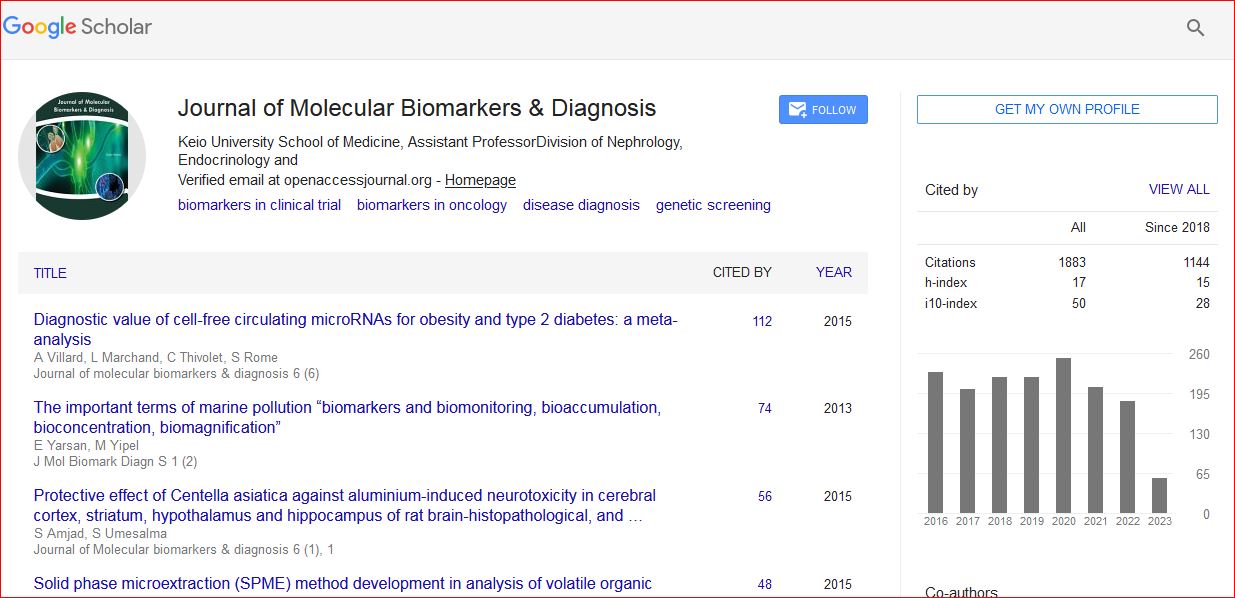
Journal of Molecular Biomarkers & Diagnosis received 2054 citations as per Google Scholar report