Perspective - (2025) Volume 16, Issue 6
Received: 01-Dec-0025, Manuscript No. jmbd-26-179554;
Editor assigned: 03-Dec-2025, Pre QC No. P-179554;
Reviewed: 15-Dec-2025, QC No. Q-179554;
Revised: 22-Dec-2025, Manuscript No. R-179554;
Published:
29-Dec-2025
, DOI: 10.37421/2155-9929.2025.16.733
Citation: Steiner, Markus. ”Revolutionizing Diagnosis: Multi-Omics Biomarker Discovery.” J Mol Biomark Diagn 16 (2025):733.
Copyright: © 2025 Steiner M. This is an open-access article distributed under the terms of the Creative Commons Attribution License, which permits unrestricted use,
distribution and reproduction in any medium, provided the original author and source are credited.
Personalized diagnosis is increasingly reliant on the identification of specific molecular biomarkers that accurately reflect an individual's unique disease state. This precision-driven approach facilitates more accurate patient stratification, enabling the selection of therapies tailored to individual needs and allowing for the early detection of disease progression or recurrence. Advances in omics technologies, including genomics, transcriptomics, and proteomics, are fundamental to the discovery and validation of these crucial biomarkers. The synergistic integration of multi-omics data further refines diagnostic accuracy, providing a comprehensive understanding of the intricate molecular landscapes that underlie disease development [1].
The advent of liquid biopsies, particularly those analyzing circulating tumor DNA (ctDNA), has profoundly transformed non-invasive cancer diagnostics and patient monitoring. These biomarkers possess the capability to detect even minimal residual disease, track therapeutic responses in real-time, and identify emerging resistance mutations. While challenges in standardization and extensive clinical validation persist, liquid biopsies present substantial promise for the future of personalized patient management [2].
Proteomic profiling offers a complementary lens through which to understand disease pathogenesis by quantifying the abundance and post-translational modifications of proteins. Leveraging mass spectrometry, proteomics has successfully identified novel protein biomarkers for the early detection and prognostication of a wide array of diseases, such as neurodegenerative disorders and autoimmune conditions. Integrating proteomic data with other molecular information sources promises to yield a more holistic and nuanced diagnostic picture [3].
Epigenetic modifications, including DNA methylation and histone alterations, play a pivotal role in regulating gene expression and are intrinsically linked to disease development. Aberrant epigenetic patterns can serve as highly sensitive and specific biomarkers for early diagnosis and prognosis, particularly in the context of cancer. Rapid advancements in sequencing technologies are now enabling genome-wide profiling of these epigenetic marks, thereby paving the way for the development of personalized epigenetic diagnostics [4].
Metabolomics offers a valuable snapshot of cellular function by meticulously analyzing the array of small molecules involved in metabolic pathways. Shifts in metabolite profiles can serve as early indicators of disease states or cellular responses to therapeutic interventions. The development of robust metabolomic biomarkers necessitates stringent sample handling protocols, sophisticated analytical techniques, and rigorous statistical analysis to identify reproducible signatures essential for personalized diagnosis [5].
The microbiome, comprising the vast collection of microorganisms residing in and on the human body, is gaining increasing recognition for its profound influence on both health and disease. Microbial dysbiosis has been implicated in a spectrum of conditions, ranging from inflammatory bowel disease and metabolic disorders to neurological impairments. Comprehensive profiling of the microbiome holds the potential to unveil novel diagnostic avenues and identify therapeutic targets for personalized interventions [6].
Single-cell technologies, such as single-cell RNA sequencing (scRNA-seq), are revolutionizing our ability to characterize cellular heterogeneity within tissues at an unprecedented level of detail. This high-resolution approach can pinpoint rare cell populations or subtle molecular alterations that might be overlooked in bulk analyses, leading to the discovery of more specific diagnostic biomarkers and a deeper cellular-level understanding of disease progression [7].
The integration of artificial intelligence (AI) and machine learning (ML) is fundamentally reshaping the landscape of biomarker discovery and diagnostic development. AI/ML algorithms are adept at analyzing complex, multi-modal datasets to discern intricate patterns, predict disease risk with greater accuracy, and enhance overall diagnostic performance. These powerful computational tools are indispensable for extracting meaningful and actionable insights from the massive volumes of data generated by contemporary molecular profiling techniques [8].
Biomarker validation represents a critical, albeit challenging, step in translating promising molecular discoveries into clinically applicable diagnostics. This rigorous process involves comprehensive testing in independent patient cohorts to meticulously confirm reproducibility, sensitivity, and specificity. Establishing robust validation frameworks is paramount for securing regulatory approval and facilitating the widespread clinical adoption of novel personalized diagnostic tests [9].
The utility of molecular biomarker profiling extends far beyond oncology, encompassing a diverse range of disease areas, including infectious diseases, cardiovascular conditions, and neurological disorders. The identification of disease-specific molecular signatures empowers earlier and more accurate diagnoses, thereby enabling timely and appropriate therapeutic interventions. The continuous evolution of molecular technologies promises to further broaden the scope and impact of personalized diagnostics across the entire spectrum of human health [10].
Personalized diagnosis hinges on the identification of specific molecular biomarkers that reflect individual disease states. This approach allows for more precise patient stratification, tailored treatment selection, and early detection of disease progression or recurrence. Advances in omics technologies, such as genomics, transcriptomics, and proteomics, are instrumental in discovering and validating these biomarkers. The integration of multi-omics data further enhances diagnostic accuracy and provides a comprehensive understanding of the molecular landscape driving disease [1].
The development of liquid biopsies, particularly those analyzing circulating tumor DNA (ctDNA), has revolutionized non-invasive cancer diagnostics and monitoring. These biomarkers can detect minimal residual disease, track treatment response, and identify resistance mutations in real-time. Challenges remain in standardization and clinical validation, but liquid biopsies offer immense potential for personalized patient management [2].
Proteomic profiling offers complementary insights into disease pathogenesis by measuring the abundance and modifications of proteins. Mass spectrometry-based proteomics has enabled the identification of novel protein biomarkers for early detection and prognostication across various diseases, including neurodegenerative disorders and autoimmune conditions. Integrating proteomic data with other molecular information can yield a more holistic diagnostic picture [3].
Epigenetic modifications, such as DNA methylation and histone modifications, play a critical role in gene regulation and disease development. Aberrant epigenetic patterns can serve as sensitive and specific biomarkers for early diagnosis and prognosis, particularly in cancer. Advancements in sequencing technologies allow for genome-wide profiling of these epigenetic marks, paving the way for personalized epigenetic diagnostics [4].
Metabolomics provides a snapshot of cellular function by analyzing the small molecules involved in metabolic pathways. Changes in metabolite profiles can reflect early disease states or cellular responses to therapy. Developing robust metabolomic biomarkers requires careful sample handling, advanced analytical techniques, and rigorous statistical analysis to identify reproducible signatures for personalized diagnosis [5].
The microbiome, the collection of microorganisms in and on the body, is increasingly recognized for its influence on health and disease. Microbial dysbiosis has been linked to various conditions, including inflammatory bowel disease, metabolic disorders, and even neurological conditions. Profiling the microbiome can offer novel diagnostic avenues and therapeutic targets for personalized interventions [6].
Single-cell technologies, such as single-cell RNA sequencing (scRNA-seq), allow for the detailed characterization of cellular heterogeneity within tissues. This high-resolution approach can identify rare cell populations or subtle molecular changes that may be missed by bulk analyses, leading to the discovery of more specific diagnostic biomarkers and a deeper understanding of disease progression at the cellular level [7].
The integration of artificial intelligence (AI) and machine learning (ML) is transforming biomarker discovery and diagnostic development. AI/ML algorithms can analyze complex, multi-modal datasets to identify patterns, predict disease risk, and improve diagnostic accuracy. These computational tools are essential for extracting actionable insights from the vast amounts of data generated by molecular profiling [8].
Biomarker validation is a critical step in translating molecular discoveries into clinical diagnostics. This process involves rigorous testing in independent cohorts to ensure reproducibility, sensitivity, and specificity. Establishing robust validation frameworks is essential for regulatory approval and widespread clinical adoption of personalized diagnostic tests [9].
The application of molecular biomarker profiling extends beyond oncology to encompass a wide range of diseases, including infectious diseases, cardiovascular conditions, and neurological disorders. Identifying disease-specific molecular signatures enables earlier and more accurate diagnoses, facilitating timely and appropriate therapeutic interventions. The continuous evolution of molecular technologies promises to further expand the scope of personalized diagnostics [10].
Personalized diagnosis is being revolutionized by molecular biomarker discovery across various 'omics' fields, including genomics, transcriptomics, and proteomics. Technologies like liquid biopsies and single-cell sequencing offer unprecedented resolution for detecting disease and understanding cellular heterogeneity. Epigenetic profiling and metabolomics provide additional layers of diagnostic information, reflecting gene regulation and cellular function respectively. The human microbiome's role in disease is also a growing area of investigation for personalized interventions. Artificial intelligence and machine learning are essential for analyzing complex multi-omic datasets and accelerating biomarker discovery. Crucially, rigorous validation of these biomarkers is necessary for their translation into clinical practice, extending their application beyond oncology to a wide range of diseases.
None
None
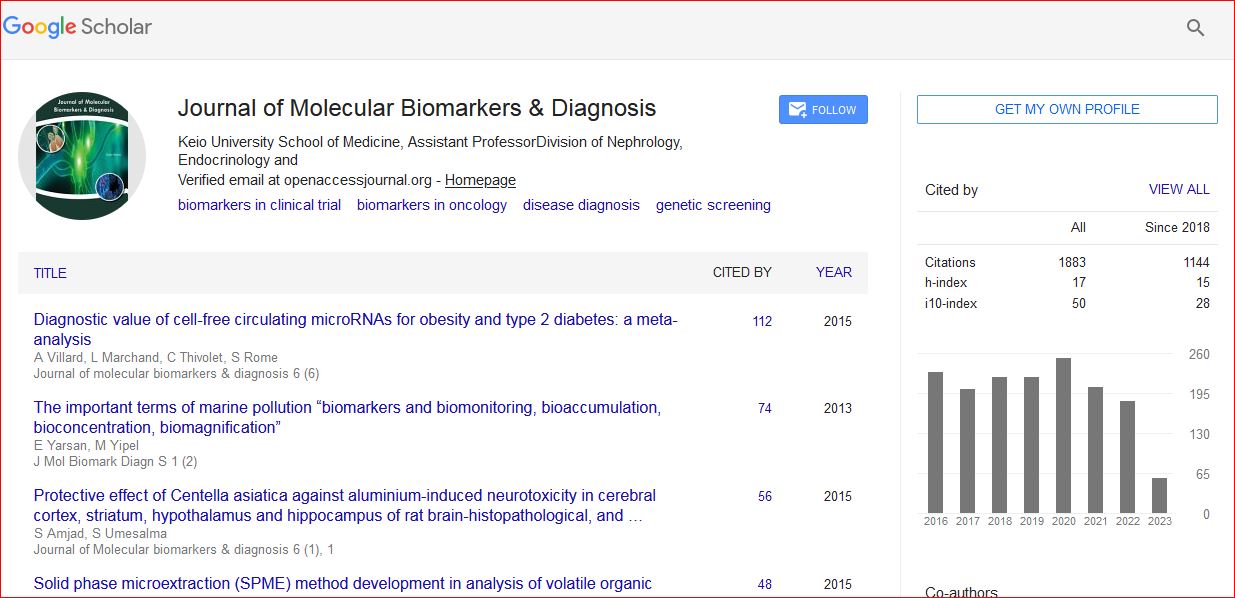
Journal of Molecular Biomarkers & Diagnosis received 2054 citations as per Google Scholar report