Brief Report - (2025) Volume 11, Issue 2
Received: 02-May-2025, Manuscript No. jotr-25-175564;
Editor assigned: 05-May-2025, Pre QC No. P-175564;
Reviewed: 19-May-2025, QC No. Q-175564;
Revised: 23-May-2025, Manuscript No. R-175564;
Published:
30-May-2025
, DOI: 10.37421/2476-2261. 2025.11.302
Citation: Rathi, Arjun. "Revolutionizing Cancer: Biomarkers, AI, Resistance.:" J Oncol Transl Res 11 (2025):302.
Copyright: © 2025 Rathi A. This is an open-access article distributed under the terms of the Creative Commons Attribution License, which permits unrestricted use, distribution and reproduction in any medium, provided the original author and source are credited.
This paper highlights the critical role of circulating tumor DNA (ctDNA) as a non-invasive biomarker in precision oncology. This innovative approach leverages ctDNA for various critical applications, including early cancer detection, robust monitoring of treatment responses, and the precise identification of underlying mechanisms of drug resistance. Ultimately, this work is paving the way for significantly more personalized and effective therapeutic strategies in cancer care [1].
This review delves into the complex molecular mechanisms that underpin primary and acquired resistance to cancer immunotherapy. Understanding these intricate pathways is truly crucial for developing effective strategies to overcome therapeutic resistance and thereby enhance the overall efficacy of current immunotherapeutic treatments for patients [2].
This article examines the diverse epigenetic alterations observed in cancer, encompassing critical changes like DNA methylation and histone modifications. It thoroughly explains their foundational role in tumor initiation and progression, importantly highlighting how these specific molecular changes can be precisely targeted for novel and impactful therapeutic interventions [3].
This paper explores the transformative potential of Artificial Intelligence (AI) in precision oncology. It discusses AIâ??s remarkable capacity to revolutionize every facet of cancer care, from diagnosis and prognosis to treatment selection and innovative drug discovery. However, it also critically addresses the significant challenges that still need to be comprehensively overcome for its widespread and successful application [4].
This research details the various intricate molecular mechanisms through which cancer cells meticulously develop acquired resistance to targeted therapies. It strongly emphasizes that a deeper understanding of these specific pathways is absolutely essential to design more effective combination therapies and ultimately overcome persistent treatment failure experienced by many patients [5].
This paper explores the significant roles of non-coding RNAs, such as microRNAs, lncRNAs, and circRNAs, in precisely regulating gene expression within cancer cells. It crucially highlights their substantial potential as innovative diagnostic biomarkers and highly promising therapeutic targets in the evolving field of molecular oncology [6].
This review offers a comprehensive update on the diverse applications of CRISPR-Cas9 technology in both cancer research and therapy. It meticulously covers its proven utility in precise gene editing for fundamental functional studies and its burgeoning potential as a highly precise therapeutic tool for targeted genetic modifications specifically within tumors [7].
This work explores the intricate and highly dynamic interplay within the tumor microenvironment (TME). It clearly explains how the diverse cellular and non-cellular components of the TME significantly influence tumor growth and metastasis, ultimately identifying key molecular targets for novel and more effective cancer therapies [8].
This article discusses the revolutionary impact of single-cell sequencing technologies in cancer research. It details how these significant advancements enable a remarkably deeper understanding of tumor heterogeneity, the dynamics of cancer evolution, the mechanisms of drug resistance, and the crucial characterization of rare cell populations, collectively offering new profound insights into disease biology [9].
This paper explores the crucial role of molecular biomarkers in accurately predicting patient response to various cancer therapies, with a particular focus on immunotherapies. It strongly underscores their immense significance in personalizing treatment strategies, thereby optimizing patient outcomes, and diligently minimizing adverse effects in everyday clinical practice [10].
Modern oncology is profoundly shaped by the pursuit of precision, aiming to tailor treatments to individual patient profiles. Circulating tumor DNA (ctDNA) is emerging as a critical non-invasive biomarker in this endeavor. It provides invaluable insights for early cancer detection, diligent monitoring of treatment responses, and crucially, the identification of mechanisms leading to drug resistance, thereby paving the way for significantly more personalized therapeutic approaches [1]. Complementing this, Artificial Intelligence (AI) holds transformative potential within precision oncology. AIâ??s capacity to revolutionize cancer diagnosis, prognosis, treatment selection, and drug discovery is immense. While challenges remain, the integration of AI promises to unlock new levels of insight and efficiency in cancer care [4].
A major hurdle in effective cancer treatment is the development of resistance. Researchers are meticulously delving into the complex molecular mechanisms that underpin both primary and acquired resistance to cancer immunotherapy. A thorough understanding of these pathways is essential for developing novel strategies to overcome such resistance and enhance the overall efficacy of current immunotherapeutic treatments [2]. Similarly, a comprehensive understanding of the various molecular mechanisms through which cancer cells develop acquired resistance to targeted therapies is critical. This knowledge is paramount for designing more effective combination therapies, ultimately aiming to overcome treatment failure in patients and improve long-term outcomes [5].
At the molecular level, epigenetic alterations, including phenomena like DNA methylation and histone modifications, play a foundational role in tumor initiation and progression. Investigating these molecular changes provides a crucial avenue for developing novel therapeutic interventions that directly target these aberrant processes [3]. Moreover, non-coding RNAs, such as microRNAs, lncRNAs, and circRNAs, are recognized for their profound roles in regulating gene expression within cancer. Their potential as innovative diagnostic biomarkers and promising therapeutic targets in molecular oncology offers exciting new avenues for both detection and treatment strategies [6].
Breakthrough technologies are continuously expanding our capabilities in cancer research and therapy. CRISPR-Cas9 technology, for example, is offering an update on its applications, demonstrating utility in gene editing for functional studies and showing burgeoning potential as a precise therapeutic tool for targeted genetic modifications within tumors [7]. Similarly, single-cell sequencing technologies have had a revolutionary impact, enabling a deeper understanding of critical aspects like tumor heterogeneity, the dynamics of cancer evolution, the intricate mechanisms of drug resistance, and the detailed characterization of rare cell populations. These advancements collectively offer profound new insights into disease biology, steering research towards more precise interventions [9].
The tumor microenvironment (TME) represents a dynamic and complex ecosystem. This work explores the intricate interplay within the TME, explaining how its cellular and non-cellular components significantly influence tumor growth and metastasis. Identifying key targets within the TME is vital for developing novel cancer therapies that can disrupt these supportive interactions [8]. Furthermore, molecular biomarkers are proving crucial for predicting patient response to various cancer therapies, particularly immunotherapies. Their significance lies in personalizing treatment strategies, thereby optimizing patient outcomes and minimizing adverse effects, ultimately advancing clinical practice towards more effective and patient-specific care [10].
Recent advancements in cancer research highlight diverse strategies for improved diagnosis and treatment. Circulating tumor DNA (ctDNA) is emerging as a critical non-invasive biomarker, showing promise for early detection, monitoring treatment responses, and identifying drug resistance, paving the way for personalized therapeutic approaches. Simultaneously, researchers are deeply investigating the complex molecular mechanisms behind primary and acquired resistance to both immunotherapy and targeted therapies. Understanding these pathways is key to developing strategies that overcome resistance and enhance treatment efficacy. Epigenetic alterations, including DNA methylation and histone modifications, play a foundational role in tumor initiation and progression, presenting novel targets for therapeutic interventions. Non-coding RNAs, such as microRNAs, lncRNAs, and circRNAs, are also recognized for their significant roles in regulating gene expression in cancer, offering potential as diagnostic biomarkers and therapeutic targets. The transformative potential of Artificial Intelligence (AI) in precision oncology is evident, poised to revolutionize cancer diagnosis, prognosis, treatment selection, and drug discovery, despite existing challenges. Advanced technologies like CRISPR-Cas9 are evolving as precise gene-editing tools for functional studies and targeted genetic modifications in tumors. Furthermore, single-cell sequencing is revolutionizing cancer research by providing a deeper understanding of tumor heterogeneity, evolution, and drug resistance. The intricate interplay within the tumor microenvironment (TME) also significantly influences tumor growth and metastasis, identifying key targets for novel therapies. Finally, molecular biomarkers are crucial for predicting patient response to various cancer therapies, particularly immunotherapies, aiming to personalize treatment strategies and optimize outcomes.
None
None
Xiaohui W, Mengjia L, Xiaoxue L. "Circulating tumor DNA in precision oncology: Clinical applications and future perspectives".Chin Med J (Engl) 136 (2023):1924-1930.
Indexed at, Google Scholar, Crossref
Jiasheng W, Jianing W, Yu H. "The emerging molecular mechanisms of immunotherapy resistance in cancer".Signal Transduct Target Ther 7 (2022):198.
Indexed at, Google Scholar, Crossref
Mengting C, Minjun J, Jiaqi Z. "Epigenetic alterations in cancer: Mechanisms, detection, and therapeutic implications".Exp Biol Med (Maywood) 248 (2023):901-913.
Indexed at, Google Scholar, Crossref
Jianan L, Mingyue W, Zhiyuan C. "Artificial intelligence in precision oncology: promises and challenges".Front Oncol 13 (2023):1107530.
Indexed at, Google Scholar, Crossref
Xiaojing L, Junli X, Yi Z. "Molecular Mechanisms of Acquired Resistance to Targeted Therapies in Cancer".Cancers (Basel) 14 (2022):4530.
Indexed at, Google Scholar, Crossref
Yaoxuan H, Liqin J, Xiumei L. "Non-coding RNAs in cancer: from mechanisms to therapeutic opportunities".Signal Transduct Target Ther 6 (2021):210.
Indexed at, Google Scholar, Crossref
Wenyan G, Li S, Yu T. "CRISPR-Cas9 in cancer research and therapy: an update".Front Oncol 13 (2023):1174984.
Indexed at, Google Scholar, Crossref
Wenjia L, Yongxing L, Yang W. "Targeting the tumor microenvironment for cancer therapy: molecular mechanisms and clinical implications".Signal Transduct Target Ther 7 (2022):335.
Indexed at, Google Scholar, Crossref
Ruiqi D, Chunqiang L, Zhengguo C. "Advances in single-cell sequencing technologies for cancer research".Cancer Gene Ther 30 (2023):549-562.
Indexed at, Google Scholar, Crossref
Yichen J, Zongyue Z, Yaping W. "Molecular Biomarkers for Predicting Immunotherapy Response in Cancer".Front Immunol 13 (2022):848211.
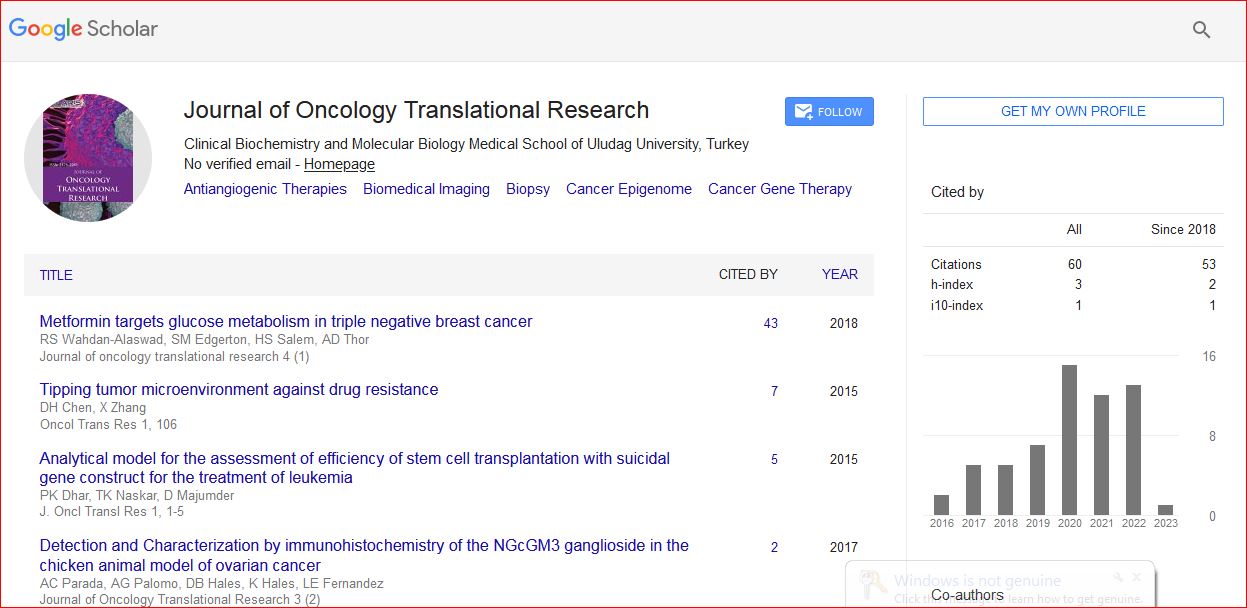
Journal of Oncology Translational Research received 93 citations as per Google Scholar report