Perspective - (2025) Volume 16, Issue 6
Received: 01-Nov-2025, Manuscript No. jch-26-178801;
Editor assigned: 03-Nov-2025, Pre QC No. P-178801;
Reviewed: 17-Nov-2025, QC No. Q-178801;
Revised: 22-Nov-2025, Manuscript No. R-178801;
Published:
29-Nov-2025
, DOI: 10.37421/2157-7099.2025.16.828
Citation: Sarr, Fatima B.. ”Revolutionizing 3D Histology: New Tech, Deep Insights.” J Cytol Histol 16 (2025):828.
Copyright: © 2025 Sarr B. Fatima This is an open-access article distributed under the terms of the Creative Commons Attribution License, which permits unrestricted use, distribution and reproduction in any medium, provided the original author and source are credited.
Recent breakthroughs in three-dimensional histological imaging are fundamentally revolutionizing our understanding of tissue architecture and cellular organization, offering unprecedented visualization capabilities. Techniques such as light-sheet microscopy, confocal microscopy, and multi-photon microscopy, when integrated with advanced tissue clearing methods, are enabling researchers to observe intact tissues in three dimensions with remarkable detail. This progress carries significant implications for the diagnosis of diseases, the development of novel therapeutics, and the advancement of fundamental biological research, allowing for in-depth studies of complex cellular interactions and spatial relationships that were previously unattainable [1].
Tissue clearing techniques, including well-established protocols like CLARITY and iDISCO, play a crucial role in facilitating deep volumetric imaging of histological samples. These methods render tissues transparent, thereby allowing light to penetrate effectively and illuminate structures located deep within the sample. The synergistic integration of these clearing methods with sophisticated microscopy platforms provides a powerful toolkit for reconstructing intricate neural circuits, meticulously studying developmental processes, and thoroughly analyzing cellular infiltration patterns within tumors [2].
Light-sheet fluorescence microscopy (LSFM) stands out for its capacity to perform rapid, high-resolution volumetric imaging while exhibiting minimal phototoxicity. These characteristics make it exceptionally well-suited for the imaging of large biological samples. A key advantage of LSFM is its ability to illuminate only the focal plane, which significantly reduces both photobleaching and photodamage, thereby permitting prolonged observation of dynamic biological processes. Consequently, LSFM is experiencing increasing adoption across a wide spectrum of applications, ranging from developmental biology to neuroscience, offering unparalleled insights into tissue morphogenesis and cellular dynamics [3].
Confocal microscopy continues to serve as an indispensable tool for high-resolution imaging of cellular structures. Significant advancements in detector technology, laser sources, and image processing algorithms have collectively enhanced its capabilities for generating accurate 3D reconstructions. Furthermore, the development of hybrid approaches, which cleverly combine confocal microscopy with other microscopy modalities, further expands its utility for investigating intricate cellular and subcellular architectures within complex tissue environments [4].
Multi-photon microscopy is particularly advantageous for imaging deep within tissues due to its inherent ability to achieve deep penetration and minimize light scattering. This makes it highly suitable for both in vivo imaging and the examination of thick tissue samples. By utilizing near-infrared lasers to excite fluorophores exclusively at the focal point, it effectively reduces phototoxicity and enables imaging of living organisms and tissues at depths exceeding the capabilities of confocal microscopy [5].
The quantitative analysis of 3D histology data presents considerable challenges, necessitating the use of sophisticated image processing and segmentation algorithms. In this domain, machine learning and deep learning approaches are gaining prominence, being increasingly applied to automate the identification and quantification of cells, nuclei, and other structural elements within vast volumetric datasets. This automation facilitates high-throughput analysis, significantly accelerating research timelines [6].
The continuous development of novel fluorescent probes and genetically encoded reporters is paramount for improving the contrast and specificity of 3D histological imaging. These advanced molecular tools are essential for enabling the visualization of specific cellular components, precise localization of proteins, and the study of dynamic molecular events within intact tissues, ultimately providing deeper and more comprehensive biological insights [7].
Integrating multiplexed imaging techniques with 3D histology opens avenues for the simultaneous detection of multiple biomarkers within a single tissue section. This cutting-edge approach, often referred to as spatial proteomics and transcriptomics, yields a comprehensive understanding of cellular heterogeneity and the intricate tissue microenvironments. Such detailed information is crucial for accurate disease characterization and the effective identification of therapeutic targets [8].
Cryo-electron tomography (Cryo-ET) is rapidly emerging as a highly potent tool for visualizing the ultrastructure of cells and tissues in their native, unperturbed state. By skillfully combining cryogenic preservation methodologies with tomographic reconstruction techniques, Cryo-ET facilitates nanoscale imaging of molecular complexes and cellular organelles within intact biological samples. This advanced method serves to complement traditional histological approaches, providing a complementary perspective at an unprecedented resolution [9].
The integration of artificial intelligence (AI) with 3D histological imaging is ushering in a transformative era for data analysis and interpretation within the field. AI algorithms are proving adept at automating complex tasks, including precise cell identification, accurate tumor grading, and the detection of subtle pathological features. This automation leads to more precise and efficient diagnostic processes, promising to unlock the full analytical potential of large-scale 3D histological datasets [10].
Recent advancements in three-dimensional histological imaging are profoundly transforming our comprehension of tissue architecture and cellular arrangement. Techniques such as light-sheet microscopy, confocal microscopy, and multi-photon microscopy, in conjunction with sophisticated tissue clearing methods, provide an unparalleled capacity for visualizing intact tissues in three dimensions. These innovations hold significant promise for improving disease diagnosis, accelerating drug development, and advancing fundamental biological research by enabling detailed studies of complex cellular interactions and spatial relationships that were previously beyond reach [1].
Tissue clearing techniques, including prominent methods like CLARITY and iDISCO, are indispensable for achieving deep volumetric imaging of histological samples. These processes render opaque tissues transparent, allowing light to penetrate and illuminate structures deep within the sample. The synergy between tissue clearing and advanced microscopy platforms creates a powerful suite of tools for reconstructing intricate neural circuits, studying developmental trajectories, and analyzing cellular infiltration in pathological conditions such as tumors [2].
Light-sheet fluorescence microscopy (LSFM) offers the distinct advantages of rapid, high-resolution volumetric imaging coupled with minimal phototoxicity, making it exceptionally well-suited for the examination of large biological specimens. Its unique ability to illuminate only the focal plane significantly mitigates photobleaching and photodamage, enabling extended observation of dynamic biological processes. LSFM is increasingly being adopted for diverse applications, from developmental biology to neuroscience, providing unprecedented insights into tissue morphogenesis and the dynamics of cellular behavior [3].
Confocal microscopy continues to be a foundational technique for high-resolution imaging of cellular structures. Continuous progress in detector technologies, laser sources, and image processing algorithms has substantially augmented its capabilities for performing accurate 3D reconstructions. Moreover, the implementation of hybrid approaches, which merge confocal microscopy with other imaging modalities, further enhances its utility for investigating complex cellular and subcellular architectures within intricate tissue contexts [4].
Multi-photon microscopy is distinguished by its capacity for deep tissue penetration and reduced light scattering, rendering it highly effective for both in vivo and thick tissue imaging applications. By employing near-infrared lasers to excite fluorophores precisely at the focal point, it minimizes phototoxicity and facilitates imaging of living organisms and tissues at greater depths than is achievable with confocal microscopy [5].
The quantitative analysis of 3D histological data necessitates the application of advanced image processing and segmentation algorithms. In this context, machine learning and deep learning methodologies are being increasingly leveraged to automate the identification and quantification of cellular components, nuclei, and other structures within extensive volumetric datasets, thereby enabling high-throughput analytical capabilities [6].
The ongoing development of novel fluorescent probes and genetically encoded reporters is critical for enhancing the contrast and specificity in 3D histological imaging. These advanced molecular tools allow for the precise visualization of specific cellular components, the determination of protein localization, and the study of dynamic molecular events within intact tissues, leading to a more profound biological understanding [7].
Integrating multiplexed imaging techniques with 3D histology enables the simultaneous detection of multiple biomarkers within a single tissue section. This advanced approach, encompassing spatial proteomics and transcriptomics, provides a comprehensive understanding of cellular heterogeneity and the complex tissue microenvironment, which is essential for accurate disease characterization and the identification of therapeutic targets [8].
Cryo-electron tomography (Cryo-ET) is emerging as a powerful tool for visualizing the ultrastructure of cells and tissues in their native state. Through the combination of cryogenic preservation with tomographic reconstruction, Cryo-ET allows for nanoscale imaging of molecular complexes and cellular organelles within intact biological samples, complementing traditional histological methods with high-resolution structural information [9].
The integration of artificial intelligence (AI) with 3D histological imaging is revolutionizing data analysis and interpretation. AI algorithms can automate critical tasks such as cell identification, tumor grading, and the detection of subtle pathological features, leading to more accurate and efficient diagnoses. This synergistic combination holds the potential to fully realize the capabilities of large-scale 3D histological datasets [10].
Recent advancements in 3D histological imaging, leveraging techniques like light-sheet, confocal, and multi-photon microscopy alongside tissue clearing methods, are revolutionizing biological research and diagnostics. These technologies enable unprecedented visualization of intact tissues in three dimensions, facilitating detailed studies of cellular interactions and spatial relationships. Tissue clearing methods such as CLARITY and iDISCO are essential for deep volumetric imaging. Light-sheet microscopy offers rapid, high-resolution imaging with minimal phototoxicity, while confocal microscopy remains a workhorse for cellular structures. Multi-photon microscopy excels in deep tissue penetration. Quantitative analysis is being enhanced by AI and machine learning for automated identification and quantification. Novel fluorescent probes and multiplexed imaging techniques provide deeper biological insights by improving contrast, specificity, and allowing simultaneous biomarker detection. Cryo-electron tomography offers nanoscale visualization of ultrastructure, complementing traditional methods. The integration of AI promises more accurate and efficient diagnoses and unlocks the full potential of 3D histological data.
None
None
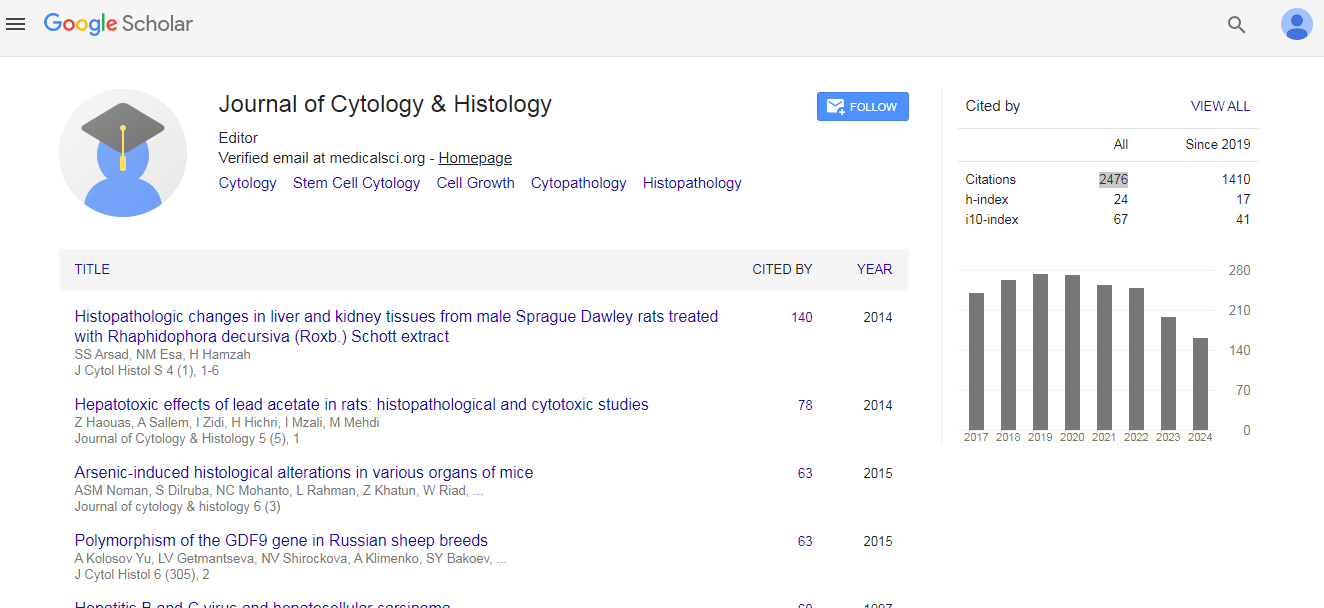
Journal of Cytology & Histology received 2476 citations as per Google Scholar report