Opinion - (2025) Volume 10, Issue 1
Received: 01-Feb-2025, Manuscript No. arwm-25-165533;
Editor assigned: 03-Feb-2025, Pre QC No. P-165533;
Reviewed: 14-Feb-2025, QC No. Q-165533;
Revised: 19-Feb-2025, Manuscript No. R-165533;
Published:
26-Feb-2025
, DOI: 10.37421/2475-7675.2025.10.386
Citation: Chang, Wang. “Resource Efficiency: The Path to Sustainable Growth.’’ Adv Recycling Waste Manag 10 (2025): 386.
Copyright: © 2025 Chang W. This is an open-access article distributed under the terms of the Creative Commons Attribution License, which permits unrestricted use, distribution and reproduction in any medium, provided the original author and source are credited.
Resource efficiency is a cornerstone concept in the pursuit of sustainable growth, representing the strategic use of natural resources in a way that minimizes environmental impact while maximizing economic and social value. As the global population continues to rise and economies expand, the pressure on finite resources such as water, energy, minerals, and raw materials becomes increasingly unsustainable. The traditional linear model of "take, make, dispose" has led to widespread resource depletion, environmental degradation, and climate change. In contrast, resource efficiency advocates for a circular approach, emphasizing conservation, optimization, and innovation to ensure long-term sustainability and equitable growth.
The principle of resource efficiency is not just about reducing consumption but also about producing more value from fewer inputs. This can be achieved through technological advancements, smarter design, recycling, reusing, and changing consumption patterns. Industries, governments, and individuals all play vital roles in this transformation. Efficiency in resource use means less waste, reduced greenhouse gas emissions, and a smaller ecological footprint. Moreover, it enables countries and companies to be more competitive by lowering production costs and fostering innovation [1,2].
One of the primary drivers of resource inefficiency is the economic model that has dominated the industrial age. This model often prioritizes short-term gains over long-term sustainability, externalizes environmental costs, and encourages overconsumption. As a result, natural ecosystems are being degraded at an unprecedented pace, and the planet's capacity to regenerate is being outstripped by human demands. In this context, resource efficiency emerges not just as an environmental necessity but also as an economic and ethical imperative. It aligns ecological boundaries with economic activities, ensuring that future generations inherit a planet capable of supporting life and prosperity [3].
Technological innovation is a crucial enabler of resource efficiency. Advances in digital technologies, such as artificial intelligence, the Internet of Things, and big data analytics, allow for more precise monitoring and management of resources. In agriculture, for example, precision farming techniques can reduce water and fertilizer use while increasing crop yields. In manufacturing, smart factories leverage automation and real-time data to minimize waste and optimize resource inputs. Even in the construction sector, green building materials and energy-efficient designs are transforming the way we build and inhabit spaces [4]. However, technology alone cannot drive resource efficiency. Institutional frameworks, regulatory policies, and economic incentives are equally important. Governments must set clear standards and create conducive environments for sustainable practices.
This includes implementing policies that promote recycling, impose penalties for excessive waste, and provide subsidies or tax breaks for green innovations. Public procurement can be a powerful tool, where governments lead by example, purchasing only sustainable goods and services. Additionally, education and public awareness campaigns are essential to shift consumer behavior towards more sustainable choices [5]. Businesses, too, have a critical role to play. By rethinking product design, supply chains, and business models, companies can significantly reduce their resource footprint. The concept of eco-design encourages the creation of products that are easier to recycle, repair, or upgrade, thereby extending their lifecycle. Circular business models, such as product-as-a-service or sharing platforms, can also contribute to resource efficiency by decoupling economic value from material consumption. Moreover, businesses that embed sustainability into their core strategies are often better positioned to manage risks, attract investment, and build customer loyalty.
In developing countries, resource efficiency offers a pathway to leapfrog traditional development trajectories that are heavily resource-intensive. With appropriate investments and policies, these countries can build green industries, generate employment, and improve living standards without replicating the environmental mistakes of industrialized nations. For instance, decentralized renewable energy systems can provide electricity to remote communities without the need for large-scale fossil fuel infrastructure. Similarly, sustainable agriculture practices can enhance food security while preserving biodiversity and soil health. Urbanization presents both challenges and opportunities for resource efficiency. Cities consume over two-thirds of the worldâ??s energy and generate the majority of carbon emissions. However, they also offer economies of scale and innovation hubs that can drive sustainable solutions. Compact urban planning, efficient public transportation, waste-to-energy systems, and green infrastructure are some of the ways cities can become more resource-efficient. By fostering collaboration between local governments, businesses, and communities, urban centers can become engines of sustainable growth.
Another vital aspect of resource efficiency is its potential to mitigate climate change. Resource-intensive industries such as energy, transportation, and construction are among the largest contributors to greenhouse gas emissions. By improving efficiency in these sectors-through energy-saving technologies, better materials, and systemic changes-emissions can be significantly reduced. Additionally, managing land and water resources more effectively can enhance carbon sequestration and climate resilience. Thus, resource efficiency is integral not only to reducing environmental harm but also to adapting to the impacts of a changing climate.
Google Scholar Cross Ref Indexed at
Google Scholar Cross Ref Indexed at
Google Scholar Cross Ref Indexed at
Google Scholar Cross Ref Indexed at
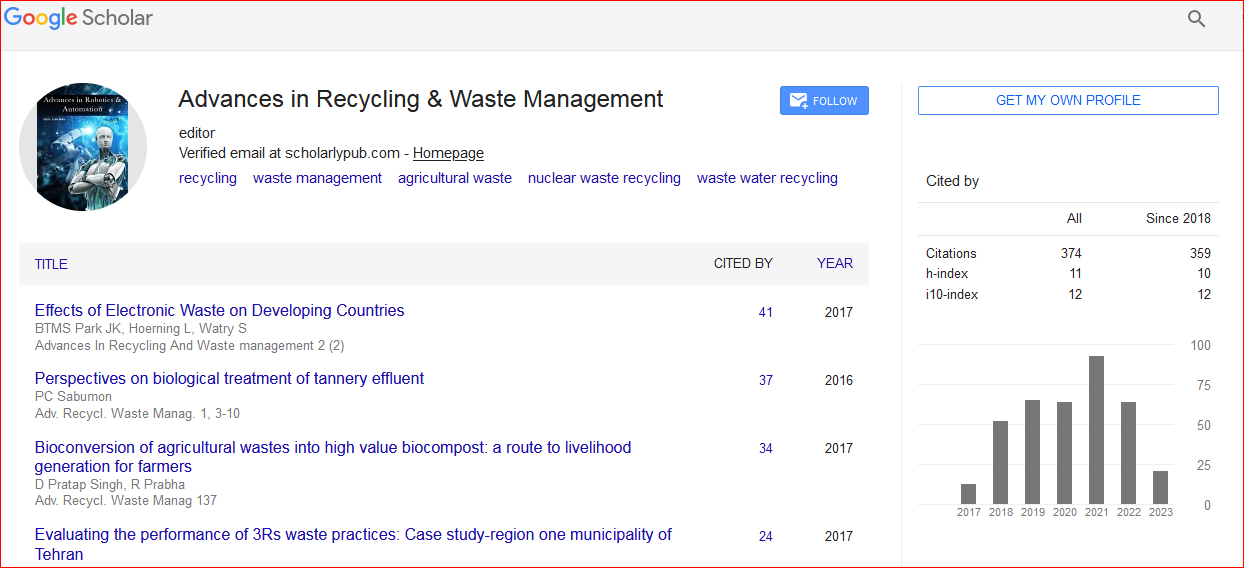
Advances in Recycling & Waste Management received 438 citations as per Google Scholar report