Brief Report - (2025) Volume 9, Issue 2
Received: 01-Apr-2025, Manuscript No. cmcr-25-177671;
Editor assigned: 03-Apr-2025, Pre QC No. P-177671;
Reviewed: 17-Apr-2025, QC No. Q-177671;
Revised: 22-Apr-2025, Manuscript No. R-177671;
Published:
29-Apr-2025
, DOI: 10.37421/2684-4915.2025.9.362
Citation: Iyer, Rajesh. ”Research Drives Diverse Medical Progress, Better Outcomes.” Clin Med Case Rep 09 (2025):362.
Copyright: © 2025 Iyer R. This is an open-access article distributed under the terms of the Creative Commons Attribution License, which permits unrestricted use, distribution and reproduction in any medium, provided the original author and source are credited.
Real-world evidence highlights the effectiveness and safety of immune checkpoint inhibitors (ICIs) in a diverse patient population suffering from various solid tumors. Significant improvements in progression-free survival and overall survival have been observed across different cancer types, while detailed insights into the spectrum and management of immune-related adverse events were also provided. These findings strongly advocate for the broader application of ICIs and offer crucial guidance for patient selection and monitoring in everyday clinical practice[1].
Data from a meta-analysis on transcatheter aortic valve implantation (TAVI) outcomes in patients presenting with both aortic stenosis and atrial fibrillation suggest a complex interaction. While TAVI generally proves effective, the co-occurrence of atrial fibrillation markedly increases post-procedural risks, specifically elevating rates of stroke and mortality. This underscores the critical need for individualized treatment approaches and meticulous risk stratification when managing this specific patient demographic[2].
Long-term effectiveness and safety of deep brain stimulation (DBS) for Parkinson's disease have been thoroughly evaluated through a meta-analysis. This research clearly demonstrates that DBS leads to substantial improvements in motor symptoms, reduces the dependency on medication, and significantly enhances patients' quality of life over extended durations. Furthermore, the study pinpoints key factors that influence long-term outcomes and potential complications, offering vital information for careful patient selection and optimized post-operative care[3].
Clinical outcomes of remdesivir treatment in hospitalized COVID-19 patients were thoroughly examined in a pivotal study during the pandemic. This research conclusively showed that remdesivir notably reduced the time to recovery compared to a placebo, firmly establishing it as a viable early treatment option for specific severe cases. Such findings were instrumental in shaping initial therapeutic strategies during the global health crisis, highlighting the profound importance of timely antiviral interventions[4].
The effectiveness of Cognitive Behavioral Therapy (CBT) for depression has been systematically evaluated through a meta-analysis. This comprehensive review confirmed CBT's substantial efficacy in alleviating depressive symptoms and preventing relapse across a wide array of patient populations. These findings reinforce CBT's position as a foundational treatment for depression, underscoring its robust clinical outcomes both when used as a standalone therapy and in combination with pharmacotherapy[5].
Clinical benefits of SGLT2 inhibitors in patients with chronic kidney disease (CKD) were investigated via a systematic review and meta-analysis. This study compellingly demonstrated that these inhibitors significantly lower the risk of kidney failure progression, reduce cardiovascular events, and decrease all-cause mortality in CKD patients, irrespective of their diabetes status. This work firmly establishes their critical role in enhancing long-term outcomes for individuals living with kidney disease[6].
The effectiveness of high-flow nasal cannula (HFNC) therapy in pediatric patients suffering from acute respiratory distress was assessed in a multicenter study. The results clearly indicate that HFNC is both a safe and effective treatment choice, considerably lessening the need for intubation and improving overall clinical outcomes in this vulnerable demographic. This research advocates for the wider adoption of HFNC as a primary non-invasive ventilatory support in pediatric respiratory care settings[7].
Long-term clinical outcomes of living donor kidney transplantation (LDKT) were explored in a single-center retrospective study. This investigation highlighted the remarkably high graft and patient survival rates associated with LDKT, often showing superiority over deceased donor transplantation in several key aspects. The study further offers crucial insights into potential post-transplant complications and identifies factors that contribute to long-term success, thereby informing clinical practice and patient counseling[8].
The clinical efficacy and safety of various biologic therapies for moderate-to-severe psoriasis were systematically reviewed and meta-analyzed. This extensive study demonstrated that biologics significantly enhance skin clearance and elevate the quality of life for patients who have not responded adequately to conventional treatments. By comparing the effectiveness of different biologic agents, the research provides valuable guidance for personalized treatment selection, considering individual patient profiles and disease severity[9].
Clinical outcomes of femtosecond laser-assisted cataract surgery (FLACS) were rigorously compared against conventional phacoemulsification through a meta-analysis. The study concluded that both surgical techniques are generally safe and effective. However, FLACS may offer distinct advantages in terms of precision and a reduced rate of complications for certain surgical parameters, although overall visual outcomes largely remained comparable. This provides a thorough overview for surgeons, assisting them in selecting the most appropriate technique for diverse patient profiles[10].
Recent medical literature showcases significant advancements in the treatment of challenging diseases, particularly in oncology and immunology. Immune checkpoint inhibitors (ICIs) have demonstrated substantial real-world effectiveness and safety in patients with various solid tumors, leading to marked improvements in progression-free and overall survival. This evidence is instrumental in guiding better patient selection and management of immune-related adverse events [1]. Parallel to this, for chronic inflammatory conditions such as moderate-to-severe psoriasis, biologic therapies offer profound benefits. These treatments consistently show significant improvements in skin clearance and enhance quality of life for patients unresponsive to conventional treatments. Comparative analysis aids in tailoring personalized treatment plans, considering patient characteristics and disease severity [9].
Innovations continue to shape practices in cardiovascular and metabolic medicine. Transcatheter Aortic Valve Implantation (TAVI), while effective for aortic stenosis, requires careful consideration when patients also present with atrial fibrillation. Studies indicate that coexisting atrial fibrillation significantly increases post-procedural risks, including higher rates of stroke and mortality. This highlights the necessity for meticulous risk stratification and tailored strategies for this patient population [2]. Furthermore, in renal health, SGLT2 inhibitors have emerged as profoundly beneficial for patients with chronic kidney disease (CKD). These inhibitors significantly reduce the risk of kidney failure progression, mitigate cardiovascular events, and lower all-cause mortality, irrespective of diabetes status. This establishes their pivotal role in improving long-term outcomes for individuals with kidney disease [6].
Significant progress is also being made in neurological and mental health interventions. Therapies like Deep Brain Stimulation (DBS) for Parkinson's disease have demonstrated remarkable efficacy. Long-term studies confirm DBS substantially enhances motor symptoms, decreases medication reliance, and elevates quality of life over extended periods. Identifying factors that influence long-term success and understanding potential complications are critical for optimal patient selection and effective post-operative management [3]. Concurrently, in mental health, Cognitive Behavioral Therapy (CBT) has consistently proven its effectiveness for depression. A comprehensive meta-analysis confirmed its substantial efficacy in reducing depressive symptoms and preventing relapse across a wide array of patient groups. This evidence firmly reinforces CBT's status as a cornerstone treatment, whether utilized alone or in combination with pharmacotherapy [5].
Advancements in critical care and transplantation procedures continue to improve patient prognoses. In pediatric acute respiratory distress, High-Flow Nasal Cannula (HFNC) therapy has been evaluated as a safe and effective treatment option. Findings indicate that HFNC significantly reduces the need for invasive intubation and improves clinical outcomes in this vulnerable population. This evidence strongly supports its broader application as a first-line non-invasive ventilatory support in various pediatric care settings [7]. In organ transplantation, Living Donor Kidney Transplantation (LDKT) has shown excellent long-term graft and patient survival rates. Notably, LDKT often demonstrates superiority over deceased donor transplantation in several key aspects. Insights gained from studying post-transplant complications and factors contributing to sustained success are invaluable for refining clinical practice protocols and providing comprehensive patient counseling [8].
Surgical fields are also continuously refining techniques, alongside responses to global health crises. Femtosecond laser-assisted cataract surgery (FLACS) presents potential advantages in terms of surgical precision and a reduced rate of complications when compared to conventional phacoemulsification. While overall visual outcomes between the two techniques remain largely similar, the nuanced benefits of FLACS provide valuable insight for surgeons in selecting the optimal technique based on specific patient profiles [10]. Moreover, the unprecedented challenge of the COVID-19 pandemic spurred rapid therapeutic development. Remdesivir emerged as a critical treatment, with a pivotal study demonstrating its ability to significantly shorten the time to recovery in hospitalized patients compared to a placebo. This established remdesivir as an important early antiviral intervention, crucial in guiding initial therapeutic approaches during a global health emergency [4].
Recent medical research highlights advancements across diverse fields, improving patient care and outcomes. Studies show Immune Checkpoint Inhibitors (ICIs) are effective and safe for various solid tumors, significantly boosting progression-free and overall survival, guiding better patient selection. In cardiology, Transcatheter Aortic Valve Implantation (TAVI) is effective for aortic stenosis, but atrial fibrillation significantly increases post-procedural risks like stroke and mortality, emphasizing personalized strategies. Neurological care sees Deep Brain Stimulation (DBS) offering long-term benefits for Parkinson's disease, improving motor symptoms, reducing medication needs, and enhancing quality of life. During the COVID-19 pandemic, remdesivir was found to shorten recovery time in hospitalized patients, proving its value as an early antiviral intervention. Mental health treatments benefit from Cognitive Behavioral Therapy (CBT), which consistently reduces depressive symptoms and prevents relapse, solidifying its role as a core therapy. Nephrology research points to SGLT2 inhibitors significantly slowing chronic kidney disease progression, reducing cardiovascular events, and mortality, even for non-diabetic patients. Pediatric respiratory care improved with High-Flow Nasal Cannula (HFNC) therapy, effectively and safely reducing intubation needs in children with acute respiratory distress. Kidney transplantation outcomes are excellent with Living Donor Kidney Transplantation (LDKT), showing superior long-term graft and patient survival compared to deceased donor options. For dermatological conditions, biologic therapies are highly effective for moderate-to-severe psoriasis, improving skin clearance and patient quality of life where conventional treatments fall short. Finally, advancements in ophthalmology indicate femtosecond laser-assisted cataract surgery (FLACS) provides enhanced precision and potentially lower complication rates compared to traditional phacoemulsification, though overall visual outcomes remain similar.
None
None
Indexed at, Google Scholar, Crossref
Indexed at, Google Scholar, Crossref
Indexed at, Google Scholar, Crossref
Indexed at, Google Scholar, Crossref
Indexed at, Google Scholar, Crossref
Indexed at, Google Scholar, Crossref
Indexed at, Google Scholar, Crossref
Indexed at, Google Scholar, Crossref
Indexed at, Google Scholar, Crossref
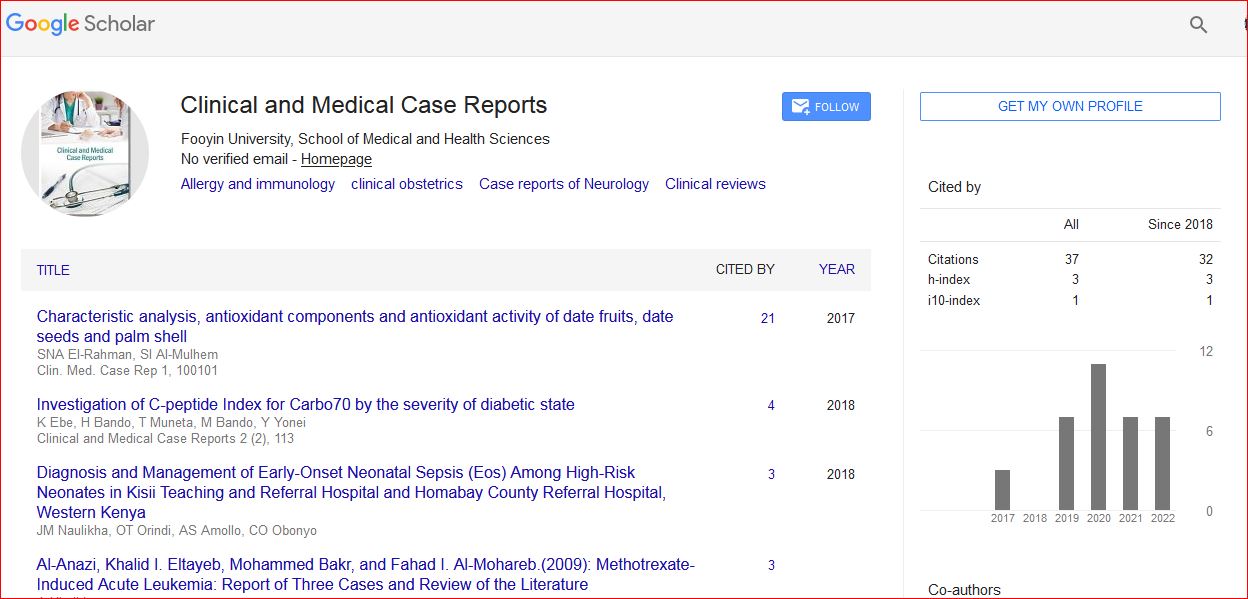
Clinical and Medical Case Reports received 53 citations as per Google Scholar report