Perspective - (2025) Volume 12, Issue 3
Received: 01-Jun-2025, Manuscript No. jreac-26-185789;
Editor assigned: 03-Jun-2025, Pre QC No. P-185789;
Reviewed: 17-Jun-2025, QC No. Q-185789;
Revised: 23-Jun-2025, Manuscript No. R-185789;
Published:
30-Jun-2025
, DOI: 10.37421/2380-2391.2025.12.429
Citation: Bergström, Hannah. ”Microplastic Research: Methods, Challenges, and Standardization.” J Environ Anal Chem 12 (2025):429.
Copyright: © 2025 Bergström H. This is an open-access article distributed under the terms of the Creative Commons Attribution License, which permits unrestricted use, distribution and reproduction in any medium, provided the original author and source are credited.
The pervasive presence of microplastics in marine environments necessitates robust analytical methodologies for their detection and quantification. Early research has established a baseline understanding of microplastic occurrence, prompting the development of more sophisticated analytical techniques to characterize these particles accurately. This field of study is rapidly evolving, driven by the need to assess the full scope of microplastic pollution and its ecological implications [1].
Spectroscopic techniques have emerged as crucial tools for identifying microplastics within complex marine matrices. Fourier-transform infrared (FTIR) and Raman spectroscopy, in particular, offer distinct advantages in characterizing polymer types. However, their application is often challenged by sample preparation complexities and the need for extensive reference libraries to ensure reliable identification [2].
Complementary to spectroscopic methods, thermal analysis techniques such as Pyrolysis-Gas Chromatography/Mass Spectrometry (Py-GC/MS) provide a powerful means to determine the chemical composition of microplastics. This method is especially valuable for identifying polymer types and additives, though challenges related to sample matrix effects and sensitivity for smaller particles persist [3].
The integrity of microplastic analysis is fundamentally threatened by contamination. Preventing cross-contamination during sample collection, processing, and analysis is paramount. Rigorous adherence to best practices and the implementation of innovative contamination control strategies are essential for generating accurate and reliable data in this field [4].
Quantifying microplastics, particularly those in the smaller size fractions (e.g., below 100 micrometers), presents significant analytical hurdles. Traditional microscopy techniques often fall short for these diminutive particles, driving the increased reliance on advanced spectroscopic and thermal methods to bridge existing knowledge gaps regarding their abundance and impact [5].
A critical bottleneck in microplastic research is the lack of standardized protocols. The development and widespread adoption of harmonized approaches for sample collection, preparation, and identification are crucial for ensuring data comparability across studies and facilitating effective environmental monitoring and policy development [6].
For microplastics residing in marine sediments, efficient extraction is a prerequisite for accurate analysis. Density separation techniques play a vital role in isolating microplastics from interfering organic and inorganic matter. Optimizing these separation steps is key to improving subsequent identification and quantification accuracy and reducing analytical workload [7].
The transformation of microplastics in the marine environment through weathering processes significantly impacts their analytical detectability and environmental fate. Understanding how factors like UV radiation, mechanical abrasion, and biofouling alter plastic characteristics is crucial for accurate classification and predicting their behavior [8].
Assessing microplastic contamination within marine organisms introduces another layer of analytical complexity. Effective digestion protocols to remove biological matrices, alongside methods sensitive enough to detect ingested microplastics, are necessary to accurately evaluate their presence and accumulation in the marine food web [9].
Microscopy, including stereo and polarized light microscopy, serves as a valuable initial screening tool for larger microplastic fragments. While useful for rapid visual assessment and counting, it is typically insufficient on its own and requires supplementation with spectroscopic methods for definitive polymer identification and analysis of smaller particles [10].
The imperative to understand the extent of microplastic pollution in marine ecosystems has driven significant advancements in analytical chemistry. Comprehensive reviews of current methodologies highlight a suite of techniques, including advanced spectroscopic methods like FTIR and Raman spectroscopy, alongside thermal analytical approaches such as Py-GC/MS, each offering unique insights into microplastic identification and quantification [1].
These methods are crucial for discerning the distribution, fate, and ecological impact of these pervasive contaminants. Spectroscopic techniques, specifically FTIR and Raman spectroscopy, are central to the identification of microplastics within diverse marine samples. The effectiveness of these methods hinges on meticulous sample preparation to mitigate matrix interferences and enhance spectral quality. Furthermore, the development of comprehensive and accurate polymer reference libraries is indispensable for reliable identification, with ongoing research exploring strategies for high-throughput analysis to accelerate the pace of discovery [2].
Pyrolysis-Gas Chromatography/Mass Spectrometry (Py-GC/MS) offers a complementary and powerful approach for the chemical characterization of microplastics in marine environments. By optimizing pyrolysis conditions and employing sophisticated data interpretation, this technique enables the differentiation of various polymer types and their associated additives. However, researchers must contend with challenges posed by sample matrix effects and the method's sensitivity limitations when dealing with very small microplastic particles [3].
A persistent challenge that undermines the reliability of all microplastic analysis is the risk of contamination. This issue necessitates the strict implementation of best practices and the continuous development of innovative solutions to prevent cross-contamination at every stage of the analytical workflow. Vigilance in laboratory controls and meticulous sample handling are indispensable for ensuring the accuracy of results, particularly for the detection of low-concentration and small-sized microplastics [4].
The accurate quantification of microplastics, especially those in the sub-100 micrometer size range, remains a significant analytical hurdle. As optical microscopy proves insufficient for these minute particles, researchers increasingly rely on advanced spectroscopic and thermal methods. Addressing these quantification challenges is vital for understanding the true prevalence and ecological significance of smaller microplastics and nanoplastics in marine ecosystems [5].
To foster robust and comparable research, the establishment of standardized analytical protocols is a critical necessity. The development and validation of harmonized approaches for microplastic sample collection, preparation, and identification are essential. Inter-laboratory comparisons and validation studies are vital to ensure the reliability of data generated globally, thereby informing effective environmental monitoring and policy decisions [6].
In the context of microplastic analysis in marine sediments, density separation is a fundamental step for efficient extraction. This process involves the careful selection of density solutions and mechanical separation techniques to effectively isolate microplastics from confounding organic and inorganic materials. Enhancing the efficiency of this initial separation directly contributes to improved accuracy and reduced workload in subsequent analytical stages [7].
The physical and chemical transformations that microplastics undergo in marine environments, collectively termed weathering, have profound implications for their analytical detection and environmental behavior. Understanding how factors such as UV radiation, mechanical abrasion, and biofouling alter the surface properties and chemical composition of plastics is critical for accurate identification and for predicting their ultimate fate and ecological impact [8].
Analyzing microplastics within biological tissues, such as marine organisms, presents unique challenges. Effective methods require efficient digestion protocols to remove organic matter without degrading the plastics themselves. The high sensitivity required for detecting microplastics within complex biological matrices is paramount for accurately assessing ingestion and accumulation within the marine food web [9].
Visual examination using microscopy, including stereo and polarized light microscopy, serves as an effective initial step for the rapid identification and quantification of larger microplastic fragments. However, this method's limitations in terms of polymer type identification and the detection of smaller particles underscore the necessity of integrating it with more advanced spectroscopic techniques for a comprehensive analytical assessment [10].
This compilation of research highlights the critical analytical methods and challenges in microplastic research within marine environments. Key techniques discussed include FTIR, Raman spectroscopy, and Py-GC/MS for identification and characterization, alongside microscopy for initial screening. Significant emphasis is placed on the pervasive challenges of sample preparation, contamination control, and the need for standardized protocols to ensure data comparability. The difficulties in quantifying smaller microplastics and nanoplastics are addressed, as are the impacts of environmental weathering on plastic characteristics and the complexities of analyzing microplastics in biological tissues. Density separation is identified as a crucial extraction step for sediments. The overall narrative underscores the ongoing efforts to refine analytical approaches for a more accurate assessment of microplastic pollution.
None
None
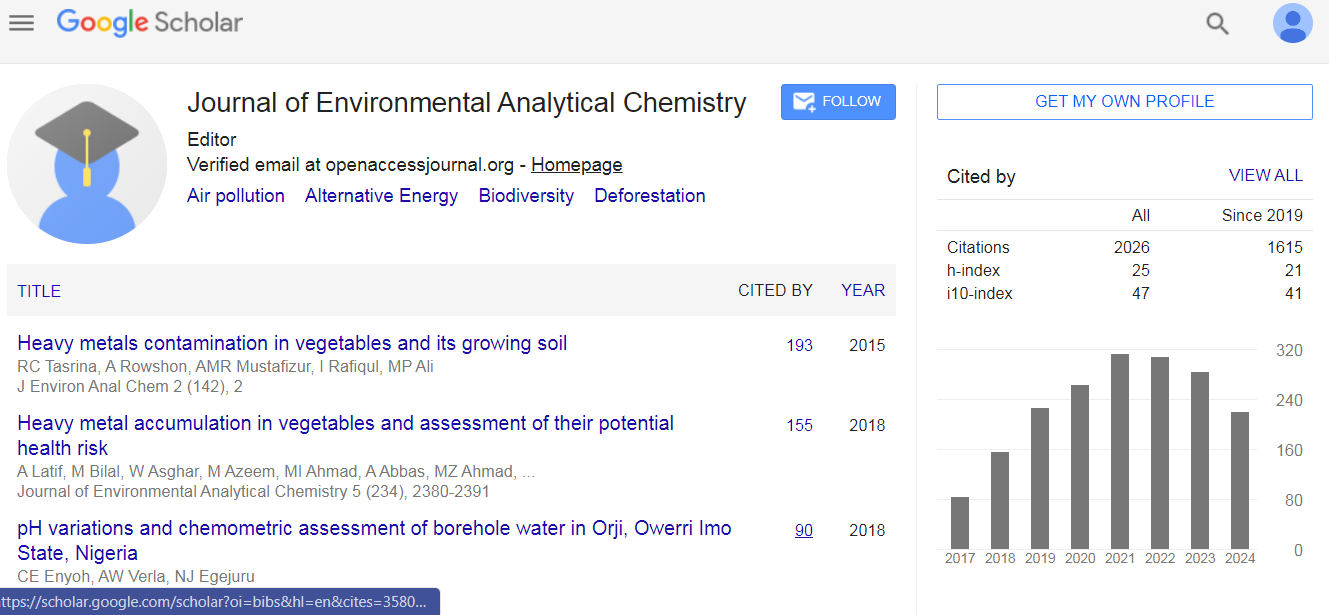
Journal of Environmental Analytical Chemistry received 1781 citations as per Google Scholar report