Perspective - (2025) Volume 10, Issue 2
Received: 01-Apr-2025, Manuscript No. jcct-26-183207;
Editor assigned: 03-Apr-2025, Pre QC No. P-183207;
Reviewed: 17-Apr-2025, QC No. Q-183207;
Revised: 22-Apr-2025, Manuscript No. R-183207;
Published:
29-Apr-2025
, DOI: 10.37421/2577-0535.2025.9.305
Citation: Petrova, Elena. ”Real-World Evidence: Transforming Oncology Trials and Healthcare.” J Cancer Clin Trials 10 (2025):305.
Copyright: © 2025 Petrova E. This is an open-access article distributed under the terms of the Creative Commons Attribution License, which permits unrestricted use, distribution and reproduction in any medium, provided the original author and source are credited.
Real-world evidence (RWE) is becoming increasingly indispensable in the landscape of oncology clinical trials, offering profound insights that extend beyond the confines of strictly controlled experimental settings. This type of evidence is crucial for a comprehensive understanding of treatment effectiveness and safety profiles as they manifest across diverse and heterogeneous patient populations encountered in routine clinical practice. RWE plays a significant role in informing critical regulatory decisions, thereby shaping the approval pathways for new cancer therapies and interventions. Furthermore, it actively supports the burgeoning initiatives of value-based healthcare, ensuring that treatments deliver demonstrable benefits relative to their cost and resource utilization [1].
The integration of RWE into clinical trial methodologies promises to accelerate the drug development process, enabling a more rapid translation of scientific discoveries into clinical applications. It also empowers researchers to optimize the design of future clinical trials, making them more efficient and representative of real-world patient experiences. Ultimately, RWE provides a more holistic and nuanced picture of a therapy's impact when used in the everyday clinical environment, moving beyond the idealized conditions of traditional trials [1].
In contemporary oncology research, there is a growing emphasis on leveraging real-world data (RWD) to augment and enhance traditional clinical trial designs, moving towards a more integrated approach to evidence generation. This strategic application of RWD is particularly valuable for conducting robust comparative effectiveness research, allowing for direct comparisons between different treatment modalities as they are used in practice. Moreover, RWD aids significantly in patient stratification, enabling the identification of specific subgroups of patients who are most likely to benefit from particular therapies, thereby personalizing treatment strategies. A key innovation is the generation of synthetic control arms using RWD, which can potentially lead to substantial reductions in both the cost and the timelines associated with conducting clinical trials. The insights gleaned from RWD, especially when applied to heterogeneous patient groups, are critically important for a true understanding of treatment outcomes as they are realized in everyday clinical care, bridging the gap between trial results and clinical reality [2].
The pivotal role of real-world evidence (RWE) in supporting regulatory submissions and ensuring effective post-market surveillance for oncology drugs is a subject of growing importance and intense scrutiny. RWE is uniquely positioned to provide essential evidence regarding the long-term effectiveness and safety of cancer therapies when administered to broad and varied patient populations in real-world settings. This complementary data stream is vital for substantiating findings from randomized controlled trials (RCTs), offering a more pragmatic view of a drug's performance. The authors strongly emphasize that for RWE to be considered credible and reliable for regulatory purposes, there must be an unwavering commitment to data quality and the rigorous application of sound methodological principles throughout the entire evidence generation process [3].
This particular paper delves into the multifaceted use of real-world data (RWD) throughout the entire lifecycle of oncology clinical trials, from their initial development through to their execution and interpretation. A significant portion of the discussion is dedicated to addressing the inherent challenges associated with the use of RWD, including issues of data heterogeneity, the common problem of missing data, and the potential for various forms of bias to influence findings. The authors critically examine and propose methods designed to effectively overcome these limitations, advocating for standardized approaches to data collection and analysis. Such standardization is deemed essential to ensure that RWD can be reliably and accurately transformed into meaningful RWE, thereby enhancing its utility in informing clinical research and practice [4].
The authors present a comprehensive and in-depth overview of the critical role that real-world evidence (RWE) plays within the rapidly evolving field of precision oncology. They meticulously detail how RWE, which is derived from a variety of sources such as electronic health records (EHRs), cancer registries, and other clinical databases, can be instrumental in identifying novel biomarkers that predict treatment response. Furthermore, RWE is crucial for effectively stratifying patients to receive targeted therapies and for meticulously monitoring treatment outcomes within the context of actual clinical practice. A particularly emphasized strategy is the synergistic integration of RWE with genomic data, which is presented as a key pathway towards achieving significant advancements in the realm of personalized cancer care, tailoring treatments to individual patient profiles [5].
Ethical considerations and the practical challenges inherent in the utilization of real-world evidence (RWE) within the context of oncology clinical trials are thoroughly examined in this article. The discussion explicitly addresses a range of critical issues, including the paramount importance of safeguarding patient privacy and ensuring the security of sensitive health data. It also highlights the potential for bias to subtly influence RWE findings, underscoring the need for vigilance. To navigate these complexities, the authors strongly advocate for the adoption of transparent research practices, the establishment of robust governance frameworks to oversee RWE generation and use, and the clear articulation of ethical guidelines. Adherence to these principles is deemed essential for the responsible and judicious application of RWE in cancer research [6].
The integration of real-world data (RWD) into adaptive clinical trial designs specifically tailored for oncology presents a dynamic and promising approach to modern clinical research. This paper elucidates precisely how RWD can be strategically employed to inform critical real-time decision-making processes within the context of adaptive trials. This includes the flexible modification of sample sizes based on accumulating evidence, the judicious adjustment of treatment arms to optimize efficacy, or the precise identification of patient subgroups that demonstrate a particularly strong benefit from a given therapy. By enabling such dynamic adjustments, this integrated approach has the significant potential to markedly increase overall trial efficiency and substantially improve the likelihood of successfully achieving trial objectives [7].
This particular article focuses on the crucial application of real-world evidence (RWE) in the development and refinement of treatment guidelines and clinical pathways specifically designed for oncology. It meticulously details how RWE can furnish indispensable information regarding the comparative effectiveness and the associated costs of various treatment options as they are administered in routine clinical practice. This evidence-based approach is vital for supporting informed decision-making processes among healthcare providers, clinical oncologists, and policymakers alike. The authors consistently underscore the fundamental importance of employing robust and scientifically sound methodologies for the generation of RWE to ensure its reliability and utility in shaping clinical practice [8].
An exploration into the considerable potential of real-world data (RWD) to substantially enhance both the efficiency and the patient recruitment processes within early-phase oncology clinical trials is presented. The authors discuss practical strategies through which RWD can be effectively utilized to identify potentially eligible patients for participation in these complex trials, to predict patient responses to investigational therapies, and to optimize the selection of clinical trial sites. The article also thoughtfully acknowledges and addresses the inherent challenges associated with the seamless integration of RWD into the intricate and demanding landscape of early-phase oncology trial development and execution [9].
This review offers a critical and thorough examination of the diverse methodologies and sophisticated analytical approaches that are currently employed for the generation of real-world evidence (RWE) within the field of oncology. The scope of the review encompasses a wide array of RWD sources, detailed data cleaning techniques essential for ensuring data integrity, and advanced statistical methods utilized for establishing causal inference. The authors place a strong emphasis on the indispensable importance of maintaining transparency and ensuring reproducibility in all RWE studies. This commitment is crucial for upholding the credibility of the generated evidence and maximizing its utility in informing both critical clinical decision-making processes and the strategic design of future clinical trials [10].
Real-world evidence (RWE) is increasingly vital in oncology clinical trials, offering insights beyond controlled trial settings. RWE helps understand treatment effectiveness and safety in diverse patient populations, informs regulatory decisions, and supports value-based healthcare initiatives. Its integration can accelerate drug development, optimize trial design, and provide a more comprehensive picture of a therapy's impact in routine clinical practice. The Department of Translational Oncology, in Russia, likely explores how RWE can bridge the gap between research and clinical application, addressing specific challenges within their healthcare system [1].
This study examines the application of real-world data (RWD) to augment traditional clinical trial designs in oncology. It highlights how RWD can be used for comparative effectiveness research, patient stratification, and generating synthetic control arms, thereby potentially reducing trial costs and timelines. The insights gained from RWD in heterogeneous patient groups are crucial for understanding treatment outcomes in everyday clinical care [2].
The article discusses the role of real-world evidence (RWE) in supporting regulatory submissions and post-market surveillance for oncology drugs. It details how RWE can provide evidence of long-term effectiveness, safety, and value in broad patient populations, complementing data from randomized controlled trials (RCTs). The authors emphasize the importance of data quality and methodological rigor when generating RWE for regulatory purposes [3].
This paper explores the use of real-world data (RWD) in the development and execution of oncology clinical trials. It addresses the challenges associated with RWD, such as data heterogeneity, missing data, and potential biases, and discusses methods for overcoming these limitations. The authors advocate for the standardized collection and analysis of RWD to ensure its reliable use in generating RWE [4].
The authors provide a comprehensive overview of real-world evidence (RWE) in precision oncology. They discuss how RWE, derived from sources like electronic health records and cancer registries, can identify novel biomarkers, stratify patients for targeted therapies, and monitor treatment outcomes in real-world settings. The integration of RWE with genomic data is highlighted as a key strategy for advancing personalized cancer care [5].
This article focuses on the ethical considerations and challenges in using real-world evidence (RWE) in oncology clinical trials. It addresses issues such as patient privacy, data security, and the potential for bias in RWE. The authors emphasize the need for transparency, robust governance frameworks, and clear ethical guidelines to ensure the responsible use of RWE [6].
The paper examines the integration of real-world data (RWD) into adaptive clinical trial designs for oncology. It explains how RWD can inform real-time decision-making in adaptive trials, such as modifying sample size, adjusting treatment arms, or identifying subgroups that benefit most from therapy. This approach aims to increase trial efficiency and the likelihood of success [7].
This article discusses the use of real-world evidence (RWE) to inform treatment guidelines and clinical pathways in oncology. It highlights how RWE can provide crucial information on the effectiveness and costs of different treatments in routine clinical practice, thereby supporting evidence-based decision-making for healthcare providers and policymakers. The authors emphasize the importance of robust RWE generation methods [8].
The authors explore the potential of real-world data (RWD) to improve the efficiency and patient recruitment in early-phase oncology clinical trials. They discuss how RWD can help identify eligible patients, predict treatment response, and optimize site selection. The article also touches upon the challenges of integrating RWD into the complex early-phase trial landscape [9].
This review critically examines the methodologies and analytical approaches used to generate real-world evidence (RWE) in oncology. It covers various RWD sources, data cleaning techniques, and statistical methods for causal inference. The authors stress the importance of transparency and reproducibility in RWE studies to ensure their credibility and utility in clinical decision-making and trial design [10].
Real-world evidence (RWE) and real-world data (RWD) are increasingly instrumental in oncology clinical trials, offering insights into treatment effectiveness and safety in diverse patient populations beyond controlled settings. RWE aids in informing regulatory decisions and supporting value-based healthcare, potentially accelerating drug development and optimizing trial designs. The use of RWD can enhance traditional trial designs by enabling comparative effectiveness research, patient stratification, and the creation of synthetic control arms, leading to cost and timeline reductions. RWE is also crucial for regulatory submissions and post-market surveillance, providing long-term data on drug performance. Methodological considerations, including data heterogeneity and bias, are critical for reliable RWE generation. Furthermore, RWE plays a role in precision oncology by identifying biomarkers and stratifying patients for targeted therapies. Ethical considerations such as privacy and data security are paramount. RWD integration into adaptive trials can improve efficiency and decision-making. Finally, RWE supports the development of treatment guidelines and clinical pathways, while also holding potential for enhancing early-phase oncology trials.
None
None
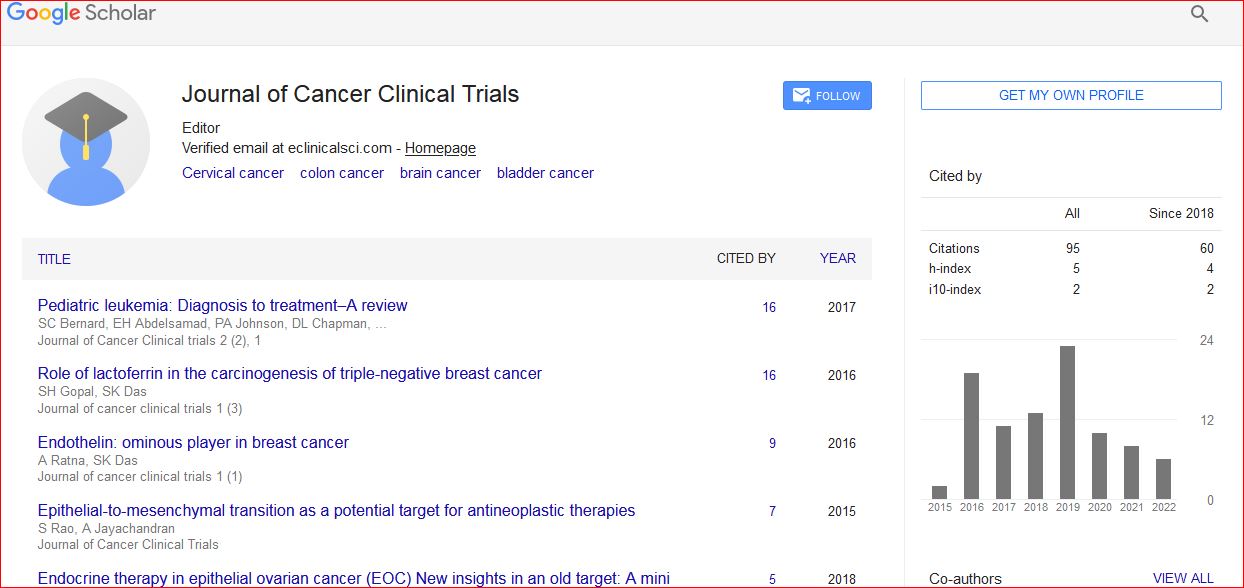
Journal of Cancer Clinical Trials received 95 citations as per Google Scholar report