Short Communication - (2025) Volume 9, Issue 2
Received: 02-Apr-2025, Manuscript No. jgge-25-173728;
Editor assigned: 04-Apr-2025, Pre QC No. P-173728;
Reviewed: 18-Apr-2025, QC No. Q-173728;
Revised: 23-Apr-2025, Manuscript No. R-173728;
Published:
30-Apr-2025
, DOI: 10.37421/2684-4567.2025.9.165
Citation: Tanaka, Hiroshi. ”Rare Variants: Diagnosis to Precision Medicine.” J Genet Genom 09 (2025):165.
Copyright: © 2025 Tanaka H. This is an open-access article distributed under the terms of the Creative Commons Attribution License, which permits unrestricted use,
distribution and reproduction in any medium, provided the original author and source are credited.
Whole Exome Sequencing (WES) has transformed the diagnosis of rare genetic diseases, systematically analyzing its application, diagnostic yield, and effectiveness in identifying pathogenic variants across various complex conditions. What this really means is WES is a powerful tool, increasingly essential for pinpointing the genetic causes of disorders that were previously hard to diagnose. [1] Understanding how both rare and common genetic variants contribute to complex diseases is a major challenge in human genetics. Research explores their respective roles, discussing methods to disentangle their effects and suggesting that an integrated approach is crucial. Here's the thing: itâ??s not just one type of variant; a combination of subtle common differences and impactful rare ones shapes our disease risk. [2] Pinpointing rare genetic variants is one thing, but understanding what they actually do functionally is the next critical step. Articles review current methods for functionally characterizing these variants, emphasizing high-throughput assays and computational predictions that bridge the gap between genotype and phenotype. Let's break it down: we need better ways to test if a rare genetic change actually impacts biology. [3] Machine Learning (ML) is rapidly transforming how we analyze rare genetic variants, especially in diagnosing Mendelian diseases. Papers explore the latest advancements in computational approaches, from variant prioritization to phenotypic prediction, highlighting their potential to accelerate diagnoses and improve patient care. What this really means is that Artificial Intelligence (AI) tools are becoming indispensable for making sense of complex genomic data in rare disease contexts. [4] Deciphering which rare genetic variants are truly pathogenic versus benign population variation is a critical challenge. Studies introduce frameworks to assess variant pathogenicity using large-scale population genetic data, demonstrating how allele frequency and constraint metrics can inform clinical interpretation. Here's the thing: by comparing individual variants to huge population datasets, we can better judge if a rare change actually causes disease. [5] Developing effective treatments for rare genetic diseases, often driven by specific rare variants, remains a significant hurdle. Reviews summarize the current landscape of therapeutic strategies, including gene therapies, RNA-based therapies, and small molecules, while outlining ongoing challenges and promising future directions. What this really means is that precision medicine is increasingly targeting the root genetic causes, but there's still a long way to go to bring these therapies to all patients. [6] While common genetic variants are often linked to cancer risk, the role of rare genetic variants is increasingly recognized as critical, especially in hereditary cancer syndromes. Papers review how rare germline variants contribute to individual cancer susceptibility, highlighting diagnostic implications and the need for comprehensive genomic screening. Let's break it down: beyond the usual suspects, rare genetic changes can also significantly elevate someone's risk of developing cancer. [7] Interpreting rare genetic variants in a clinical context is complex, requiring careful consideration of evidence across multiple domains. Articles discuss established guidelines and emerging challenges in variant interpretation, from single-gene analysis to integrating data from whole-genome sequencing for patient care. Here's the thing: translating raw genetic data into meaningful clinical information, especially for rare variants, demands a rigorous, standardized approach. [8] Rare genetic variants are increasingly identified as underlying causes of a wide spectrum of neurological and neurodevelopmental disorders, often presenting with complex and heterogeneous phenotypes. Reviews highlight the diagnostic utility of genomic sequencing in these conditions and the challenges in linking specific variants to precise clinical outcomes. What this really means is that unraveling the genetic basis of these brain disorders frequently comes down to finding those impactful rare changes. [9] While pharmacogenomics often focuses on common genetic polymorphisms, rare variants can have profound, individualized impacts on drug response and toxicity. Reviews discuss the emerging evidence for the role of rare variants in influencing drug metabolism, transport, and efficacy, emphasizing the need for comprehensive genomic profiling in personalized medicine. Here's the thing: for some people, it's those uncommon genetic differences that truly dictate how their body handles medication, making precision prescribing even more complex. [10]
The landscape of rare genetic disease diagnosis has been fundamentally reshaped by Whole Exome Sequencing (WES). This advanced genomic tool offers a systematic approach to identifying pathogenic variants, significantly improving diagnostic yields for previously challenging conditions. What this really means is WES is now essential for pinpointing the genetic root causes of many disorders [1]. Moreover, understanding the intricate contribution of both rare and common genetic variants to complex diseases represents a major frontier in human genetics. It's not just one type of variant; a combination of subtle common differences and impactful rare ones collectively shapes an individual's disease risk, necessitating an integrated research approach [2].
Beyond simply identifying rare genetic variants, the crucial next step involves functionally characterizing what these variants actually do. Current methodologies leverage high-throughput assays and computational predictions to bridge the gap between genotype and observable phenotype. Let's break it down: we need better ways to experimentally validate if a rare genetic change truly impacts biological processes [3]. Complementing this, Machine Learning (ML) is quickly becoming indispensable for analyzing rare genetic variants, particularly in the diagnosis of Mendelian diseases. Advanced computational approaches, ranging from variant prioritization to phenotypic prediction, hold immense potential to accelerate diagnoses and significantly enhance patient care. What this really means is that Artificial Intelligence (AI) tools are now critical for interpreting vast and complex genomic data in rare disease contexts [4].
A significant hurdle in clinical genomics is deciphering which rare genetic variants are genuinely pathogenic versus those that are benign population variations. To address this, a framework has been developed that assesses variant pathogenicity using large-scale population genetic data, incorporating allele frequency and constraint metrics to inform clinical interpretation. Here's the thing: by comparing individual variants against massive population datasets, we can more accurately judge if a rare genetic alteration is disease-causing [5]. Consequently, the clinical interpretation of rare genetic variants is inherently complex, demanding careful consideration of evidence from multiple domains. This process has led to the establishment of guidelines and ongoing efforts to overcome emerging challenges, from single-gene analysis to integrating comprehensive whole-genome sequencing data for direct patient benefit. Here's the thing: translating raw genomic data into clinically actionable information, especially for rare variants, requires a rigorous and standardized methodology [8].
Rare genetic variants are increasingly implicated as underlying causes for a broad range of conditions, extending beyond classic Mendelian diseases. They are recognized as critical contributors to individual cancer susceptibility, especially within hereditary cancer syndromes, highlighting the necessity for comprehensive genomic screening beyond common variants. Let's break it down: rare genetic changes can also significantly elevate someone's risk of developing cancer [7]. Furthermore, these variants are identified as key drivers of many neurological and neurodevelopmental disorders, which often present with complex and varied phenotypes. Genomic sequencing proves invaluable for diagnosis in these conditions, though challenges remain in precisely linking specific variants to clinical outcomes [9].
Finally, the impact of rare genetic variants extends profoundly into pharmacogenomics. While much of pharmacogenomic research focuses on common genetic polymorphisms, rare variants can exert individualized effects on drug response and toxicity. This necessitates a broader approach to personalized medicine, emphasizing comprehensive genomic profiling to account for these uncommon genetic differences that truly dictate how an individual's body handles medication, making precision prescribing even more complex [10]. Despite these advancements in understanding, developing effective treatments for rare genetic diseases driven by specific rare variants remains a substantial hurdle. Current therapeutic strategies, including gene, RNA-based, and small molecule therapies, show promise, yet significant challenges persist in bringing these precision medicines to all affected patients. What this really means is that while we are increasingly targeting the genetic roots of diseases, the journey to universal access to these therapies is still ongoing [6].
Rare genetic variants are increasingly recognized as pivotal factors in human health and disease. Whole Exome Sequencing (WES) has emerged as a transformative diagnostic tool for rare genetic diseases, offering a powerful method to pinpoint underlying genetic causes that were previously elusive. Understanding the interplay between rare and common genetic variants is crucial for unraveling complex disease etiologies, suggesting that both subtle common differences and impactful rare ones contribute to disease risk. Beyond identification, functionally characterizing these rare variants is the next critical step, bridging the gap between genotype and phenotype through high-throughput assays and computational predictions. Machine Learning (ML) is revolutionizing the analysis of these variants, particularly in Mendelian diseases, by accelerating diagnoses and improving patient care through advanced computational approaches. A significant challenge lies in distinguishing pathogenic variants from benign population variations, where population-based genetic data, allele frequency, and constraint metrics prove invaluable for clinical interpretation. Clinical interpretation itself requires rigorous, standardized approaches, evolving from single-gene analysis to integrating comprehensive genomic data. Rare variants also play a critical role in hereditary cancer syndromes, necessitating comprehensive genomic screening to assess individual susceptibility. Their influence extends to neurological and neurodevelopmental disorders, where genomic sequencing is vital for diagnosis, despite challenges in linking specific variants to precise clinical outcomes. Finally, rare variants profoundly impact pharmacogenomics, dictating individualized drug responses and toxicity, underscoring the need for comprehensive genomic profiling in personalized medicine. Precision medicine aims to target these root genetic causes, though bringing effective gene, RNA-based, and small molecule therapies to all patients remains a significant hurdle. This body of research collectively highlights the pervasive and complex role of rare genetic variants across diagnosis, etiology, interpretation, and treatment in diverse medical fields.
None
None
1. Rosario N, Alessandro N, Giovanni N. "Whole Exome Sequencing in the Diagnostic Workup of Rare Genetic Diseases: A Systematic Review".Diagnostics (Basel) 11 (2021):1081.
Indexed at, Google Scholar, Crossref
2. Alexander G, Sang HL, Kenneth P. "The role of rare and common variants in complex disease".Nat Rev Genet 23 (2022):494-511.
Indexed at, Google Scholar, Crossref
3. Xu L, Yu L, Meng Z. "Functional characterization of rare genetic variants".Cell Mol Life Sci 78 (2021):323-339.
Indexed at, Google Scholar, Crossref
4. Annekatrien S, Steven VdS, L.E.L.M. V. "Machine learning for rare disease genomics: recent advances and future directions".Hum Mutat 43 (2022):1629-1647.
Indexed at, Google Scholar, Crossref
5. Nicola W, Iulia MA, Joshua DB. "Population-based assessment of rare variant pathogenicity".Nature 581 (2020):34-39.
Indexed at, Google Scholar, Crossref
6. Guoqiang C, Shasha H, Shaobin Z. "Therapeutic approaches for rare genetic diseases: current challenges and future perspectives".Signal Transduct Target Ther 8 (2023):48.
Indexed at, Google Scholar, Crossref
7. Sean MO, Daniel K, Malgorzata P. "Contribution of Rare Variants to Cancer Susceptibility".Cancers (Basel) 13 (2021):3519.
Indexed at, Google Scholar, Crossref
8. Sue R, Sherri B, Scott CB. "Clinical interpretation of genetic variants: from single genes to whole genomes".Genome Med 12 (2020):103.
Indexed at, Google Scholar, Crossref
9. Elizabeth EP, Felecia G, Lynette BW. "Rare Genetic Variants in Neurological and Neurodevelopmental Disorders".J Clin Med 9 (2020):3889.
Indexed at, Google Scholar, Crossref
10. Ann KD, Andrea T, Jonathan GH. "The Role of Rare Genetic Variants in Pharmacogenomics".Trends Pharmacol Sci 42 (2021):110-120.
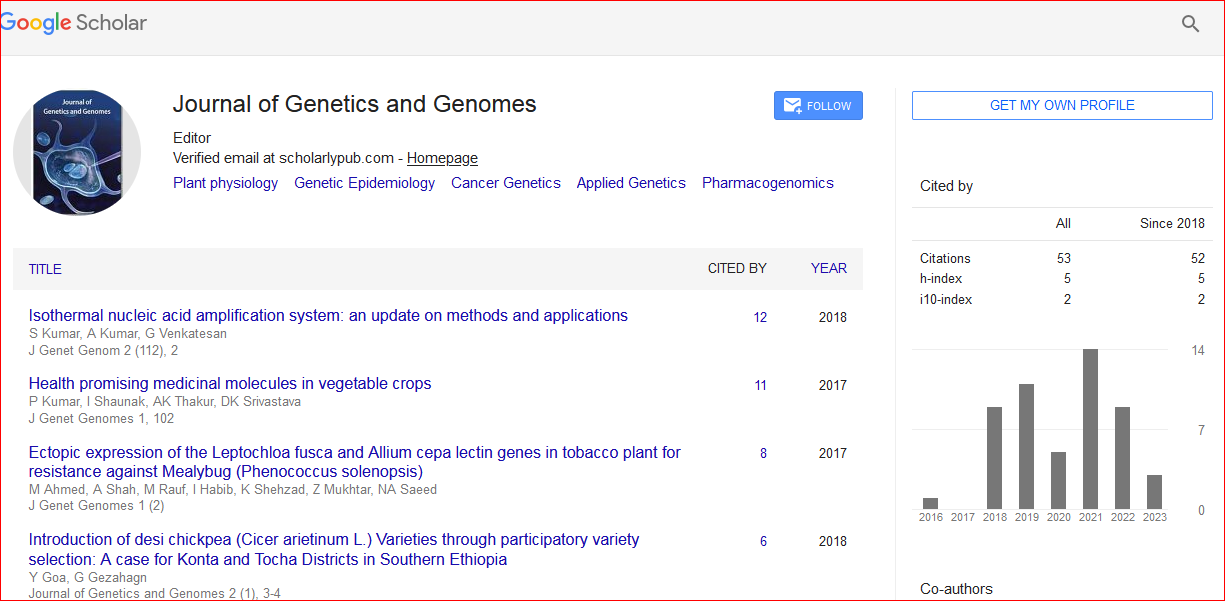
Journal of Genetics and Genomes received 65 citations as per Google Scholar report