Brief Report - (2025) Volume 9, Issue 3
Received: 02-Jun-2025, Manuscript No. jgge-25-174475;
Editor assigned: 04-Jun-2025, Pre QC No. P-174475;
Reviewed: 18-Jun-2025, QC No. Q-174475;
Revised: 23-Jun-2025, Manuscript No. R-174475;
Published:
30-Jun-2025
, DOI: 10.37421/2684-4567.2025.9.178
Citation: Tanaka, Hiroshi. ”Rare Genetic Variants: Powering Precision Medicine.” J Genet Genom 09 (2025):178.
Copyright: © 2025 Tanaka H. This is an open-access article distributed under the terms of the Creative Commons Attribution License, which permits unrestricted use,
distribution and reproduction in any medium, provided the original author and source are credited.
The role of rare genetic variants in the etiology of common diseases is a significant area of focus, particularly concerning conditions like diabetes and cardiometabolic traits. It is understood that these variants, despite their low frequency, can have profound phenotypic effects and considerably contribute to disease risk, often characterized by large effect sizes. Advancements in sequencing technologies have been pivotal in their discovery, though challenges persist in interpreting their functional significance and overall clinical utility[1].
Significant progress in genomic technologies has profoundly impacted our ability to identify rare genetic variants, especially those implicated in various neurological diseases. These technological strides include diverse advanced sequencing methods, and their application paves the way for emerging therapeutic strategies that are built upon understanding these variants. This particularly emphasizes personalized medicine approaches tailored for complex neurological conditions[2].
The intricate relationship between rare genetic variants and cancer predisposition encompasses both germline mutations, which are inherited from parents, and somatic mosaicism, acquired throughout development. These specific variants can significantly elevate an individual's risk for various cancers. This highlights the critical importance of genetic testing and counseling as tools for early detection and for developing personalized prevention strategies[3].
Rare genetic variants exert a significant influence on the development and progression of diverse cardiovascular diseases. Contemporary genomic sequencing techniques have successfully unveiled a multitude of these variants, providing invaluable insights into underlying disease mechanisms. This progress opens new avenues for precision medicine in areas such as diagnosis, risk stratification, and the development of targeted therapies for inherited cardiac conditions[4].
Recent findings have shed light on the involvement of rare genetic variants in autism spectrum disorder (ASD). These variants, whether occurring de novo or inherited, contribute substantially to ASD susceptibility and the observed phenotypic heterogeneity of the condition. The importance of large-scale genomic studies combined with rigorous functional analyses is underscored to unravel the complex genetic architecture of ASD and inform future diagnostic and therapeutic interventions effectively[5].
Beyond disease etiology, rare genetic variants play an intricate role in individual drug responses, often in conjunction with polygenic risk scores. They can profoundly alter drug metabolism, modify efficacy, and impact adverse event profiles, ultimately leading to variable patient outcomes. This necessitates integrating comprehensive genomic data, including rare variants, into pharmacogenomic studies to personalize drug prescriptions and optimize therapeutic strategies for better patient care[6].
There is a growing recognition of the significant contribution of rare genetic variants in conferring susceptibility to autoimmune diseases. These variants exert their effects through their impact on immune pathways, which can significantly elevate disease risk beyond what common variants typically explain. Whole-exome and whole-genome sequencing are emphasized as crucial tools for uncovering these pivotal genetic determinants, leading to improved diagnosis and the potential for targeted therapeutic development[7].
The clinical utility of identifying rare genetic variants is continuously expanding within the framework of personalized medicine. Specifically, variants with high penetrance offer precise diagnostic insights, effectively guide treatment choices, and provide crucial information for risk assessment across a spectrum of diseases. The integration of comprehensive genomic data into routine clinical practice is highlighted as fundamental for moving towards more tailored and ultimately more effective healthcare solutions[8].
The identification of rare genetic variants is central to understanding and diagnosing developmental delay and intellectual disability. Advanced sequencing technologies have dramatically improved diagnostic yields for these complex conditions by successfully uncovering de novo and inherited pathogenic variants. Accurate genetic diagnosis is paramount for providing appropriate genetic counseling, facilitating informed family planning, and paving the way for potential future therapeutic interventions[9].
From a population genomics perspective, rare genetic variants exert a profound impact on complex human traits and overall health. They are recognized to contribute significantly to heritability and disease risk, frequently exhibiting larger effect sizes than more common variants. Effectively detecting and interpreting these rare variants within large population datasets requires sophisticated computational and statistical approaches, which in turn provide valuable insights into evolutionary processes and disease etiology[10].
Rare genetic variants exert a significant influence in the etiology of common diseases, often exhibiting substantial phenotypic effects and contributing considerably to disease risk through large effect sizes [1]. Advanced genomic sequencing techniques have been instrumental in unveiling a multitude of these variants, particularly in conditions like diabetes and cardiometabolic traits. The continuous progress in these technologies has provided crucial insights into underlying disease mechanisms, which in turn opens new avenues for precision medicine approaches in diagnosis, risk stratification, and targeted therapies for inherited cardiac conditions [1, 4]. The ongoing challenge for researchers and clinicians alike lies in fully interpreting their functional significance and establishing their definitive clinical utility [1].
These rare variants also critically impact neurological diseases, where outlining the progress in genomic technologies has greatly facilitated their identification. Understanding these variants is essential for developing new therapeutic strategies, emphasizing personalized medicine approaches for complex neurological conditions [2]. Similarly, rare genetic variants are increasingly implicated in autism spectrum disorder (ASD), with studies highlighting how these variants, often de novo or inherited, contribute substantially to ASD susceptibility and its observed phenotypic heterogeneity. The importance of large-scale genomic studies and thorough functional analyses is underscored to unravel the complex genetic architecture of ASD and inform future diagnostic and therapeutic interventions [5]. Furthermore, the identification of rare genetic variants is fundamental for understanding and diagnosing developmental delay and intellectual disability. Advanced sequencing technologies have drastically improved diagnostic yields for these complex conditions by successfully uncovering de novo and inherited pathogenic variants. Accurate genetic diagnosis in this context is paramount for providing appropriate genetic counseling, facilitating informed family planning, and paving the way for potential future therapeutic interventions [9].
The complex relationship between rare genetic variants and cancer predisposition involves distinguishing between germline mutations, inherited from parents, and somatic mosaicism, which is acquired during development. These specific variants can significantly increase an individual's risk for various cancers, highlighting the critical importance of genetic testing and counseling for early detection and for establishing personalized prevention strategies [3]. In the realm of autoimmune diseases, there is a growing recognition of how rare genetic variants confer susceptibility. The articles explain how these variants, through their impact on immune pathways, can significantly elevate disease risk beyond what common variants typically explain. The importance of whole-exome and whole-genome sequencing is thus underscored as crucial tools for uncovering these pivotal genetic determinants, leading to improved diagnosis and fostering targeted therapeutic development [7].
Beyond direct disease causation, rare genetic variants intricately influence individual drug responses, often in concert with polygenic risk scores. They can profoundly alter drug metabolism, modify efficacy, and impact adverse event profiles, ultimately leading to variable patient outcomes. Consequently, the integration of comprehensive genomic data, including the profiles of rare variants, into pharmacogenomic studies is strongly advocated to personalize drug prescriptions and optimize therapeutic strategies for better patient care [6]. Moreover, the clinical utility of identifying rare genetic variants is continuously expanding within the broader framework of personalized medicine. Specifically, those variants with high penetrance offer precise diagnostic insights, effectively guide treatment choices, and provide crucial information for risk assessment across a spectrum of diseases. The overarching emphasis is on integrating genomic data more comprehensively into routine clinical practice to move towards more tailored and ultimately more effective healthcare solutions [8].
From a population genomics perspective, rare genetic variants exert a profound impact on complex human traits and overall health. They are recognized to contribute significantly to heritability and disease risk, frequently exhibiting larger effect sizes than more common variants. Effectively detecting and interpreting these rare variants within extensive large population datasets demands sophisticated computational and statistical approaches. Such analyses provide valuable insights into evolutionary processes and contribute significantly to our understanding of disease etiology at a population level [10].
Rare genetic variants are increasingly recognized as pivotal contributors to the etiology of various common and complex human diseases. Despite their low frequency, these variants often exert significant phenotypic effects and substantially increase disease risk, frequently with large effect sizes. Advances in genomic sequencing technologies, including whole-exome and whole-genome sequencing, have dramatically improved our ability to discover and identify these crucial genetic determinants across a spectrum of conditions. The impact of rare variants is broad, affecting areas from cardiometabolic traits like diabetes to neurological disorders, cancer predisposition, and cardiovascular diseases. They play a significant role in conditions such as autism spectrum disorder and developmental delay, where accurate genetic diagnosis is vital for counseling and intervention. Furthermore, rare variants influence susceptibility to autoimmune diseases and critically affect individual drug responses, highlighting their importance in pharmacogenomics. The expanding clinical utility of these variants underscores their role in personalized medicine, providing precise diagnostic insights, guiding treatment choices, and informing risk assessment. Integrating genomic data into clinical practice is key to tailoring effective healthcare and understanding complex traits from a population genomics perspective.
None
None
1. Kukurba, KR, Mahajan, A, Pospisilik, JA. "Rare Genetic Variants and Common Diseases: A Focus on Diabetes and Cardiometabolic Traits".Trends Endocrinol Metab 34 (2023):341-351.
Indexed at, Google Scholar, Crossref
2. Chen, T, Wang, M, Hu, B. "Rare genetic variants in neurological diseases: a review of current genomic technologies and therapeutic approaches".Ann Transl Med 11 (2023):175.
Indexed at, Google Scholar, Crossref
3. Susak, M, Marjanovic, D, Marjanovic, N. "Rare Genetic Variants and Cancer Predisposition: From Germline to Somatic Mosaicism".Int J Mol Sci 23 (2022):14781.
Indexed at, Google Scholar, Crossref
4. Ware, JS, Walsh, R, Buchan, RJ. "The role of rare genetic variants in cardiovascular disease".Nat Rev Cardiol 20 (2023):406-422.
Indexed at, Google Scholar, Crossref
5. An, J, Jiang, W, Liu, Y. "Rare genetic variants in autism spectrum disorder: a review of recent advances".Hum Genet 141 (2022):11-26.
Indexed at, Google Scholar, Crossref
6. Li, J, Zhou, W, Wu, Q. "Rare genetic variants, polygenic risk scores, and drug response: A comprehensive review".Pharmacol Res 195 (2023):106889.
Indexed at, Google Scholar, Crossref
7. Zhernakova, A, Franke, L, Trynka, G. "The contribution of rare genetic variants to autoimmune disease susceptibility".Nat Rev Rheumatol 16 (2020):367-380.
Indexed at, Google Scholar, Crossref
8. Ashley, EA, Scharfe, C, Quertermous, T. "The clinical utility of rare genetic variants in personalized medicine".Genome Med 13 (2021):47.
Indexed at, Google Scholar, Crossref
9. Vissers, LELM, Gilissen, C, Veltman, JA. "Rare genetic variants associated with developmental delay/intellectual disability".Clin Genet 96 (2019):287-296.
Indexed at, Google Scholar, Crossref
10. Lohmueller, KE, Fuller, ZL, Moorjani, P. "The impact of rare genetic variants on complex traits and human health: a population genomics perspective".Curr Opin Genet Dev 63 (2020):68-73.
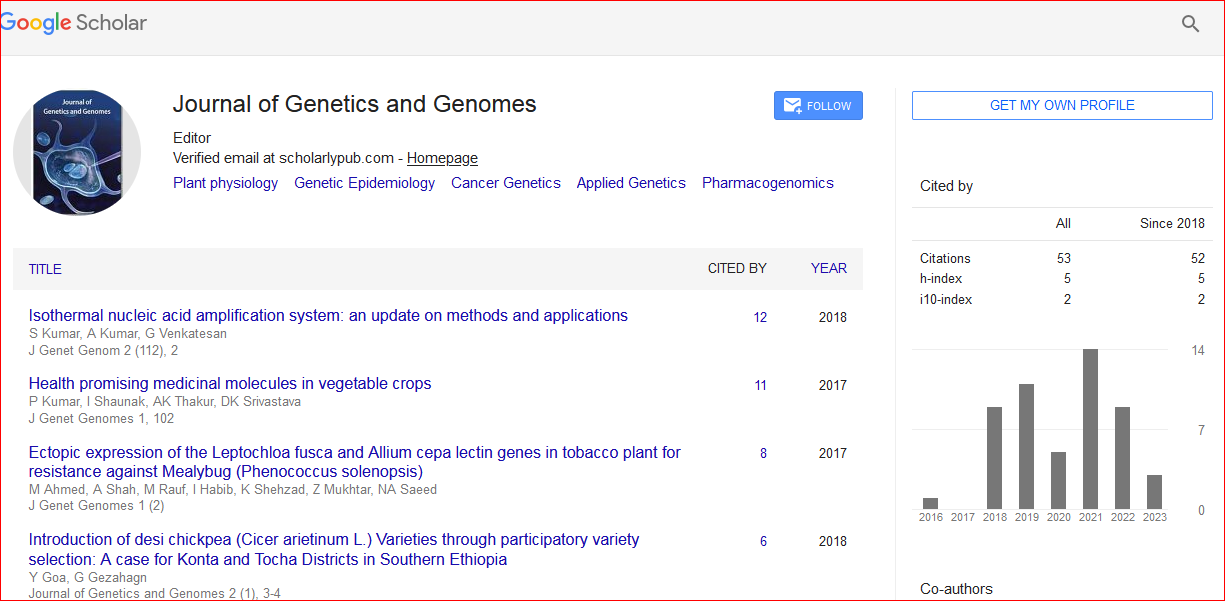
Journal of Genetics and Genomes received 65 citations as per Google Scholar report