Perspective - (2025) Volume 14, Issue 3
Received: 01-May-2025, Manuscript No. mcce-26-190175;
Editor assigned: 05-May-2025, Pre QC No. P-190175;
Reviewed: 19-May-2025, QC No. Q-190175;
Revised: 22-May-2025, Manuscript No. R-190175;
Published:
29-May-2025
, DOI: 10.37421/2470-6965.2025.14.409
Citation: Hassan, Laila. ”Rapid Diagnostic Tests: Revolutionizing Malaria Management And Control.” Malar Contr Elimination 14 (2025):409.
Copyright: © 2025 Hassan L. This is an open-access article distributed under the terms of the Creative Commons Attribution License, which permits unrestricted use, distribution and reproduction in any medium, provided the original author and source are credited.
Rapid diagnostic tests (RDTs) are profoundly transforming the landscape of malaria case management, offering a beacon of hope in the global fight against this persistent disease. These innovative tools facilitate the swift and accurate identification of Plasmodium infections directly at the point of care, a critical advancement that empowers healthcare providers to initiate prompt and appropriate treatment. This precision in diagnosis not only ensures that patients receive the correct medication without delay but also significantly curtails the inappropriate use of antimalarial drugs, a major driver of drug resistance. Furthermore, the integration of RDTs into national malaria control programs has dramatically bolstered diagnostic capabilities, particularly in resource-limited settings where access to traditional laboratory diagnostics like microscopy may be scarce. This enhanced diagnostic capacity translates into improved patient outcomes, enabling healthcare systems to allocate their valuable resources more efficiently and effectively towards combating malaria. The cost-effectiveness of employing malaria RDTs in comparison to microscopy has been a subject of extensive research and exploration across diverse healthcare settings. While the initial procurement cost of RDTs may appear substantial, studies consistently highlight their economic viability in the long term. This is primarily attributed to the reduction in downstream treatment costs stemming from accurate diagnoses and the consequent avoidance of unnecessary interventions for non-malaria fevers. The findings from such analyses are instrumental in guiding public health policies and underscore the strategic importance of RDTs in optimizing national malaria control budgets and maximizing the impact of financial investments in disease management. The performance characteristics of different RDT brands are of paramount importance for ensuring the reliability and accuracy of malaria diagnosis in clinical practice. Rigorous scientific evaluation of these tests against established diagnostic benchmarks such as microscopy and molecular techniques like PCR is essential. Such assessments provide critical data that informs procurement decisions, helping health authorities to select the most sensitive and specific RDTs available on the market. Moreover, these studies emphasize the ongoing necessity for robust quality assurance mechanisms to uphold diagnostic accuracy and maintain the integrity of malaria surveillance and treatment strategies over time. Implementing malaria RDTs, especially in remote and underserved geographical areas, presents a unique set of challenges that necessitate carefully crafted strategies. Overcoming barriers related to accessibility, healthcare worker training, and the establishment of reliable supply chains is fundamental to maximizing the benefits of RDTs. Community engagement also plays a pivotal role, fostering understanding and trust in the technology among the populations it serves. Addressing these multifaceted challenges is crucial for leveraging RDTs effectively in the pursuit of malaria elimination goals. The direct impact of RDT-guided treatment on mitigating the burden of malaria in highly endemic regions cannot be overstated. By ensuring that antimalarial medications are administered only to individuals confirmed to have malaria through RDT testing, these tools play a crucial role in preserving the efficacy of existing drugs. This targeted approach to treatment is a cornerstone of efforts to combat antimalarial drug resistance and promotes a more rational and sustainable use of these vital medicines, a critical component in the long-term strategy for controlling and ultimately eliminating malaria. The technological evolution of malaria RDTs has been remarkable, moving from early-generation diagnostic platforms to sophisticated newer multiplex assays. These advanced RDTs possess the capability to detect multiple Plasmodium species simultaneously and can even identify markers associated with drug resistance. This ongoing innovation in RDT technology promises to further enhance their utility and expand their application in diverse epidemiological settings, significantly contributing to the global momentum towards malaria elimination and the development of more effective control strategies. Understanding the complete patient journey, from the initial onset of malaria-like symptoms through the diagnostic process and subsequent treatment, is indispensable for optimizing the implementation and impact of RDTs. Qualitative research that explores the experiences and perceptions of both patients and healthcare providers offers invaluable insights. These studies reveal how the introduction of RDTs can foster greater trust in diagnostic accuracy and improve patient adherence to prescribed treatment regimens, thereby enhancing the overall effectiveness of malaria case management. A significant concern in the widespread deployment of RDTs is the imperative to maintain their quality and ensure consistent performance in challenging field conditions. Strategies focused on quality assurance, such as the implementation of external quality assessment schemes and the provision of ongoing supportive supervision to healthcare workers, are vital. These measures are essential for guaranteeing that the results obtained from RDTs remain reliable, thereby underpinning effective malaria case management and ensuring that clinical decisions are based on accurate diagnostic information. Beyond individual patient care, RDTs are proving to be an indispensable tool for strengthening malaria surveillance and monitoring efforts. The ability of RDTs to provide near real-time data on malaria infection prevalence allows public health officials to pinpoint geographical hotspots of transmission, track epidemiological trends effectively, and dynamically adjust targeted vector control and case-finding strategies. This enhanced surveillance capability is crucial for guiding interventions and making informed decisions as countries progress towards malaria elimination. The influence of RDTs on antimalarial prescribing practices within primary healthcare settings has been demonstrably positive and significant. Research indicates a substantial decrease in both the over-prescription and under-prescription of antimalarial drugs when RDTs are utilized for diagnostic confirmation. This leads to more appropriate and effective treatment regimens, thereby playing a crucial role in slowing the development and spread of drug resistance, a persistent threat to malaria control efforts worldwide.
Rapid diagnostic tests (RDTs) are instrumental in revolutionizing malaria case management by enabling quick and accurate identification of Plasmodium infections at the point of care. This facilitates timely treatment, reduces the misuse of antimalarial drugs, and supports targeted interventions. The integration of RDTs into national malaria control programs has significantly improved diagnostic capacity, especially in resource-limited settings, leading to better patient outcomes and more efficient resource allocation [1].
This study explores the cost-effectiveness of using malaria RDTs compared to microscopy in various healthcare settings. It highlights how RDTs, despite their initial cost, can be more economically viable in the long run due to reduced treatment costs from accurate diagnosis and fewer unnecessary interventions. The findings underscore the importance of RDTs in optimizing malaria control budgets [2].
Evaluating the performance of different RDT brands is crucial for ensuring reliable malaria diagnosis. This research assesses the sensitivity and specificity of several commercially available RDTs against microscopy and PCR. It provides valuable insights for procurement decisions and highlights the need for ongoing quality assurance to maintain diagnostic accuracy [3].
This paper discusses the challenges and strategies for implementing malaria RDTs in remote and underserved areas. It emphasizes the importance of training healthcare workers, establishing effective supply chains, and fostering community engagement to maximize the benefits of RDTs in achieving malaria elimination goals [4].
The study investigates the impact of RDT-guided treatment on reducing the burden of malaria in regions with high endemicity. By ensuring that only confirmed malaria cases receive antimalarials, RDTs contribute to drug resistance mitigation and more rational drug use, a critical component for sustainable malaria control [5].
This review examines the evolution of malaria RDT technology, from early generation tests to newer multiplex platforms capable of detecting multiple Plasmodium species and drug resistance markers. It highlights the ongoing innovation in RDTs that will further enhance their utility in malaria elimination efforts [6].
Understanding the patient journey with malaria, from symptom onset to diagnosis and treatment, is key to optimizing RDT implementation. This qualitative study explores patient and healthcare provider experiences, revealing how RDTs can improve trust in diagnosis and adherence to treatment [7].
This article addresses the critical issue of maintaining the quality of malaria RDTs in the field. It discusses strategies for quality assurance, including external quality assessment schemes and supportive supervision, to ensure that RDT results remain reliable for effective case management [8].
The role of RDTs in surveillance and monitoring of malaria transmission is explored here. By providing real-time data on infection prevalence, RDTs can help identify hot spots, track trends, and inform targeted vector control and case-finding strategies, crucial for moving towards malaria elimination [9].
This research investigates the impact of RDTs on the appropriate prescription of antimalarial drugs in primary healthcare settings. It demonstrates a significant reduction in over-prescription and sub-prescription of antimalarials when RDTs are used, leading to more effective treatment regimens and potentially slowing the development of drug resistance [10].
Rapid diagnostic tests (RDTs) are revolutionizing malaria management by enabling quick, accurate diagnosis at the point of care. This leads to timely treatment, reduces antimalarial drug misuse, and improves diagnostic capacity, especially in resource-limited areas. RDTs are cost-effective in the long run, optimizing malaria control budgets. Evaluating RDT brand performance is crucial, highlighting the need for quality assurance. Implementation challenges in remote areas require strategies for training, supply chains, and community engagement. RDT-guided treatment significantly reduces malaria burden and mitigates drug resistance. Technological advancements in RDTs, including multiplex platforms, enhance their utility. Understanding patient and healthcare provider perspectives improves RDT implementation and adherence. Maintaining RDT quality through assurance schemes is vital for reliable results. RDTs also strengthen surveillance by providing real-time data for targeted interventions and elimination efforts. Finally, RDTs improve antimalarial prescribing practices, reducing inappropriate drug use and slowing resistance.
None
None
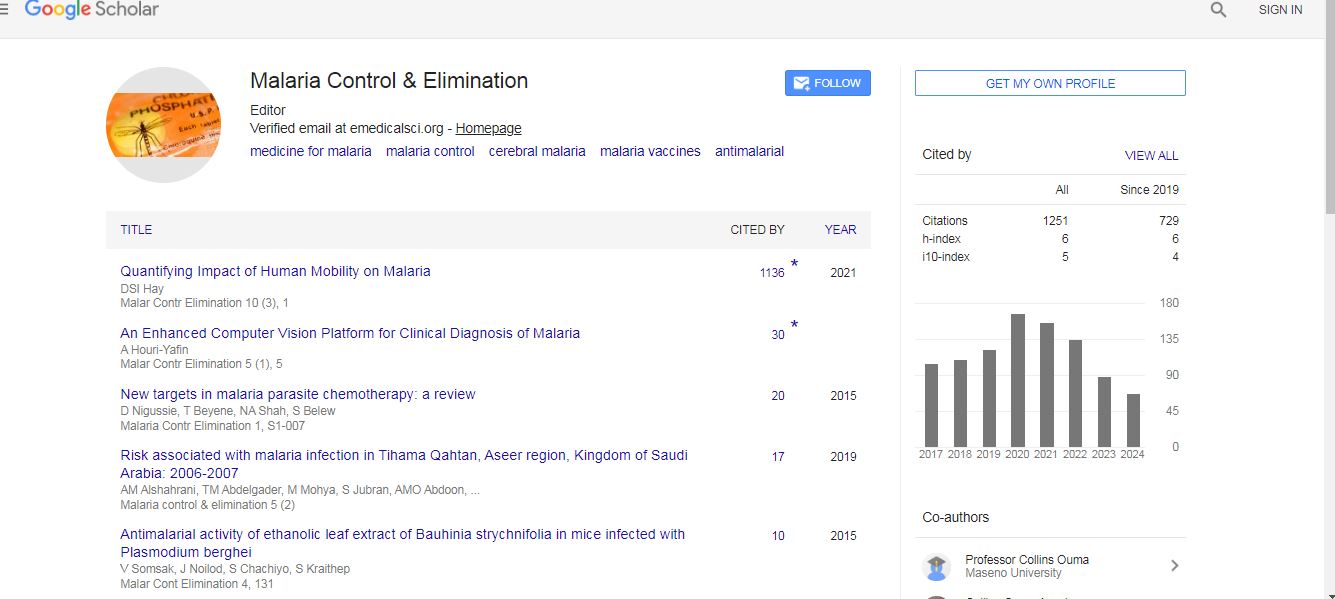
Malaria Control & Elimination received 1187 citations as per Google Scholar report