Commentary - (2025) Volume 12, Issue 3
Received: 01-Jun-2025, Manuscript No. jreac-26-185786;
Editor assigned: 03-Jun-2025, Pre QC No. P-185786;
Reviewed: 17-Jun-2025, QC No. Q-185786;
Revised: 23-Jun-2025, Manuscript No. R-185786;
Published:
30-Jun-2025
, DOI: 10.37421/2380-2391.2025.12.431
Citation: Al-Farsi, Amina. ”QuEChERS: Pesticide Residue Analysis in Soils.” J Environ Anal Chem 12 (2025):431.
Copyright: © 2025 Al-Farsi A. This is an open-access article distributed under the terms of the Creative Commons Attribution License, which permits unrestricted use, distribution and reproduction in any medium, provided the original author and source are credited.
The QuEChERS (Quick, Easy, Cheap, Effective, Rugged, and Safe) method has emerged as a cornerstone in the field of environmental analysis, particularly for the extraction and quantification of pesticide residues in complex matrices such as agricultural soil. Its inherent simplicity and efficiency have led to widespread adoption, driving innovation in analytical techniques for monitoring environmental contaminants. The application of QuEChERS in soil analysis is crucial for understanding the fate and transport of pesticides, assessing potential risks to ecosystems, and ensuring the safety of agricultural products. This study details the application of the QuEChERS method for the efficient extraction and analysis of pesticide residues in agricultural soil. The research highlights the method's suitability for handling complex soil matrices and its capacity for simultaneous multi-residue detection. Key advancements involve optimizing extraction parameters for different soil types and identifying sensitive and selective chromatographic-mass spectrometric techniques for accurate quantification. The findings underscore the importance of validated QuEChERS protocols for robust environmental monitoring and food safety assurance. [1] Significant research efforts have been dedicated to refining the QuEChERS approach to enhance its applicability and performance across a diverse range of analytes and matrices. This includes the development of modified protocols to address specific challenges, such as the extraction of polar pesticides or the analysis of aged soil samples. The continuous evolution of the QuEChERS methodology reflects its adaptability and its indispensable role in modern analytical chemistry. This research presents a refined QuEChERS approach for analyzing organophosphorus and pyrethroid pesticides in various soil samples. It focuses on improving extraction efficiency by evaluating different solvent combinations and sorbent materials. The study demonstrates high recovery rates and low limits of detection, confirming the method's sensitivity. This work contributes to establishing standardized protocols for reliable pesticide residue monitoring in agricultural soils, crucial for assessing environmental contamination. [2] The inherent complexity of soil matrices, characterized by variations in organic matter content, pH, and moisture, often necessitates method optimization to achieve accurate and reliable results. Researchers have investigated various factors influencing extraction efficiency, including the choice of extraction solvents, salt additions, and clean-up procedures. These investigations aim to minimize matrix effects and enhance the sensitivity and selectivity of the analytical method. The study investigates the effectiveness of the QuEChERS method coupled with Gas Chromatography-Mass Spectrometry (GC-MS) for the analysis of a broad spectrum of pesticide residues in diverse agricultural soil types. It addresses the challenges posed by soil organic matter and moisture content, proposing modifications to the standard QuEChERS procedure to mitigate matrix effects. The results show excellent linearity, accuracy, and precision, validating the method for routine environmental monitoring of pesticide contamination. [3] The development of advanced detection techniques, such as Liquid Chromatography-Mass Spectrometry (LC-MS/MS) and High-Resolution Mass Spectrometry (LC-HRMS), has significantly expanded the capabilities of QuEChERS-based analyses. These techniques offer superior sensitivity, selectivity, and the ability to identify and quantify a broad range of pesticide residues simultaneously, even at trace levels. This advancement is critical for comprehensive environmental risk assessment. This paper reports on the development and validation of a QuEChERS-based liquid chromatography-tandem mass spectrometry (LC-MS/MS) method for quantifying neonicotinoid insecticides in agricultural soils. The method is designed for high throughput and sensitivity, essential for monitoring these widely used but environmentally significant pesticides. The study demonstrates robust performance across different soil matrices, providing reliable data for risk assessment and regulatory purposes. [4] Furthermore, the environmental fate and persistence of pesticides in soil are critical concerns for sustainable agriculture and environmental protection. Studies employing QuEChERS have provided valuable insights into how different agricultural practices, soil types, and environmental conditions influence pesticide degradation and accumulation. This understanding is vital for developing effective strategies to mitigate pesticide contamination. This work evaluates the performance of the QuEChERS method for the analysis of persistent organic pollutants (POPs), including specific pesticide residues, in aged agricultural soils. The study focuses on optimizing extraction conditions to efficiently recover these often recalcitrant compounds. The proposed method offers a cost-effective and reliable approach for assessing long-term soil contamination by pesticides, contributing to a better understanding of their environmental fate. [5] The need for rapid and on-site screening methods has also been addressed through the adaptation of QuEChERS. Developing simplified protocols that can be performed in the field allows for preliminary assessment of contamination levels, enabling targeted sampling and timely decision-making in environmental monitoring programs. This accessibility is crucial for efficient resource allocation and rapid response. This study presents a multi-residue analytical method based on QuEChERS extraction followed by Liquid Chromatography-High Resolution Mass Spectrometry (LC-HRMS) for the analysis of a wide range of pesticides in agricultural soil. The HRMS provides enhanced selectivity and sensitivity, enabling the identification and quantification of numerous pesticide residues simultaneously. This approach is valuable for comprehensive soil quality assessments and the detection of emerging contaminants. [6] The challenges associated with analyzing polar pesticides, which exhibit different chemical properties compared to non-polar counterparts, have also spurred modifications to the standard QuEChERS protocol. These adaptations aim to improve the extraction efficiency and recovery of water-soluble pesticides, broadening the scope of QuEChERS applications in comprehensive environmental monitoring. This paper focuses on the adaptation of the QuEChERS method for the analysis of polar pesticides, such as glyphosate, in agricultural soils, which often pose extraction challenges. The study explores modified extraction and clean-up procedures to improve the recovery of these more water-soluble compounds. The developed method offers a practical solution for monitoring polar pesticide residues, expanding the scope of QuEChERS applications in environmental analysis. [7] The influence of agricultural practices on pesticide residue levels is another area where QuEChERS-based studies provide essential data. By comparing pesticide concentrations under different farming systems, researchers can evaluate the effectiveness of sustainable agriculture approaches in reducing pesticide load in the environment, informing policy and practice. This research investigates the influence of different agricultural practices on pesticide residue levels in soil, using the QuEChERS method for analysis. The study compares residue concentrations in soils managed with conventional versus organic farming techniques. The QuEChERS method proved effective in detecting and quantifying a range of pesticides, providing valuable data to understand the impact of farming systems on pesticide persistence in the environment. [8] The validation of analytical methods is paramount for ensuring the reliability and comparability of scientific data. Comprehensive validation studies, including assessment of linearity, accuracy, precision, and limits of detection and quantification, are essential for establishing the robustness of QuEChERS for routine use in environmental laboratories. This study reports on the development of a rapid and sensitive QuEChERS method for the on-site screening of pesticide residues in agricultural soils. The focus is on simplifying the extraction and clean-up steps to enable field analysis. The method demonstrated good correlation with laboratory-based analyses, offering a promising tool for preliminary risk assessment and targeted sampling strategies in environmental monitoring programs. [9] Finally, understanding the distribution and fate of pesticides across different soil depths is critical for a holistic assessment of soil contamination and its potential impact on groundwater. Validated QuEChERS methods enable researchers to systematically investigate pesticide behavior within the soil profile, informing soil management and remediation strategies. This paper presents a comprehensive validation study of the QuEChERS method for the determination of pesticide residues in different soil horizons of an agricultural field. The research addresses potential variations in extraction efficiency and matrix effects across soil depths. The validated method proves robust and reliable for assessing pesticide distribution and fate within the soil profile, providing critical information for soil management and remediation efforts. [10]
The QuEChERS methodology has been extensively adapted and refined for the analysis of pesticide residues in agricultural soils, a critical aspect of environmental monitoring and food safety assurance. Its fundamental principles of being Quick, Easy, Cheap, Effective, Rugged, and Safe contribute to its widespread applicability in diverse analytical laboratories. This study details the application of the QuEChERS method for the efficient extraction and analysis of pesticide residues in agricultural soil. The research highlights the method's suitability for handling complex soil matrices and its capacity for simultaneous multi-residue detection. Key advancements involve optimizing extraction parameters for different soil types and identifying sensitive and selective chromatographic-mass spectrometric techniques for accurate quantification. The findings underscore the importance of validated QuEChERS protocols for robust environmental monitoring and food safety assurance. [1] The optimization of QuEChERS protocols often involves tailoring extraction parameters to specific soil types and pesticide classes. Factors such as solvent composition, the addition of salts to enhance partitioning, and the selection of appropriate sorbents for dispersive solid-phase extraction (dSPE) clean-up are crucial for maximizing analyte recovery and minimizing matrix interferences. This research presents a refined QuEChERS approach for analyzing organophosphorus and pyrethroid pesticides in various soil samples. It focuses on improving extraction efficiency by evaluating different solvent combinations and sorbent materials. The study demonstrates high recovery rates and low limits of detection, confirming the method's sensitivity. This work contributes to establishing standardized protocols for reliable pesticide residue monitoring in agricultural soils, crucial for assessing environmental contamination. [2] The integration of QuEChERS with advanced detection techniques, such as Gas Chromatography-Mass Spectrometry (GC-MS) and Liquid Chromatography-Mass Spectrometry (LC-MS/MS), has greatly enhanced the analytical power for pesticide residue determination. GC-MS is well-suited for volatile and semi-volatile compounds, while LC-MS/MS offers superior performance for less volatile and thermally labile pesticides. The study investigates the effectiveness of the QuEChERS method coupled with Gas Chromatography-Mass Spectrometry (GC-MS) for the analysis of a broad spectrum of pesticide residues in diverse agricultural soil types. It addresses the challenges posed by soil organic matter and moisture content, proposing modifications to the standard QuEChERS procedure to mitigate matrix effects. The results show excellent linearity, accuracy, and precision, validating the method for routine environmental monitoring of pesticide contamination. [3] High-resolution mass spectrometry (HRMS) coupled with LC has further advanced the capabilities of QuEChERS-based analysis, enabling the simultaneous identification and quantification of a wide array of pesticides and their metabolites with high specificity and sensitivity. This allows for more comprehensive environmental profiling and the detection of emerging contaminants. This paper reports on the development and validation of a QuEChERS-based liquid chromatography-tandem mass spectrometry (LC-MS/MS) method for quantifying neonicotinoid insecticides in agricultural soils. The method is designed for high throughput and sensitivity, essential for monitoring these widely used but environmentally significant pesticides. The study demonstrates robust performance across different soil matrices, providing reliable data for risk assessment and regulatory purposes. [4] Addressing the challenges posed by different soil properties, such as high organic matter content or varying moisture levels, is a common focus in QuEChERS method development for soil analysis. Modifications to the standard procedure are often implemented to mitigate matrix effects and ensure consistent extraction efficiency across different soil types. This work evaluates the performance of the QuEChERS method for the analysis of persistent organic pollutants (POPs), including specific pesticide residues, in aged agricultural soils. The study focuses on optimizing extraction conditions to efficiently recover these often recalcitrant compounds. The proposed method offers a cost-effective and reliable approach for assessing long-term soil contamination by pesticides, contributing to a better understanding of their environmental fate. [5] The analysis of polar pesticides, which present unique extraction challenges due to their solubility characteristics, requires specific adaptations of the QuEChERS method. Researchers have explored modified extraction and clean-up strategies to improve the recovery and accuracy of these compounds, expanding the applicability of QuEChERS to a broader range of pesticide chemistries. This study presents a multi-residue analytical method based on QuEChERS extraction followed by Liquid Chromatography-High Resolution Mass Spectrometry (LC-HRMS) for the analysis of a wide range of pesticides in agricultural soil. The HRMS provides enhanced selectivity and sensitivity, enabling the identification and quantification of numerous pesticide residues simultaneously. This approach is valuable for comprehensive soil quality assessments and the detection of emerging contaminants. [6] The impact of agricultural practices on pesticide residue accumulation in soils is an area of significant research interest, with QuEChERS serving as a key analytical tool. Studies comparing conventional and organic farming systems help to elucidate the environmental benefits of sustainable practices and inform agricultural policy. This paper focuses on the adaptation of the QuEChERS method for the analysis of polar pesticides, such as glyphosate, in agricultural soils, which often pose extraction challenges. The study explores modified extraction and clean-up procedures to improve the recovery of these more water-soluble compounds. The developed method offers a practical solution for monitoring polar pesticide residues, expanding the scope of QuEChERS applications in environmental analysis. [7] The development of rapid, on-site screening methods based on QuEChERS is crucial for efficient environmental monitoring. Simplifying the extraction and clean-up procedures allows for field-deployable kits that provide preliminary data, enabling targeted sampling and immediate risk assessment, thus optimizing resource allocation in monitoring programs. This research investigates the influence of different agricultural practices on pesticide residue levels in soil, using the QuEChERS method for analysis. The study compares residue concentrations in soils managed with conventional versus organic farming techniques. The QuEChERS method proved effective in detecting and quantifying a range of pesticides, providing valuable data to understand the impact of farming systems on pesticide persistence in the environment. [8] Validation of QuEChERS methods is essential to ensure their reliability and reproducibility across different laboratories and for regulatory purposes. Comprehensive validation encompasses evaluating parameters such as linearity, accuracy, precision, selectivity, and limits of detection and quantification, confirming the method's suitability for its intended application. This study reports on the development of a rapid and sensitive QuEChERS method for the on-site screening of pesticide residues in agricultural soils. The focus is on simplifying the extraction and clean-up steps to enable field analysis. The method demonstrated good correlation with laboratory-based analyses, offering a promising tool for preliminary risk assessment and targeted sampling strategies in environmental monitoring programs. [9] Finally, understanding the spatial distribution and temporal dynamics of pesticide residues within different soil horizons is vital for a complete assessment of soil contamination. Validated QuEChERS methods enable systematic studies of pesticide movement and persistence in the soil profile, providing critical data for soil management and environmental remediation strategies. This paper presents a comprehensive validation study of the QuEChERS method for the determination of pesticide residues in different soil horizons of an agricultural field. The research addresses potential variations in extraction efficiency and matrix effects across soil depths. The validated method proves robust and reliable for assessing pesticide distribution and fate within the soil profile, providing critical information for soil management and remediation efforts. [10]
The QuEChERS method is a widely adopted technique for the extraction and analysis of pesticide residues in agricultural soils. Studies have focused on optimizing this method for various soil types and pesticide classes, often employing advanced detection techniques like GC-MS and LC-MS/MS. Research has also addressed the challenges of analyzing polar pesticides and the impact of agricultural practices on residue levels. The development of rapid, on-site screening methods and comprehensive validation studies are crucial for ensuring the reliability and practical application of QuEChERS in environmental monitoring and risk assessment. Understanding pesticide distribution within soil horizons further enhances its utility.
None
None
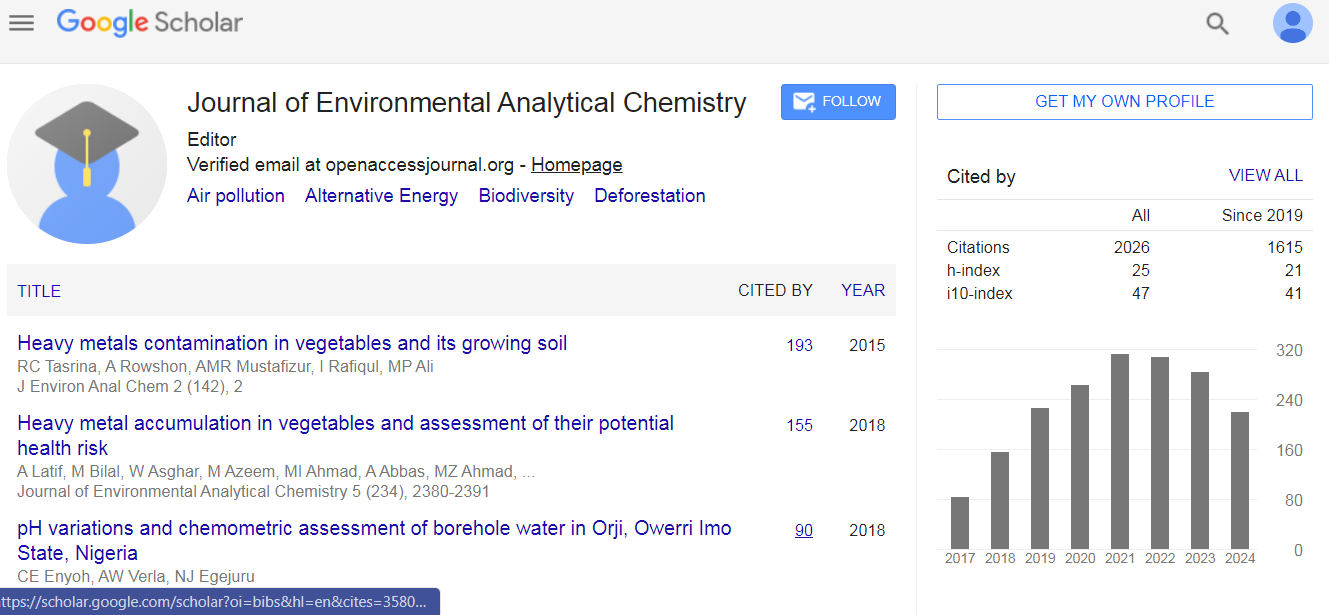
Journal of Environmental Analytical Chemistry received 1781 citations as per Google Scholar report