Brief Report - (2025) Volume 11, Issue 3
Received: 01-Aug-2025, Manuscript No. jmt-25-175181;
Editor assigned: 04-Aug-2025, Pre QC No. P-175181;
Reviewed: 18-Aug-2025, QC No. Q-175181;
Revised: 22-Aug-2025, Manuscript No. R-175181;
Published:
29-Aug-2025
, DOI: 10.37421/2471-271X.2025.11.347
Citation: Graves, Daniel. ”Psychotherapy: Enduring Efficacy, Adaptability, Accessibility.” J Ment Disord Treat 11 (2025):347.
Copyright: © 2025 Graves D. This is an open-access article distributed under the terms of the Creative Commons Attribution License, which permits unrestricted use, distribution and reproduction in any medium, provided the original author and source are credited.
This major review confirms that psychodynamic psychotherapy is really effective for a wide range of mental health issues. It shows that this therapy approach provides significant benefits, performing just as well as other established treatments for many disorders. The findings highlight its strong evidence base and its value as a core treatment option [1].
This comprehensive review underscores that Cognitive Behavioral Therapy (CBT) remains the gold standard for treating anxiety disorders. It outlines the current state of the evidence, affirming CBT's strong efficacy across various anxiety presentations, and also points towards critical areas for future research and refinement, like personalized approaches and broader dissemination [2].
This extensive network meta-analysis offers a critical look at psychological therapies for adult depression. It highlights that all major psychological treatments are generally more effective than usual care or control conditions. What this really means is that a variety of therapeutic approaches can offer significant relief for depression, reinforcing the importance of patient choice and access to different modalities [3].
Here's the thing about how psychotherapy works: this article argues that both common factors, like the therapeutic relationship, and specific techniques contribute to change. It emphasizes a transdiagnostic perspective, suggesting that understanding these universal elements, regardless of specific diagnosis, is key to improving treatment outcomes and tailoring interventions more effectively [4].
This systematic review and meta-analysis offers solid evidence that video psychotherapy is largely just as effective as traditional in-person therapy for adults. It suggests that moving sessions online doesn't compromise clinical outcomes, which is a big deal for expanding access to mental health care, especially for people who face barriers like distance or mobility [5].
This comprehensive meta-analysis confirms that psychotherapy is an effective treatment for various eating disorders. The findings reinforce that psychological interventions play a crucial role in recovery, providing vital support for clinicians in making evidence-based treatment decisions for individuals struggling with these complex conditions [6].
This meta-analysis definitively shows that Cognitive Behavioral Therapy (CBT) is highly effective for treating anxiety disorders in children and adolescents. It highlights the strong evidence base for CBT's positive impact on youth mental health, emphasizing its role as a primary intervention. This really means that early access to CBT can make a significant difference for young people struggling with anxiety [7].
This systematic review tackles a common concern, showing that the effectiveness of psychotherapy for adult depression has not decreased over recent decades. This is important because it counters the narrative that treatments might be losing their potency, affirming psychotherapy's consistent and enduring value as a treatment for depression [8].
This meta-analysis focuses on early intervention for psychosis, demonstrating that psychological interventions are effective for individuals experiencing a first episode. The findings emphasize the critical role of timely psychological support in improving outcomes and reducing symptoms during this crucial phase, pointing to the importance of integrated care models [9].
This systematic review makes a strong case for integrative psychotherapy, showing its effectiveness for common mental disorders. It highlights that combining elements from different therapeutic approaches often yields positive results, suggesting flexibility and tailored treatment plans can be very beneficial. What this means is that clinicians can thoughtfully blend techniques to best meet individual patient needs [10].
Research consistently highlights the broad effectiveness of psychotherapy across a diverse range of mental health conditions. Psychodynamic psychotherapy, for example, is confirmed to be highly effective for a wide array of mental health issues, providing significant benefits comparable to other established treatments. This robust evidence base positions it as a valuable core treatment option [1]. Similarly, for individuals struggling with eating disorders, psychotherapy offers crucial and effective support, with psychological interventions playing a vital role in recovery and informing evidence-based clinical decisions [6].
For adult depression, an extensive network meta-analysis reveals that all major psychological treatments are generally more effective than standard care or control conditions. This finding emphasizes that a variety of therapeutic approaches can provide substantial relief, reinforcing the importance of patient choice and ensuring access to different modalities [3]. It is also noteworthy that the effectiveness of psychotherapy for adult depression has not declined over recent decades, counteracting any concerns about treatment potency and affirming its consistent and enduring value [8].
Cognitive Behavioral Therapy (CBT) has emerged as a particularly strong intervention, especially for anxiety disorders. It is widely regarded as the gold standard for treating anxiety in adults, with strong evidence supporting its efficacy across various presentations. Future research areas include personalized approaches and broader dissemination to maximize its impact [2]. Expanding on this, CBT is definitively effective for anxiety disorders in children and adolescents. This strong evidence base points to the significant positive impact CBT can have on youth mental health, underscoring that early access can make a substantial difference for young people [7].
The mechanisms through which psychotherapy brings about change are multifaceted. This includes both common factors, such as the therapeutic relationship, and specific techniques. A transdiagnostic perspective suggests that understanding these universal elements, irrespective of a specific diagnosis, is key to improving treatment outcomes and tailoring interventions more effectively [4]. Building on this flexibility, integrative psychotherapy, which thoughtfully combines elements from various therapeutic approaches, demonstrates effectiveness for common mental disorders. This indicates that tailored treatment plans, blending techniques, can be very beneficial in meeting individual patient needs [10].
Furthermore, the accessibility and adaptability of psychotherapy continue to evolve. Video psychotherapy, for example, has been found to be largely as effective as traditional in-person therapy for adults. This is a significant development for expanding access to mental health care, especially for those facing geographical or mobility barriers, as it shows clinical outcomes are not compromised by online delivery [5]. Finally, early intervention plays a critical role in conditions like psychosis. Psychological interventions are effective for individuals experiencing a first episode of psychosis, emphasizing the importance of timely support in improving outcomes and reducing symptoms during this crucial phase, and highlighting the need for integrated care models [9].
Psychotherapy consistently proves to be an effective and adaptable treatment for a broad spectrum of mental health conditions, with its overall efficacy holding steady over recent decades. Specific modalities demonstrate significant benefits across various disorders. For example, psychodynamic psychotherapy is highly effective for a wide range of mental health issues, performing as well as other established treatments and solidifying its role as a core therapeutic option. Cognitive Behavioral Therapy (CBT) is widely recognized as the gold standard for treating anxiety disorders in adults, showing strong efficacy, and is also definitively effective for anxiety in children and adolescents, emphasizing the importance of early intervention. Beyond anxiety, psychological therapies, including a variety of approaches, are more effective than usual care for adult depression, reinforcing the value of patient choice. Psychotherapy also plays a crucial role in the recovery from eating disorders. For individuals experiencing a first episode of psychosis, timely psychological interventions are effective in improving outcomes. The mechanisms of change in psychotherapy involve both common factors, such as the therapeutic relationship, and specific techniques, suggesting a transdiagnostic perspective can enhance treatment. Integrative psychotherapy, which combines elements from different approaches, also yields positive results for common mental disorders, promoting tailored treatment plans. Furthermore, modern delivery methods like video psychotherapy are largely as effective as in-person sessions, greatly expanding access to mental health care. These findings collectively underscore psychotherapy's vital and enduring role in promoting mental well-being through diverse applications and accessible formats.
None
None
Falk L, Svenja L, Sebastian H. "The Efficacy of Psychodynamic Psychotherapy for Mental Disorders: A Systematic Review and Meta-Analysis of Randomized Clinical Trials".Am J Psychiatry 181 (2024):224-242.
Indexed at, Google Scholar, Crossref
Stefan GH, David CB, Lauren MWO. "Cognitive Behavioral Therapy for Anxiety Disorders: A Comprehensive Review of Current Evidence and Future Directions".Clin Psychol Rev 84 (2021):101970.
Indexed at, Google Scholar, Crossref
Andrea C, Toshi AF, Georgia ES. "Psychological Therapies for the Treatment of Depression in Adults: A Systematic Review and Network Meta-Analysis".Lancet Psychiatry 10 (2023):517-531.
Indexed at, Google Scholar, Crossref
Bruce EW, Karla A, Andrew SI. "Common and specific mechanisms of change in psychotherapy: a transdiagnostic perspective".World Psychiatry 19 (2020):314-324.
Indexed at, Google Scholar, Crossref
Christian B, Alin CB, Jonathan PR. "Clinical effectiveness of video psychotherapy compared to in-person psychotherapy for adults: a systematic review and meta-analysis".Psychol Med 53 (2023):3073-3088.
Indexed at, Google Scholar, Crossref
Rebecca LS, Stephen T, Phillipa JH. "Effectiveness of Psychotherapy for Eating Disorders: A Systematic Review and Meta-analysis of Randomized Clinical Trials".JAMA Psychiatry 77 (2020):408-417.
Indexed at, Google Scholar, Crossref
Cathy C, Alison W, Emily AMH. "Efficacy of Cognitive Behavioral Therapy for Anxiety Disorders in Children and Adolescents: A Systematic Review and Meta-analysis of Randomized Controlled Trials".J Am Acad Child Adolesc Psychiatry 59 (2020):214-224.e1.
Indexed at, Google Scholar, Crossref
Pim C, Filip S, Gerhard A. "The effects of psychotherapy for adult depression are not decreasing over time: A systematic review and meta-analysis".Clin Psychol Rev 69 (2019):1-13.
Indexed at, Google Scholar, Crossref
Max B, Mark VDG, Philippe D. "Psychological interventions for individuals with a first episode of psychosis: A systematic review and meta-analysis of randomized controlled trials".Schizophr Res 227 (2021):26-36.
Indexed at, Google Scholar, Crossref
John CN, Marvin RG, Louis GC. "Integrative Psychotherapy for Common Mental Disorders: A Systematic Review and Meta-Analysis of Randomized Controlled Trials".Psychother Res 30 (2020):393-408.
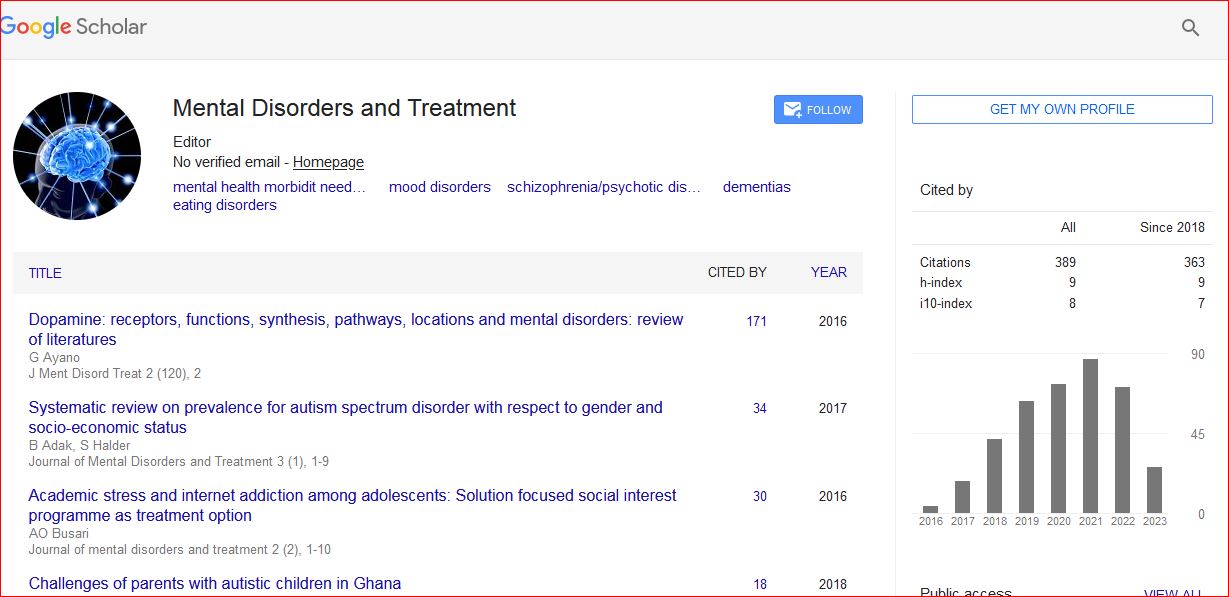
Mental Disorders and Treatment received 556 citations as per Google Scholar report