Perspective - (2025) Volume 11, Issue 3
Received: 02-Jun-2025, Manuscript No. abp-25-173823;
Editor assigned: 04-Jun-2025, Pre QC No. P-173823;
Reviewed: 18-Jun-2025, QC No. Q-173823;
Revised: 23-Jun-2025, Manuscript No. R-173823;
Published:
30-Jun-2025
, DOI: 10.37421/2472-0496.2025.11.326
Citation: Brandt, Lucas. ”Psychological Distress: Causes, Support, Solutions.” Abnorm Behav Psychol 11 (2025):326.
Copyright: © 2025 Brandt L. This is an open-access article distributed under the terms of the Creative Commons Attribution License, which permits unrestricted use, distribution and reproduction in any medium, provided the original author and source are credited.
Perceived social support significantly buffers the impact of psychological distress and enhances well-being among university students, particularly evident during challenging times like the COVID-19 pandemic. This suggests that fostering strong social networks is a crucial intervention strategy for student mental health [1].
This foundational understanding underscores how interpersonal connections are not just comfort but a protective factor, directly influencing the mental state of individuals facing adversity. The pandemic, with its isolating effects, made the role of social support even more pronounced, demonstrating its capability to enhance overall well-being. Young adults frequently experience psychological distress, yet various factors, including stigma and lack of awareness, act as barriers to seeking professional help. Understanding these barriers is critical for designing effective mental health support services tailored to this demographic [2].
These barriers create a silent struggle, where young adults, despite experiencing significant emotional challenges, might feel unable or unwilling to reach out. Addressing both the internal perceptions of mental health and the external accessibility of services becomes paramount to breaking this cycle of unaddressed distress. Healthcare workers in public hospitals, particularly during global health crises like the COVID-19 pandemic, face elevated levels of psychological distress. Factors like heavy workload, fear of contagion, and lack of adequate support contribute significantly to this burden, highlighting the need for robust mental health support systems [3].
The frontline nature of their work during crises exposes healthcare professionals to intense and prolonged stress, often leading to burnout and significant mental health decline. Acknowledging and actively mitigating these stressors through systemic support is critical not just for their well-being but for the continued functioning of public health services. Mindfulness-based interventions demonstrate significant effectiveness in reducing psychological distress across various populations. These interventions provide practical strategies for managing stress, anxiety, and depression by promoting present-moment awareness and non-judgmental acceptance [4].
The power of mindfulness lies in its ability to reorient an individual's relationship with their thoughts and emotions, offering a tangible path to reduced suffering. By promoting a calmer, more focused state, these interventions provide a proactive tool for enhancing mental resilience in everyday life. Excessive social media use contributes to psychological distress among university students, often mediated by phenomena like the 'fear of missing out' (FoMO) and subsequent sleep quality disturbances. Addressing these mediating factors is key to mitigating the negative mental health impacts of digital engagement [5].
The constant connectivity and curated realities presented on social media can foster comparisons and anxieties, leading to a vicious cycle where FoMO exacerbates distress and compromises vital restorative sleep. Understanding this intricate relationship allows for targeted interventions to promote healthier digital habits. Different coping strategies have varied effects on psychological distress, particularly during significant stressors like pandemics. Adaptive coping mechanisms, such as problem-focused strategies or seeking social support, tend to reduce distress, while maladaptive strategies can exacerbate it, highlighting the importance of promoting healthy coping skills [6].
The choice of how one responds to stress is not neutral; it profoundly shapes mental outcomes. By promoting and teaching constructive coping mechanisms, individuals can better navigate life's inevitable challenges, transforming potential crises into opportunities for growth rather than sources of overwhelming distress. Mental health stigma significantly contributes to psychological distress and serves as a major barrier to help-seeking among university students. Efforts to destigmatize mental illness and promote open discussions are crucial for improving access to care and supporting student well-being [7].
The societal perception of mental illness often creates an environment where individuals feel shame or embarrassment, preventing them from accessing necessary support. Breaking down these stigmas through education and empathetic communication is a fundamental step towards creating a more inclusive and supportive mental health landscape. Sleep disturbance and psychological distress exhibit a reciprocal relationship, particularly in older adults, where each can exacerbate the other over time. This highlights the need for integrated interventions that address both sleep quality and mental health to improve overall well-being in this population [8].
The intricate connection between sleep and mental state means that neglecting one often leads to the deterioration of the other. For older adults, this reciprocal relationship can become particularly challenging, making holistic approaches that consider both physiological and psychological factors indispensable for enhancing their quality of life. Resilience plays a crucial buffering role against psychological distress, especially during widespread crises such as the COVID-19 pandemic. Individuals with higher resilience tend to experience lower levels of distress despite challenging external circumstances, underscoring the importance of cultivating resilient traits and coping resources [9].
Resilience is not merely the absence of distress but the capacity to adapt and recover from adversity. In times of crisis, this inner strength becomes a vital resource, enabling individuals to withstand pressure and maintain mental equilibrium, reinforcing the value of programs that build such protective qualities. Childhood trauma is a significant predictor of psychological distress in adulthood, with a dose-response relationship suggesting that more severe or prolonged trauma leads to greater distress. Early intervention and support for trauma survivors are therefore essential for preventing long-term mental health challenges [10].
The enduring impact of early life experiences on adult mental health cannot be overstated. Recognizing the profound and lasting effects of childhood trauma necessitates proactive and sensitive interventions to mitigate its long-term psychological fallout, ensuring that individuals receive the healing and support required to thrive.
Psychological distress is a significant concern across various demographics. Young adults frequently experience it, facing unique barriers like stigma and lack of awareness in seeking help [2]. This issue also profoundly affects specific populations under stress, such as university students navigating challenges like the COVID-19 pandemic [1]. The pandemic itself highlighted particular vulnerabilities, with healthcare workers in public hospitals experiencing elevated distress due to heavy workloads, fear of contagion, and inadequate support [3]. The prevalence of distress points to a widespread need for accessible and understanding mental health resources.
Modern lifestyle factors contribute considerably to psychological distress. For instance, excessive social media use among university students is linked to distress, often mediated by the 'fear of missing out' (FoMO) and subsequent sleep disturbances [5]. Beyond digital habits, sleep disturbance generally shares a reciprocal relationship with psychological distress, particularly observed in older adults, where poor sleep can exacerbate mental health issues and vice versa [8]. These interconnections underscore the multifaceted nature of distress and the various environmental and behavioral elements that influence it, suggesting that interventions must consider a broad spectrum of daily life factors.
The long-term impact of early life experiences is also a critical factor; childhood trauma is a strong predictor of psychological distress in adulthood, with a clear dose-response relationship indicating more severe trauma leads to greater distress [10]. Conversely, protective factors play a crucial role in buffering these negative impacts. Resilience, for example, is vital in mitigating psychological distress during widespread crises like the COVID-19 pandemic, where resilient individuals tend to experience lower distress levels despite challenging circumstances [9]. This highlights the importance of both early intervention for trauma and fostering inherent strengths.
Effective interventions and coping strategies are essential for managing and reducing psychological distress. Mindfulness-based interventions have demonstrated significant effectiveness across various populations, offering practical strategies for managing stress, anxiety, and depression through present-moment awareness [4]. The type of coping strategy employed also matters; adaptive mechanisms, such as problem-focused approaches or seeking social support, tend to reduce distress during stressors, while maladaptive ones can worsen it [6]. This emphasizes the importance of fostering healthy coping skills through education and support programs.
Despite the prevalence and impact of psychological distress, significant barriers hinder individuals from seeking necessary help. Mental health stigma is a primary contributor to distress and a major impediment to help-seeking, particularly among university students [7]. This reinforces the need for concerted efforts to destigmatize mental illness and promote open discussions, which are crucial for improving access to care and supporting overall well-being. Understanding this complex interplay of factorsâ??from external stressors and individual vulnerabilities to protective mechanisms and systemic barriersâ??is fundamental for developing comprehensive mental health support strategies that truly make a difference.
Psychological distress is a significant public health concern affecting diverse groups, including university students, young adults, healthcare professionals, and older adults. The COVID-19 pandemic prominently amplified distress levels, impacting students who benefited from social support and frontline healthcare workers burdened by overwhelming demands [1, 3, 9]. Beyond pandemic-specific stressors, modern challenges such as excessive social media use contribute to distress among students, often through mechanisms like the 'fear of missing out' and disrupted sleep patterns [5]. The long-term effects of adverse early life experiences also play a critical role, with childhood trauma identified as a strong predictor of adult psychological distress [10]. Crucially, the data points to both protective factors and significant barriers in managing mental well-being. Perceived social support acts as a powerful buffer against distress, enhancing overall well-being [1]. Similarly, resilience is a key trait that helps individuals navigate and mitigate distress during crises [9]. Effective interventions include mindfulness-based approaches, which offer practical strategies for managing stress and anxiety by fostering present-moment awareness [4]. The adoption of adaptive coping strategies, such as problem-focused methods, is also shown to reduce distress, whereas maladaptive responses can exacerbate it [6]. However, pervasive issues like mental health stigma and a general lack of awareness present substantial barriers to help-seeking, particularly among young adults and university students [2, 7]. The interconnectedness of physical and mental health is also highlighted, with sleep disturbance exhibiting a reciprocal relationship with psychological distress, where each can worsen the other, especially in older adults [8]. This comprehensive picture underscores the imperative for integrated, multi-faceted mental health strategies that prioritize social connections, build resilience, promote healthy coping, reduce stigma, and ensure accessible, tailored support for vulnerable populations.
None
None
1. Md AI, Nazmul H, Md SI. "Impact of perceived social support on psychological distress and well-being among university students during the COVID-19 pandemic".PLoS One 18 (2023):e0284523.
Indexed at, Google Scholar, Crossref
2. Emily SHT, Jia ES, Wei JP. "Psychological distress in young adults and factors associated with help-seeking behavior".BMC Public Health 22 (2022):1787.
Indexed at, Google Scholar, Crossref
3. Mulugeta M, Awraris W, Sintayehu D. "Psychological distress and associated factors among health workers in Ethiopian public hospitals during the COVID-19 pandemic: a cross-sectional study".BMJ Open 11 (2021):e044732.
Indexed at, Google Scholar, Crossref
4. Li-Yuan L, Yen-Chun L, Yu-Ting Y. "Effectiveness of mindfulness-based interventions on psychological distress: A systematic review and meta-analysis of randomized controlled trials".J Psychiatr Res 130 (2020):494-508.
Indexed at, Google Scholar, Crossref
5. Muhammad S, Mehwish R, Ghulam H. "Social media use and psychological distress: The mediating role of fear of missing out and sleep quality among university students".Heliyon 9 (2023):e19757.
Indexed at, Google Scholar, Crossref
6. Xinyi L, Siyu Z, Linjie L. "Coping strategies and psychological distress during the COVID-19 pandemic: A systematic review".Psychiatry Res 303 (2021):114138.
Indexed at, Google Scholar, Crossref
7. Ruoyan H, Qianqian X, Huiru T. "Mental health stigma and its impact on psychological distress and help-seeking among university students".Curr Psychol 42 (2022):18197-18206.
Indexed at, Google Scholar, Crossref
8. Min-Jie X, Ming-Yuan H, Jun-Hua Z. "The reciprocal relationship between sleep disturbance and psychological distress among older adults: A longitudinal study".Sleep Med 111 (2023):184-190.
Indexed at, Google Scholar, Crossref
9. Yuqian T, Xuejiao L, Xuejiao H. "The buffering effect of resilience on psychological distress during the COVID-19 pandemic: A cross-sectional study in China".Front Public Health 9 (2021):670607.
Indexed at, Google Scholar, Crossref
10. Li-Ling W, Bo Y, Yan-Hua Z. "Childhood trauma and psychological distress in adulthood: A systematic review and meta-analysis".J Affect Disord 266 (2020):196-209.
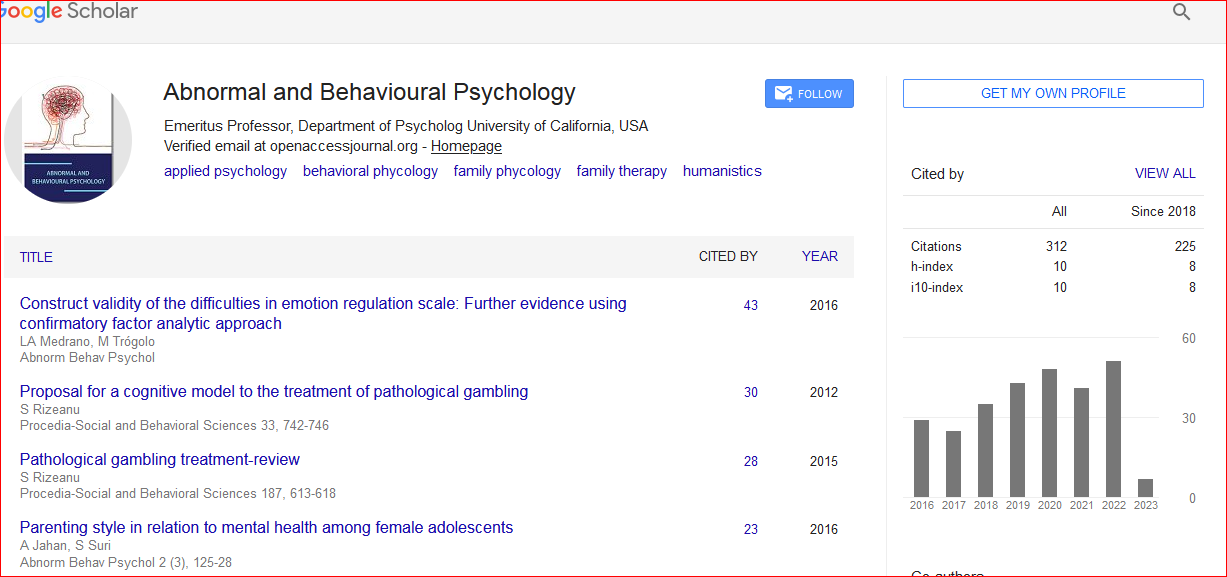
Abnormal and Behavioural Psychology received 361 citations as per Google Scholar report