Short Communication - (2025) Volume 16, Issue 3
Received: 02-Jun-2025, Manuscript No. jmbd-26-179398;
Editor assigned: 04-Jun-2025, Pre QC No. P-179398;
Reviewed: 16-Jun-2025, QC No. Q-179398;
Revised: 23-Jun-2025, Manuscript No. R-179398;
Published:
30-Jun-2025
, DOI: 10.37421/2155-9929.2025.16.708
Citation: Haddadi, Leila. ”Proteogenomics: Revolutionizing Disease Understanding and Discovery.” J Mol Biomark Diagn 16 (2025):708.
Copyright: © 2025 Haddadi L. This is an open-access article distributed under the terms of the Creative Commons Attribution License, which permits unrestricted use, distribution and reproduction in any medium, provided the original author and source are credited.
Proteogenomics represents a sophisticated approach that intricately integrates proteomic and genomic data to unravel the complexities of disease mechanisms and pinpoint novel biomarkers. This powerful paradigm serves to bridge the critical gap between an individual's genetic predispositions and the resultant functional consequences observed at the protein level, thereby enhancing the precision of clinical diagnostics and therapeutic strategies. Its value is particularly pronounced in the field of oncology, where it offers profound insights into tumor heterogeneity, facilitates the identification of actionable drug targets, and aids in predicting treatment responses, ultimately paving the way for truly personalized medicine [1].
The burgeoning application of proteogenomics within cancer research is fundamentally revolutionizing our comprehension of tumor biology and accelerating the development of more targeted therapeutic interventions. By enabling the simultaneous analysis of both genomic alterations and protein expression profiles, researchers are empowered to precisely identify oncogenic pathways, discover new therapeutic targets, and predict patient outcomes with an unprecedented degree of accuracy. This integrated analytical framework is absolutely crucial for deciphering the intricate molecular landscape that characterizes cancer and for driving forward the advancement of personalized treatment strategies [2].
Fundamentally, the integration of proteomic and genomic data provides a far more comprehensive understanding of disease pathogenesis than either of these powerful approaches could achieve in isolation. This becomes particularly evident when identifying functional genetic variants and elucidating their specific impact on fundamental cellular processes. Proteogenomics thus enables the discovery of biomarkers that accurately reflect the true biological state of a disease, leading directly to significant improvements in diagnostic accuracy and the development of more effective therapeutic interventions [3].
The critical journey of translating proteogenomic findings into tangible clinical applications hinges on the meticulous development of robust analytical pipelines and the rigorous validation of any newly identified biomarkers. While challenges persist in areas such as data integration, standardization, and interpretation, the continuous proliferation of high-throughput technologies and increasingly sophisticated computational tools is markedly accelerating the pace at which proteogenomic discoveries can transition from the laboratory bench to the patient's bedside, promising substantial advancements in the quality of patient care [4].
Proteogenomic approaches are proving to be instrumental in the complex task of dissecting tumor heterogeneity, which remains a major obstacle in the effective treatment of cancer. By meticulously identifying distinct molecular subtypes within tumors and characterizing their associated protein expression profiles, proteogenomics can profoundly inform the selection of the most optimal therapies for individual patients and provide crucial insights into potential resistance mechanisms. This sophisticated level of molecular detail is absolutely critical for tailoring treatment strategies and ultimately improving clinical outcomes [5].
The synergy derived from integrating genomic and proteomic analyses offers a profoundly powerful lens through which to identify novel drug targets. Proteogenomics uniquely allows researchers to directly connect specific genetic mutations with aberrant protein activity, thereby providing direct and actionable insights into the fundamental molecular drivers of disease. This enhanced understanding is indispensable for the development of targeted therapies that boast improved efficacy while simultaneously minimizing undesirable side effects, particularly in the context of complex and challenging diseases such as cancer [6].
From a clinical perspective, the utilization of proteogenomics holds immense and transformative promise for the realization of personalized medicine. By thoroughly analyzing a patient's unique and specific genomic and proteomic profile, clinicians are empowered to make significantly more informed decisions concerning diagnosis, prognosis, and the optimal selection of treatment. This integrated analytical approach moves us substantially closer to achieving truly individualized healthcare, thereby optimizing therapeutic interventions and markedly improving patient outcomes [7].
The remarkable synergy achieved between comprehensive genomic and detailed proteomic analyses provides an unparalleled depth of understanding regarding the intricate molecular underpinnings of various diseases. Proteogenomics uniquely facilitates the identification of novel diagnostic and prognostic biomarkers through the direct measurement of protein products, which are the ultimate effectors of all cellular functions. This capability is absolutely crucial for the development of more accurate, reliable, and clinically useful tools [8].
Navigating the complexities of proteogenomic data analysis presents both significant challenges and exciting opportunities. The intricate integration of multi-omics data necessitates the deployment of sophisticated bioinformatics tools and the application of robust statistical methodologies. However, ongoing advancements in artificial intelligence and machine learning are progressively enabling more effective interpretation of these complex proteogenomic datasets, thereby accelerating the discovery of clinically relevant and actionable insights [9].
The practical applications of proteogenomics extend well beyond the realm of cancer, encompassing a wide array of other complex diseases. By meticulously integrating both genomic and proteomic information, researchers can cultivate a deeper understanding of underlying disease mechanisms, identify crucial early diagnostic markers, and engineer more effective therapeutic strategies for a diverse range of conditions, ultimately contributing to significant improvements in overall public health [10].
Proteogenomics, by its very nature, involves the comprehensive integration of proteomic and genomic data, offering a powerful and sophisticated approach to understanding the intricate mechanisms of disease and to identifying novel biomarkers with diagnostic and prognostic potential. This innovative methodology effectively bridges the crucial gap between an individual's genetic predispositions and their functional consequences at the protein level. Consequently, proteogenomics significantly enhances the precision of clinical diagnostics and the efficacy of therapeutic strategies. This approach is particularly valuable in the field of oncology, where it can illuminate the complexities of tumor heterogeneity, identify critical drug targets, and predict patient responses to treatment, ultimately paving the way for more personalized and effective medicine [1].
In the dynamic landscape of cancer research, the application of proteogenomics is actively revolutionizing our fundamental understanding of tumor biology and is critically underpinning the development of highly targeted therapies. By enabling the simultaneous analysis of both genomic alterations and protein expression, researchers are empowered to identify key oncogenic pathways, discover novel drug targets, and predict patient outcomes with a greater degree of accuracy than ever before. This integrated analytical approach is therefore of paramount importance for deciphering the complex molecular landscape of cancer and for advancing the field of personalized treatment strategies [2].
Fundamentally, the integration of proteomic and genomic data provides a more complete and nuanced picture of disease pathogenesis than either approach could offer in isolation. This is especially true when it comes to identifying functional genetic variants and understanding their precise impact on critical cellular processes. Proteogenomics thus enables the discovery of biomarkers that accurately reflect the true biological state of a disease, leading to substantial improvements in diagnostic accuracy and the development of more effective therapeutic interventions [3].
The successful clinical translation of proteogenomic findings is fundamentally contingent upon the development of robust analytical pipelines and the rigorous validation of all identified biomarkers. While certain challenges remain in areas such as data integration, standardization, and interpretation, the increasing availability of high-throughput technologies and sophisticated computational tools is markedly accelerating the pace at which proteogenomic discoveries can move from the research laboratory to clinical practice, promising significant advancements in patient care [4].
Pertinently, proteogenomic approaches are proving to be highly instrumental in the critical task of dissecting tumor heterogeneity, which stands as a major obstacle in the effective treatment of cancer. By enabling the identification of distinct molecular subtypes and their corresponding protein expression profiles, proteogenomics can significantly inform the selection of optimal therapies for individual patients and facilitate the prediction of resistance mechanisms. This detailed level of molecular insight is crucial for tailoring treatment strategies and improving overall clinical outcomes [5].
The inherent synergy between genomic and proteomic analyses provides a significantly deeper understanding of the molecular underpinnings of disease. Proteogenomics uniquely allows for the direct identification of novel drug targets by enabling researchers to connect specific genetic mutations to aberrant protein activity, thereby offering direct insights into the molecular drivers of disease. This enhanced understanding is vital for developing targeted therapies with improved efficacy and reduced side effects, particularly in the context of complex diseases like cancer [6].
The proactive utilization of proteogenomics in the clinical setting holds immense promise for the advancement of personalized medicine. By thoroughly analyzing a patient's specific genomic and proteomic profile, clinicians are better equipped to make more informed decisions regarding diagnosis, prognosis, and the selection of appropriate treatment. This integrated approach moves us considerably closer to achieving truly individualized healthcare, optimizing therapeutic interventions and improving patient outcomes [7].
The integration of genomic and proteomic data offers a powerful lens for identifying novel diagnostic and prognostic biomarkers. Proteogenomics allows for this by directly measuring protein products, which are the ultimate effectors of cellular function and disease manifestation. This capability is crucial for developing more accurate and reliable clinical tools for disease management [8].
Navigating the complexities inherent in proteogenomic data analysis presents both significant challenges and exciting opportunities. The integration of multi-omics data necessitates the use of sophisticated bioinformatics tools and robust statistical methods. Fortunately, advances in artificial intelligence and machine learning are increasingly enabling more effective interpretation of complex proteogenomic datasets, thereby accelerating the discovery of clinically relevant insights [9].
The application of proteogenomics extends beyond the domain of cancer to encompass other complex diseases. By integrating genomic and proteomic information, researchers can achieve a deeper understanding of disease mechanisms, identify early diagnostic markers, and develop more effective therapeutic strategies for a wide range of conditions, ultimately contributing to significant improvements in public health [10].
Proteogenomics, the integration of genomic and proteomic data, is revolutionizing disease understanding and biomarker discovery. This approach enhances precision in diagnostics and therapeutics, particularly in oncology, by clarifying tumor heterogeneity and identifying drug targets for personalized medicine. It enables researchers to connect genetic mutations to protein activity, leading to the development of more effective targeted therapies. While challenges in data analysis exist, advancements in AI and machine learning are accelerating the translation of proteogenomic discoveries from research to clinical applications. This integrated methodology offers a deeper understanding of disease pathogenesis and holds immense promise for personalized patient care across various complex diseases, not limited to cancer.
None
None
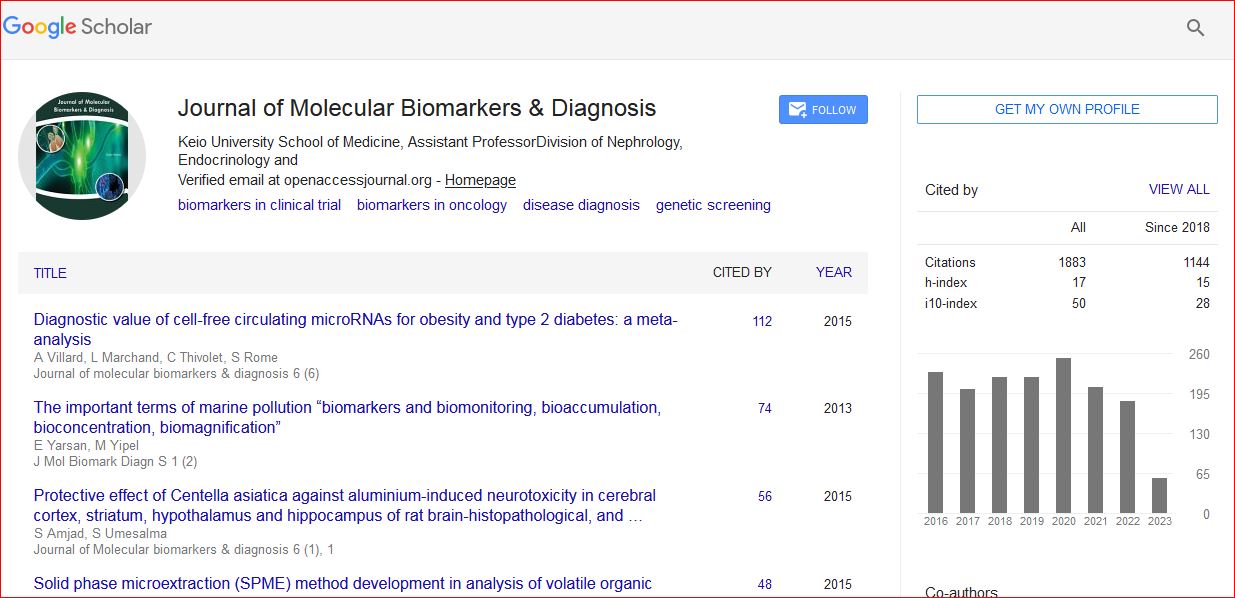
Journal of Molecular Biomarkers & Diagnosis received 2054 citations as per Google Scholar report