Brief Report - (2025) Volume 17, Issue 3
Received: 01-May-2025, Manuscript No. jcst-25-172448;
Editor assigned: 05-May-2025, Pre QC No. P-172448;
Reviewed: 19-May-2025, QC No. Q-172448;
Revised: 22-May-2025, Manuscript No. R-172448;
Published:
29-May-2025
, DOI: 10.37421/1948-5956.2025.17.701
Citation: Dupont, Olivier. ”Protein Kinases: Disease Drivers,
Therapeutic Targets, Biomarkers.” J Cancer Sci Ther 17 (2025):701.
Copyright: © 2025 Dupont O. This is an open-access article distributed under the terms of the Creative Commons Attribution License, which permits unrestricted use,
distribution and reproduction in any medium, provided the original author and source are credited.
Protein kinases are pivotal regulators in cellular signal transduction, their dysregulation frequently implicated in the development and progression of various pathologies. A comprehensive understanding of their roles has led to significant advancements in therapeutic strategies across numerous diseases. In oncology, protein kinases are recognized for their critical involvement in cancer progression, with ongoing efforts focused on developing kinase inhibitors as effective therapeutic agents. This field has seen clinical successes, yet faces persistent challenges, notably the development of resistance, which necessitates emerging strategies to enhance treatment efficacy [1].
Beyond cancer, protein kinases play crucial roles in the pathogenesis of a range of neurological disorders, including prevalent conditions such as Alzheimer's disease, Parkinson's disease, and stroke. Dysregulation of specific kinases contributes significantly to neuronal damage and neurodegeneration, underscoring the potential for targeting these kinases to develop novel therapeutic interventions for these debilitating conditions [2].
Similarly, the multifaceted roles of protein kinases extend to regulating immune responses, where their critical involvement in the pathogenesis of inflammatory and autoimmune diseases is well-documented. Specific kinase pathways, when dysregulated in conditions like rheumatoid arthritis and lupus, present promising targets for developing inhibitors aimed at modulating detrimental immune responses [3].
The inherent structural biology of protein kinases provides insights into their diverse functions. Their remarkable plasticity and conformational dynamics enable specific regulatory mechanisms, illustrating how different kinase states, influenced by substrate binding and post-translational modifications, contribute to signaling fidelity and can be strategically exploited for therapeutic targeting [4].
The impact of protein kinases is also profound in metabolic health, as evidenced by their critical involvement in the pathogenesis of metabolic syndrome, encompassing conditions such as obesity, insulin resistance, and dyslipidemia. Specific kinase pathways regulate crucial aspects of glucose and lipid metabolism, and their dysregulation directly contributes to disease development, suggesting these enzymes as compelling targets for therapeutic interventions [5].
Interestingly, the utility of targeting protein kinases is not confined to endogenous human pathways; an emerging strategy involves targeting host cell protein kinases to combat viral infections. This approach moves beyond direct antiviral agents by recognizing how viruses often hijack host kinase pathways for their replication and survival. Inhibiting specific host kinases can disrupt the viral life cycle, offering a novel and potentially broad-spectrum approach to antiviral therapies [6].
The precise control over protein kinase abundance and activity is fundamental to maintaining cellular homeostasis. This is largely managed through post-translational regulation, particularly via ubiquitination and subsequent proteasomal degradation. This sophisticated ubiquitin-proteasome system ensures kinases operate at appropriate levels, and its dysregulation can contribute to various diseases, including cancer [7].
However, the effectiveness of targeted therapies, especially in cancer, is often hampered by the development of acquired resistance to protein kinase inhibitors. This significant challenge stems from complex mechanisms including genetic mutations, the activation of bypass pathways, and epigenetic changes that render initial treatments ineffective. Overcoming drug resistance remains a major focus, emphasizing the urgent need for combination therapies and innovative strategies [8].
Furthermore, protein kinases are increasingly recognized for their roles extending beyond classical cytoplasmic signaling to regulating chromatin structure and epigenetic modifications. By phosphorylating histone and non-histone proteins, kinases influence gene expression, DNA repair, and replication, thus opening new avenues for understanding and targeting epigenetic dysregulation in disease [9].
This comprehensive understanding of protein kinase biology culminates in their dual utility as both crucial therapeutic targets and invaluable predictive biomarkers in the realm of personalized medicine. Understanding individual kinase profiles can profoundly guide treatment decisions, predict drug responses, and monitor disease progression, thereby paving the way for more tailored and ultimately effective therapeutic strategies [10].
Protein kinases are enzymes with fundamental roles in nearly all cellular processes, acting as critical regulators of signal transduction pathways. Their ability to phosphorylate target proteins drives a vast array of cellular activities, from growth and differentiation to metabolism and immune responses. Dysregulation of these intricate phosphorylation networks is a common hallmark in many human diseases, making protein kinases highly significant targets for therapeutic intervention. For instance, in cancer, aberrant protein kinase activity is a known driver of uncontrolled cell proliferation and survival. Researchers actively develop and deploy kinase inhibitors to combat cancer progression, with considerable clinical achievements. However, the emergence of drug resistance, driven by various molecular mechanisms, remains a significant hurdle in achieving long-term efficacy, demanding continuous innovation in therapeutic strategies [1, 8].
Beyond oncology, protein kinases are deeply implicated in the complex pathogenesis of neurological disorders. Conditions such as Alzheimer's disease, Parkinson's disease, and stroke are characterized by neuronal damage and neurodegeneration, processes significantly influenced by the dysregulation of specific protein kinases. Identifying and targeting these critical kinases offers promising avenues for developing novel treatments that could mitigate disease progression and improve patient outcomes [2]. Similarly, the immune system's delicate balance is heavily reliant on precise kinase activity. In inflammatory and autoimmune diseases like rheumatoid arthritis and lupus, specific kinase pathways become dysregulated, leading to exacerbated immune responses. Modulating these pathways through targeted kinase inhibitors represents a key strategy to restore immune homeostasis and alleviate disease symptoms [3].
The remarkable versatility of protein kinases is partly explained by their intrinsic structural biology. Their inherent plasticity and conformational dynamics allow them to adopt various states, which are crucial for their diverse functions and specific regulatory mechanisms. Substrate binding and post-translational modifications intricately influence these states, ensuring signaling fidelity and offering multiple points of exploitation for therapeutic design [4]. Furthermore, metabolic health is profoundly affected by protein kinase activity. In metabolic syndromeâ??a cluster of conditions including obesity, insulin resistance, and dyslipidemiaâ??specific kinase pathways that regulate glucose and lipid metabolism are often dysregulated. Understanding these pathways is crucial for developing targeted interventions that can address the root causes of these widespread metabolic disorders [5].
Intriguingly, the therapeutic potential of targeting kinases extends to the realm of infectious diseases. A novel strategy against viral infections involves targeting host cell protein kinases, rather than directly attacking viral components. This approach acknowledges that viruses often commandeer host kinase pathways to facilitate their replication and survival. By inhibiting these specific host kinases, it is possible to disrupt the viral life cycle, thereby offering a broad-spectrum approach to antiviral therapy that could be effective against a range of viruses [6].
The precise regulation of protein kinase levels and activity is also paramount for cellular function. This is often achieved through post-translational modifications, particularly ubiquitination followed by proteasomal degradation. This sophisticated ubiquitin-proteasome system meticulously controls kinase abundance and activity, and any disruption in these mechanisms can contribute to various pathologies, including the unchecked growth seen in cancer [7].
Moreover, the influence of protein kinases is not limited to cytoplasmic signaling. They are increasingly recognized for their roles in regulating chromatin structure and epigenetic modifications within the nucleus. Kinases phosphorylate key histone and non-histone proteins, thereby impacting gene expression, DNA repair mechanisms, and DNA replication. This expanded understanding of kinase function opens new frontiers for investigating and targeting epigenetic dysregulation in various diseases, including developmental disorders and cancer [9]. This comprehensive understanding of protein kinase biology underscores their critical value. They serve not only as primary therapeutic targets but also as essential predictive biomarkers in the evolving landscape of personalized medicine. Leveraging individual kinase profiles can significantly refine treatment decisions, predict patient responses to therapies, and effectively monitor disease progression, ultimately facilitating more tailored and impactful therapeutic strategies [10].
Protein kinases are central to diverse cellular processes, their dysregulation implicated in a wide array of diseases. In cancer, they drive progression, making them key therapeutic targets, though resistance to inhibitors poses a challenge that emerging strategies aim to overcome. Neurological disorders like Alzheimer's and Parkinson's also see crucial roles for protein kinases, with targeting these enzymes offering potential novel interventions. Similarly, in inflammatory and autoimmune conditions, specific kinase pathways are dysregulated, pointing to kinase inhibitors as modulators of immune responses. Beyond disease pathogenesis, the structural biology of protein kinases highlights their remarkable plasticity and conformational dynamics, explaining their varied functions and regulatory mechanisms which can be exploited therapeutically. Their involvement extends to metabolic syndrome, where specific pathways regulating glucose and lipid metabolism are dysregulated. Interestingly, protein kinases are not just targets in human diseases; targeting host cell protein kinases is an emerging strategy to combat viral infections by disrupting their life cycle. The regulation of protein kinases themselves is complex, involving post-translational modifications like ubiquitination and proteasomal degradation, which precisely control their abundance and activity. A significant hurdle in cancer therapy is acquired resistance to kinase inhibitors, driven by genetic and epigenetic changes, underscoring the need for combination therapies. Furthermore, protein kinases are recognized for their roles in regulating chromatin structure and epigenetic modifications, influencing gene expression and DNA repair. Ultimately, understanding individual kinase profiles is crucial, as they serve as both therapeutic targets and predictive biomarkers in personalized medicine, guiding tailored and effective treatment strategies.
Indexed at, Google Scholar, Crossref
Indexed at, Google Scholar, Crossref
Indexed at, Google Scholar, Crossref
Indexed at, Google Scholar, Crossref
Indexed at, Google Scholar, Crossref
Indexed at, Google Scholar, Crossref
Indexed at, Google Scholar, Crossref
Indexed at, Google Scholar, Crossref
Indexed at, Google Scholar, Crossref
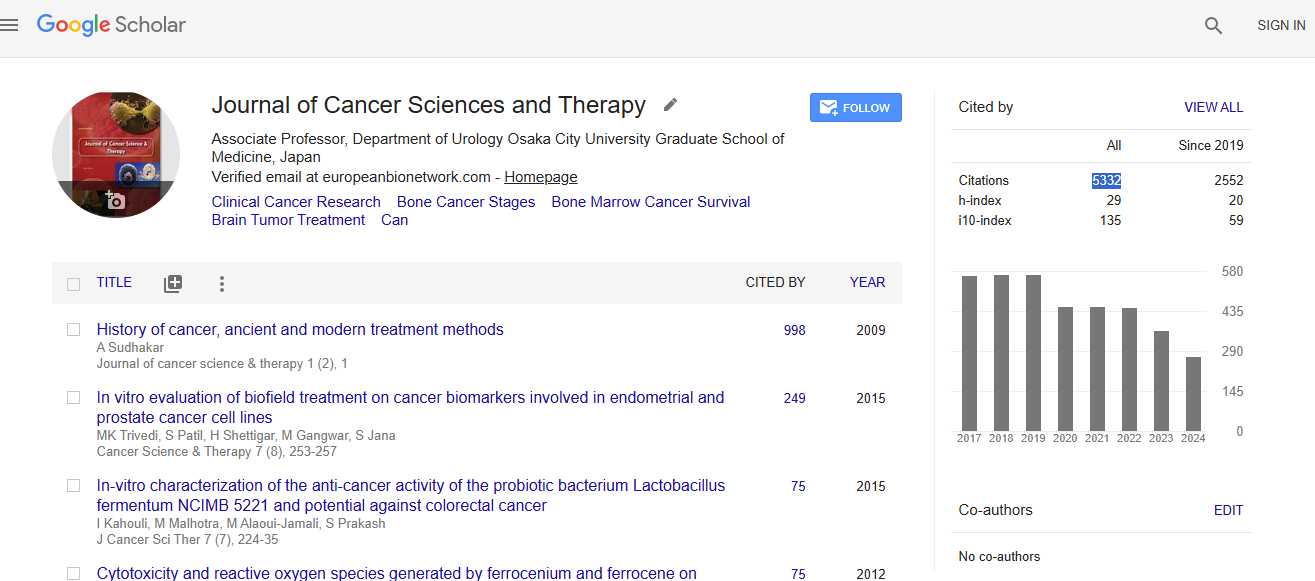
Cancer Science & Therapy received 5332 citations as per Google Scholar report