Brief Report - (2025) Volume 12, Issue 4
Received: 01-Aug-2025, Manuscript No. ijn-26-183985;
Editor assigned: 04-Aug-2025, Pre QC No. P-183985;
Reviewed: 18-Aug-2025, QC No. Q-183985;
Revised: 22-Aug-2025, Manuscript No. R-183985;
Published:
29-Aug-2025
, DOI: 10.37421/2376-0281.2025.12.640
Citation: Pereira, Joao. ”Personalized Neurorehabilitation: Technology and Holistic Recovery.” Int J Neurorehabilitation Eng 12 (2025):640.
Copyright: © 2025 Pereira J. This is an open-access article distributed under the terms of the Creative Commons Attribution License, which permits unrestricted use, distribution and reproduction in any medium, provided the original author and source are credited.
The field of neurorehabilitation for traumatic brain injury (TBI) is a complex and evolving area of research and clinical practice, characterized by significant challenges and exciting advances. This introduction will explore the multifaceted landscape of TBI neurorehabilitation, drawing upon key contributions to the literature. The inherent heterogeneity of TBI, arising from diverse injury mechanisms, severities, and patient characteristics, presents a fundamental challenge to developing universally effective interventions. This variability necessitates a move towards highly personalized approaches, tailoring treatments to the unique needs of each individual survivor. The integration of novel technologies is also becoming increasingly central to improving rehabilitation outcomes, offering new avenues for assessment, intervention, and recovery [1].
Within this evolving paradigm, virtual reality (VR) has emerged as a promising tool, particularly for enhancing motor and cognitive retraining. Immersive VR environments can foster greater patient engagement and provide carefully calibrated challenges, thereby facilitating the crucial process of neuroplasticity. The practical aspects of implementing VR in clinical settings, alongside its future potential, are important considerations for its widespread adoption and efficacy [2].
Beyond VR, technology-assisted rehabilitation encompasses a broader range of tools, including robotics and exergames. These technologies offer objective metrics for performance evaluation, allow for increased intensity and repetition of therapeutic exercises, which are vital for motor relearning, and can provide valuable data for tracking progress. However, challenges related to accessibility and cost remain significant barriers to their broader implementation [3].
Cognitive deficits, such as impairments in attention, memory, and executive functions, are common and often debilitating sequelae of TBI. Consequently, cognitive rehabilitation strategies are a critical component of recovery. Evidence-based approaches, including computer-based training, metacognitive strategies, and compensatory techniques, are employed, with a strong emphasis on customizing these interventions to match individual cognitive profiles [4].
A persistent challenge in neurorehabilitation is the translation of promising research findings into effective and routine clinical practice. Barriers to this translation include the lack of standardized protocols, insufficient funding for implementation initiatives, and the necessity for improved interdisciplinary communication and specialized training for healthcare professionals. Bridging this gap is essential for maximizing the impact of research advancements [5].
Emerging pharmacological interventions are also being explored with the aim of enhancing neuroplasticity and promoting recovery after TBI. This research focuses on various drug classes, including those that modulate inflammation, neurotrophic factors, and neurotransmitter systems, though demonstrating consistent efficacy and safety in clinical trials remains a significant hurdle [6].
Given the diverse nature of TBI and its consequences, the development of personalized rehabilitation strategies is paramount. These strategies must consider factors such as injury severity, the specific cognitive and physical impairments experienced, and the individual's psychosocial well-being. A multidisciplinary, patient and family-centered approach is essential for setting and achieving meaningful rehabilitation goals [7].
Complementing traditional rehabilitation therapies, lifestyle interventions play a crucial role in supporting neurorecovery. Modifiable factors such as regular exercise, optimal nutrition, and good sleep hygiene can significantly influence brain health and resilience, thereby contributing to a more robust recovery process [8].
Advanced neuroimaging techniques are increasingly utilized to deepen our understanding of TBI pathophysiology and to objectively monitor rehabilitation progress. Tools like functional magnetic resonance imaging (fMRI) and diffusion tensor imaging (DTI) are invaluable for visualizing structural and functional alterations within the brain, providing insights that can guide therapeutic interventions [9].
Finally, the psychological and social well-being of TBI survivors profoundly impacts their rehabilitation outcomes. Addressing mental health issues such as depression, anxiety, and post-traumatic stress disorder, alongside facilitating social reintegration through targeted programs, is critical for holistic recovery and improved quality of life [10].
The intricate landscape of neurorehabilitation following traumatic brain injury (TBI) is marked by persistent challenges and ongoing advancements, necessitating a comprehensive approach to patient care. A primary obstacle is the inherent heterogeneity of TBI, stemming from variations in injury mechanisms, severity, and individual patient factors. This variability underscores the critical need for personalized interventions that are tailored to the unique profile of each survivor, moving away from one-size-fits-all models. Furthermore, the integration of new and evolving technologies is becoming indispensable for enhancing diagnostic capabilities, optimizing therapeutic delivery, and ultimately improving functional recovery and long-term outcomes [1].
Among the technological innovations gaining traction is virtual reality (VR), which offers a novel platform for both motor and cognitive rehabilitation after TBI. The immersive nature of VR environments can significantly boost patient engagement and provide a controlled yet challenging training ground, thereby promoting the brain's capacity for neuroplasticity. As VR gains prominence, careful consideration of its practical implementation in clinical settings and exploration of its future applications are crucial for maximizing its therapeutic potential [2].
Technology-assisted rehabilitation, encompassing a range of modalities such as robotics and exergames, plays a vital role in supporting TBI recovery. These sophisticated tools provide objective measures of performance, enable higher intensities of practice, and facilitate repetitive movements essential for motor relearning. They also offer valuable data for tracking patient progress over time. However, challenges related to the cost and accessibility of these technologies must be addressed to ensure equitable access for all affected individuals [3].
Cognitive impairments, including deficits in attention, memory, and executive functions, are common and significantly impact a TBI survivor's quality of life and ability to reintegrate into daily activities. Cognitive rehabilitation strategies aim to mitigate these deficits through evidence-based approaches such as computer-based training, metacognitive strategies, and compensatory techniques. A cornerstone of effective cognitive rehabilitation is the meticulous tailoring of interventions to align with each individual's specific cognitive profile and needs [4].
A significant hurdle in the field of neurorehabilitation is the effective translation of research discoveries into routine clinical practice. This gap is often attributed to a confluence of factors, including the absence of standardized clinical protocols, insufficient funding allocated for the implementation of new interventions, and a need for enhanced interdisciplinary communication and professional development among healthcare providers. Bridging this translational gap is paramount for ensuring that evidence-based practices are consistently applied [5].
In parallel with behavioral interventions, research is exploring emerging pharmacological approaches designed to bolster neuroplasticity and accelerate recovery following TBI. This area of investigation involves examining various drug classes that target mechanisms such as inflammation, neurotrophic factor signaling, and neurotransmitter systems. Nevertheless, demonstrating clear efficacy and robust safety profiles in rigorous clinical trials remains a substantial challenge for these pharmaceutical interventions [6].
The recognition of TBI's profound impact necessitates the development of personalized rehabilitation plans that account for a wide array of factors. These include the severity and nature of the brain injury, the specific cognitive and physical impairments present, and the individual's psychosocial status. A collaborative, multidisciplinary approach that prioritizes patient and family-centered goals is fundamental to developing effective and individualized rehabilitation trajectories [7].
Beyond formal rehabilitation programs, lifestyle interventions offer a supportive framework for neurorecovery after TBI. Strategies encompassing regular physical exercise, balanced nutrition, and optimized sleep hygiene are increasingly understood to be critical modifiable factors that can enhance brain health, promote resilience, and synergistically complement traditional therapeutic modalities [8].
Advanced neuroimaging techniques are playing an increasingly instrumental role in both understanding the intricate pathophysiology of TBI and objectively monitoring the efficacy of rehabilitation interventions. Modalities such as functional magnetic resonance imaging (fMRI) and diffusion tensor imaging (DTI) provide unprecedented insights into structural and functional brain changes, thereby guiding therapeutic strategies and assessment [9].
Finally, the psychological and social dimensions of TBI rehabilitation are crucial determinants of successful outcomes. Survivors often face significant mental health challenges, including depression, anxiety, and post-traumatic stress disorder. Effective rehabilitation must therefore incorporate robust mental health support, facilitate social reintegration, and address these psychosocial factors comprehensively to promote overall well-being and functional recovery [10].
Neurorehabilitation after traumatic brain injury (TBI) faces challenges due to TBI's varied nature, requiring personalized interventions and the integration of new technologies. Virtual reality (VR) and technology-assisted rehabilitation, including robotics and exergames, show promise for motor and cognitive recovery by enhancing engagement and providing objective feedback. Cognitive rehabilitation focuses on improving attention, memory, and executive functions through tailored strategies. Translating research into clinical practice remains a hurdle, with issues of standardization and funding. Emerging pharmacological interventions aim to boost neuroplasticity. Personalized, multidisciplinary rehabilitation plans are essential, considering injury severity and psychosocial well-being. Lifestyle interventions like exercise and good sleep also support recovery. Advanced neuroimaging aids in understanding TBI and tracking progress. Addressing psychological and social challenges is vital for holistic recovery and improving quality of life.
None
None
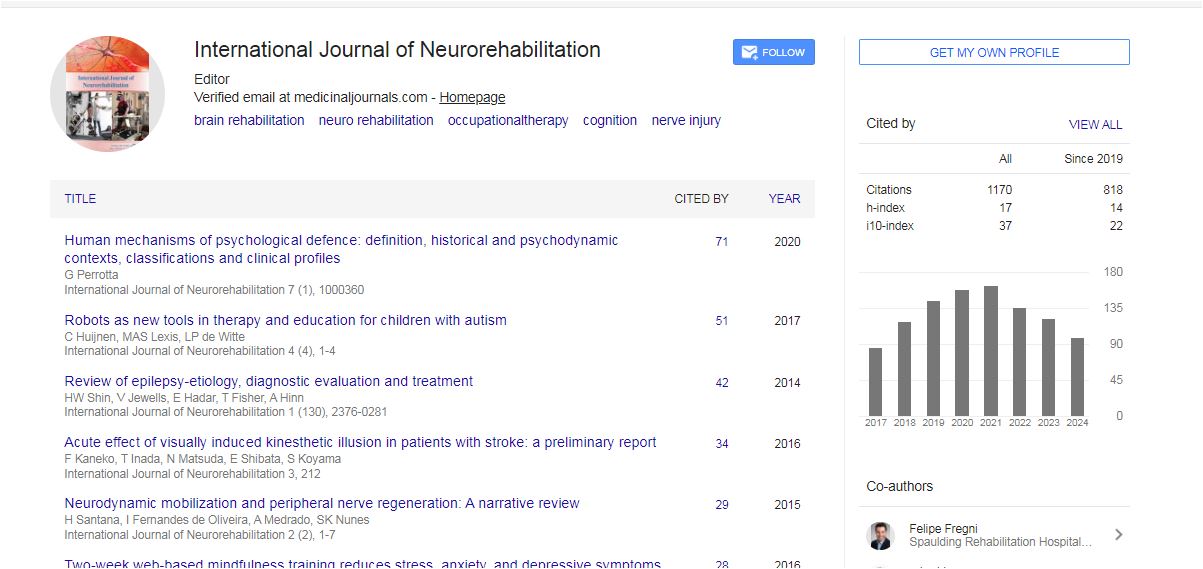
International Journal of Neurorehabilitation received 1078 citations as per Google Scholar report