Commentary - (2025) Volume 14, Issue 3
Received: 02-Jun-2025, Manuscript No. jnc-25-171658;
Editor assigned: 04-Jun-2025, Pre QC No. P-171658;
Reviewed: 16-Jun-2025, QC No. Q-171658;
Revised: 23-Jun-2025, Manuscript No. R-171658;
Published:
30-Jun-2025
, DOI: 10.37421/2167-1168.2025.14.708
Citation: Andres, Dmitry. “Protecting Patient Information: Ethical and Legal Responsibilities of Nurses in Digital Care.” J Nurs Care 14 (2025): 708.
Copyright: © 2025 Andres D. This is an open-access article distributed under the terms of the Creative Commons Attribution License, which permits unrestricted use, distribution and reproduction in any medium, provided the original author and source are credited.
Electronic Health Records (EHRs), cloud storage and connected health devices have revolutionized care coordination and access to information. However, they also introduce risks such as unauthorized access, data breaches and cyberattacks. Nurses must remain vigilant about these vulnerabilities and practice due diligence when handling digital records. Confidentiality is a foundational ethical principle in nursing, rooted in respect for patient autonomy and dignity. The American Nurses Association (ANA) Code of Ethics emphasizes that nurses must safeguard all personal patient data, whether spoken, written, or stored electronically. Breaches of confidentiality not only damage trust but can also cause psychological, social and financial harm to patients. Laws such as the Health Insurance Portability and Accountability Act (HIPAA) in the U.S., the General Data Protection Regulation (GDPR) in the EU and similar national regulations set standards for the protection of health information. Nurses must understand relevant laws governing data sharing, storage and disclosure, including when information can be legally shared for instance, during public health emergencies or with patient consent [2].
Nurses are responsible for accurate documentation in EHRs while ensuring only authorized personnel have access. Secure login practices, logging off unattended devices and reporting unauthorized access are essential habits. Nurses must also avoid sharing patient information through unsecured channels such as personal emails, messaging apps, or social media. Ongoing education in health informatics and data privacy is critical. Healthcare institutions must provide nurses with regular training on cybersecurity, phishing awareness and digital ethics. Nursing curricula should incorporate case-based scenarios to prepare future professionals for real-world ethical dilemmas in digital care. Digital care can present nuanced ethical challenges for example, what to do when a patient inadvertently discloses sensitive information during a telehealth visit in a shared household. Nurses must be trained to respond sensitively while adhering to privacy protocols. In cases of potential breaches, they should follow institutional reporting procedures and contribute to corrective actions. Nurses must advocate for systems and practices that prioritize patient privacy. This includes participating in the design of health IT systems to ensure usability and security and educating patients about how their data is used. Nurses also serve as gatekeepers balancing information sharing with other team members against patient confidentiality [3-4].
The increasing integration of digital technologies into healthcare has transformed patient care but also raised critical concerns about privacy and data protection. Nurses, as frontline healthcare providers, play a vital role in safeguarding sensitive patient information within electronic health records, telehealth systems and mobile health applications. Maintaining strict adherence to these principles not only upholds patient trust but also prevents potential misuse or unauthorized disclosure of private information. In the digital era, nurses must exercise diligence when accessing patient records, using secure communication channels and ensuring that electronic devices are protected from breaches or theft. From a legal standpoint, nurses are bound by data protection regulations such as the Health Insurance Portability and Regular training on cybersecurity practices, digital ethics and institutional privacy policies empowers nurses to identify and respond to data threats effectively. Ultimately, protecting patient information is not only a legal duty but also an ethical obligation that reflects professional integrity and respect for patient dignity. By embracing these responsibilities, nurses can contribute to a trustworthy and secure digital healthcare environment that prioritizes patient welfare and confidentiality [5].
Google Scholar Cross Ref Indexed at
Google Scholar Cross Ref Indexed at
Google Scholar Cross Ref Indexed at
Google Scholar Cross Ref Indexed at
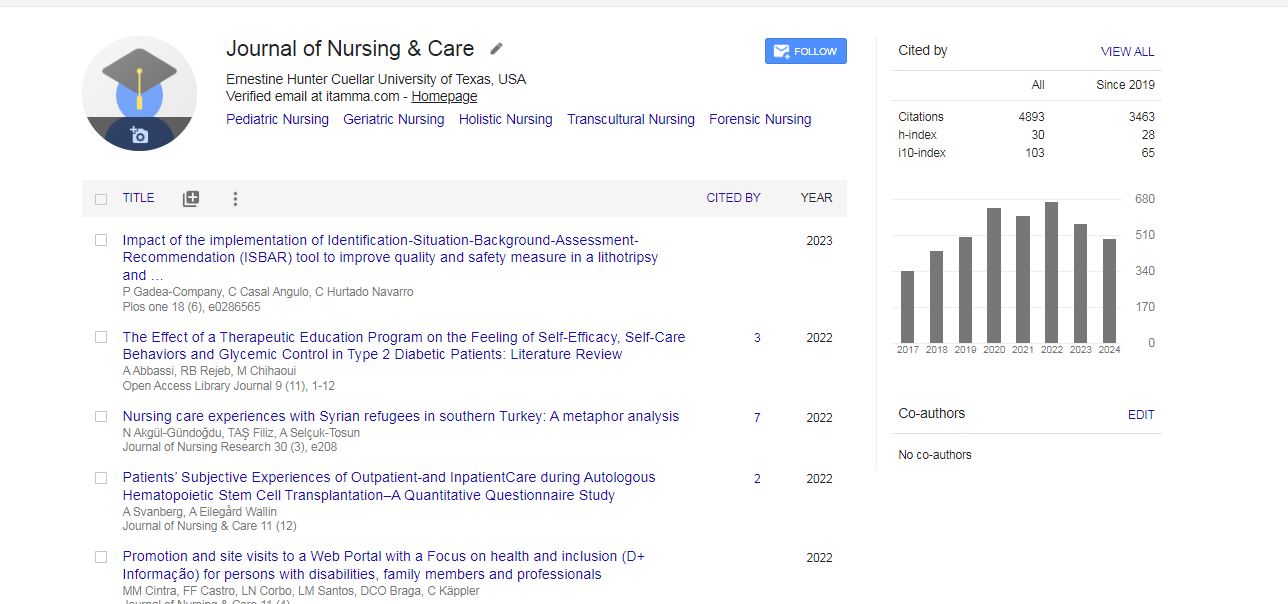
Journal of Nursing & Care received 4230 citations as per Google Scholar report