Perspective - (2025) Volume 9, Issue 6
Received: 01-Dec-2025, Manuscript No. cmcr-25-178337;
Editor assigned: 03-Dec-2025, Pre QC No. P-178337;
Reviewed: 17-Dec-2025, QC No. Q-178337;
Revised: 22-Dec-2025, Manuscript No. R-178337;
Published:
29-Dec-2025
, DOI: 10.37421/2684-4915.2025.9.409
Citation: Suzuki, Kenta. ”Prognostic Factors Guide Personalized Patient Outcomes.” Clin Med Case Rep 09 (2025):409.
Copyright: © 2025 Suzuki K. This is an open-access article distributed under the terms of the Creative Commons Attribution License, which permits unrestricted use, distribution and reproduction in any medium, provided the original author and source are credited.
Predicting patient outcomes is a cornerstone of modern medicine, influencing treatment strategies, patient counseling, and the allocation of healthcare resources. A growing body of research is dedicated to identifying and validating prognostic indicators across a diverse range of medical conditions, moving towards more personalized and effective interventions. This article delves into how inflammatory biomarkers help predict outcomes for patients with non-small cell lung cancer receiving immunotherapy. What it really means is that tracking specific inflammation markers could give doctors a clearer picture of who will respond well to treatment and who might need alternative strategies, ultimately helping tailor therapy for better patient survival [1].
Here's the thing about epicardial adipose tissue (EAT) in type 2 diabetes: its volume and characteristics might actually be a powerful indicator of future cardiovascular complications. This research suggests that measuring EAT could offer a non-invasive way to identify high-risk diabetic patients, allowing for more proactive management to prevent heart issues [2].
Understanding the long-term prognosis for acute encephalitis patients is crucial for patient and family counseling. This systematic review underscores the varied outcomes, ranging from full recovery to persistent neurological deficits, and highlights the factors that contribute to these long-term challenges, guiding rehabilitation and support strategies [3].
This study examines how machine learning can improve our ability to predict outcomes in sepsis patients. What this really means is that by leveraging advanced algorithms, we can identify patients at higher risk of adverse events earlier, potentially enabling more timely and aggressive interventions to save lives and reduce complications [4].
When it comes to COVID-19, understanding inflammatory markers is key to predicting disease severity and patient prognosis. This review synthesizes current evidence, showing that certain markers are consistently linked to worse outcomes, providing critical insights for clinicians to identify vulnerable patients and optimize care pathways [5].
Sarcopenia, or muscle loss, is proving to be a significant prognostic factor for individuals with chronic kidney disease (CKD). What this means is that assessing muscle mass and strength in CKD patients can help predict disease progression and mortality, highlighting the importance of nutritional and exercise interventions as part of their comprehensive care [6].
This research provides a clear picture of what influences the prognosis of primary Sjögren's syndrome. Understanding these prognostic factors helps clinicians anticipate disease course, identify patients at risk for severe complications like lymphoma, and personalize management strategies to improve long-term outcomes for those living with this autoimmune condition [7].
When considering major depressive disorder, knowing the prognosis and the factors that influence it is essential. This systematic review clarifies that while recovery is common, recurrence is a significant challenge, pointing to the critical need for long-term management strategies and targeted interventions based on identified risk factors to improve patient well-being [8].
This article highlights the significant role of preoperative inflammatory markers in predicting outcomes for gastric cancer patients undergoing surgery. What this tells us is that simple blood tests before an operation can offer valuable insights into a patient's likely prognosis, helping surgeons and oncologists make more informed decisions about treatment intensity and follow-up care [9].
Let's break down the significance of inflammatory markers in Graves' ophthalmopathy. This study reveals that specific markers of inflammation can predict the disease's trajectory and severity, offering a way to identify patients who may experience more aggressive forms and allowing for earlier, more targeted therapeutic interventions to preserve vision and quality of life [10].
Collectively, these systematic reviews and meta-analyses underscore a critical shift in clinical practice towards more precise prognostication. They demonstrate how various indicatorsâ??from molecular biomarkers to physical assessments and advanced computational modelsâ??are being harnessed to refine risk stratification, personalize treatment, and ultimately enhance patient care and quality of life across a wide array of health challenges. This comprehensive approach empowers healthcare providers with the knowledge to make more informed decisions, leading to better outcomes for patients.
Modern clinical practice increasingly relies on accurate prognostication to guide patient management, particularly in complex diseases. This collection of systematic reviews and meta-analyses highlights diverse approaches to predicting patient outcomes, spanning from molecular biomarkers to advanced computational models. The goal is consistently to enable earlier intervention, personalize treatment, and ultimately enhance patient survival and quality of life across various medical specialties. Understanding a patient's likely disease trajectory is paramount for effective patient and family counseling, resource allocation, and targeted therapeutic strategies.
Inflammatory biomarkers consistently emerge as significant prognostic indicators across several conditions. For instance, tracking specific inflammation markers could give doctors a clearer picture of who will respond well to immunotherapy for non-small cell lung cancer, aiding in tailored therapy for better patient survival [1]. Similarly, in the context of COVID-19, understanding these markers is key to predicting disease severity and prognosis, providing critical insights for clinicians to identify vulnerable patients and optimize care pathways [5]. The role of inflammation extends to surgical oncology, where preoperative inflammatory markers offer valuable insights into the likely prognosis for gastric cancer patients undergoing curative resection, informing decisions about treatment intensity [9]. Furthermore, specific markers of inflammation can predict the trajectory and severity of Graves' ophthalmopathy, enabling earlier, more targeted therapeutic interventions to preserve vision and quality of life [10]. These findings collectively underscore the diagnostic and prognostic power of inflammatory profiles in diverse disease settings.
Prognostic indicators are not limited to systemic inflammation. For patients with type 2 diabetes, the volume and characteristics of epicardial adipose tissue (EAT) might actually be a powerful, non-invasive indicator of future cardiovascular complications, allowing for more proactive management to prevent heart issues [2]. In another chronic condition, sarcopenia, or muscle loss, is proving to be a significant prognostic factor for individuals with chronic kidney disease (CKD). Assessing muscle mass and strength in CKD patients can help predict disease progression and mortality, highlighting the importance of nutritional and exercise interventions as part of their comprehensive care [6]. These examples demonstrate the breadth of physiological parameters that can inform prognosis, from adipose tissue composition to musculoskeletal health.
Neurological conditions and autoimmune disorders also benefit from a deeper understanding of prognostic factors. For patients with acute encephalitis, understanding their long-term prognosis is crucial for patient and family counseling. Outcomes vary significantly, from full recovery to persistent neurological deficits, and identifying contributing factors is essential for guiding rehabilitation and support strategies [3]. Similarly, this research provides a clear picture of what influences the prognosis of primary Sjögren's syndrome. Understanding these prognostic factors helps clinicians anticipate disease course, identify patients at risk for severe complications like lymphoma, and personalize management strategies to improve long-term outcomes [7]. These studies emphasize the need for detailed individual assessments to predict and mitigate potential long-term challenges.
In mental health, knowing the prognosis and the factors that influence it is essential when considering major depressive disorder. While recovery is common, recurrence presents a significant challenge, pointing to the critical need for long-term management strategies and targeted interventions based on identified risk factors to improve patient well-being [8]. Meanwhile, technology is transforming prognostic capabilities. This study examines how machine learning can improve our ability to predict outcomes in sepsis patients. What this really means is that by leveraging advanced algorithms, we can identify patients at higher risk of adverse events earlier, potentially enabling more timely and aggressive interventions to save lives and reduce complications [4]. The integration of advanced analytics, alongside traditional clinical and biomarker assessments, represents a powerful frontier in refining prognostic accuracy across various medical domains.
Recent medical research highlights the critical role of various biomarkers and factors in predicting patient prognoses across a spectrum of diseases. Tracking specific inflammatory markers offers a clearer picture of treatment response in non-small cell lung cancer patients receiving immunotherapy, guiding tailored therapy for improved survival. Similarly, understanding inflammatory markers is key to predicting COVID-19 severity and patient outcomes, allowing clinicians to identify vulnerable individuals and optimize care. The significance of inflammation extends to gastric cancer, where preoperative inflammatory markers provide valuable insights into a patient's likely prognosis after curative resection, and to Graves' ophthalmopathy, where these markers can predict disease trajectory and severity, aiding in targeted interventions. Beyond inflammation, epicardial adipose tissue characteristics are emerging as a powerful, non-invasive indicator for future cardiovascular complications in type 2 diabetes, facilitating proactive management. In chronic kidney disease, sarcopenia, or muscle loss, is a significant prognostic factor, influencing disease progression and mortality, which underlines the importance of nutritional and exercise strategies. Machine learning is revolutionizing sepsis management by improving outcome prediction, allowing for earlier identification of high-risk patients and more timely interventions. Moreover, research clarifies the varied long-term prognosis for acute encephalitis patients, from full recovery to persistent neurological deficits, crucial for guiding rehabilitation. Finally, understanding prognostic factors in primary Sjögren's syndrome helps anticipate disease course and personalize management, while in major depressive disorder, recognizing the challenge of recurrence necessitates long-term strategies for patient well-being. This collective body of work emphasizes the shift towards personalized and predictive medicine.
None
None
Indexed at, Google Scholar, Crossref
Indexed at, Google Scholar, Crossref
Indexed at, Google Scholar, Crossref
Indexed at, Google Scholar, Crossref
Indexed at, Google Scholar, Crossref
Indexed at, Google Scholar, Crossref
Indexed at, Google Scholar, Crossref
Indexed at, Google Scholar, Crossref
Indexed at, Google Scholar, Crossref
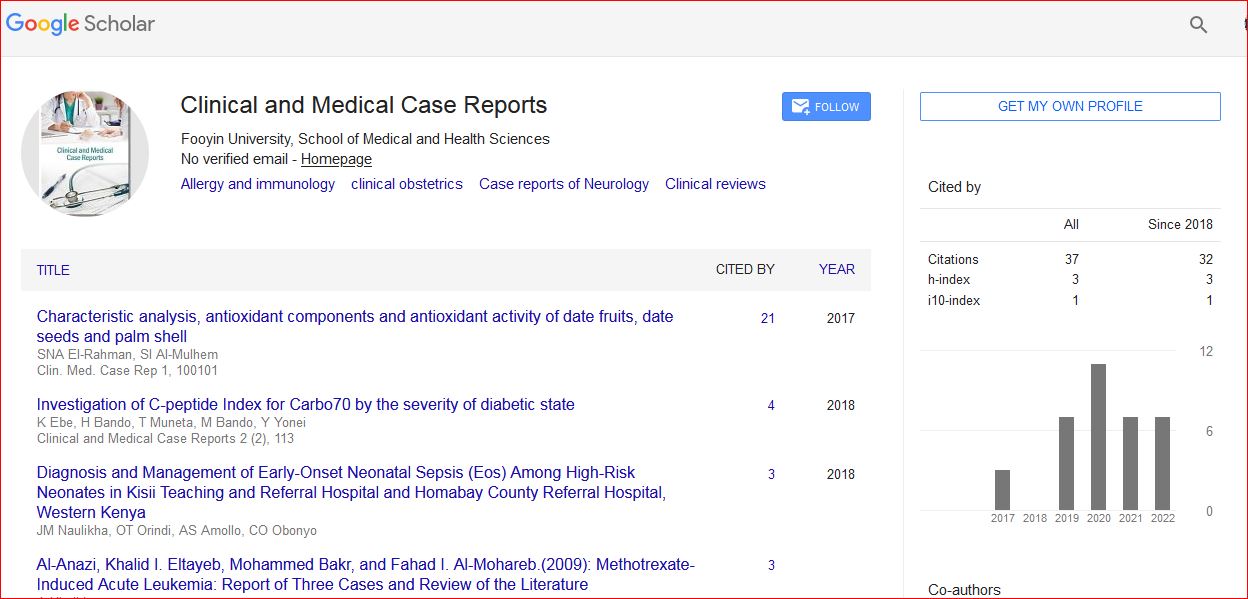
Clinical and Medical Case Reports received 53 citations as per Google Scholar report