Short Communication - (2025) Volume 14, Issue 2
Received: 01-Apr-2025, Manuscript No. jhoa-26-187780;
Editor assigned: 03-Apr-2025, Pre QC No. P-187780;
Reviewed: 17-Apr-2025, QC No. Q-187780;
Revised: 22-Apr-2025, Manuscript No. R-187780;
Published:
29-Apr-2025
, DOI: 10.37421/2167-1095.2025.14.514
Citation: Khan, Ahmed. ”Primary Healthcare: Screening, Adherence, and Digital Health.” J Hypertens 14 (2025):514.
Copyright: © 2025 Khan A. This is an open-access article distributed under the terms of the Creative Commons Attribution License, which permits unrestricted use, distribution and reproduction in any medium, provided the original author and source are credited.
The early detection of hypertension is a critical public health imperative, with primary healthcare centers (PHCs) serving as the frontline for identification and intervention. These centers are uniquely positioned to implement systematic screening protocols and provide accessible diagnostic tools, thereby enabling timely management and preventing severe cardiovascular complications. The effectiveness of such programs hinges on adequately trained healthcare providers who can confidently engage in these vital screening activities [1].
Implementing effective hypertension screening in primary care, particularly in resource-limited settings, presents a complex interplay of challenges and facilitators. Experiences from various regions highlight the importance of factors such as patient adherence to screening recommendations, sustained motivation among healthcare providers, and the availability of robust follow-up care pathways. Addressing these elements is crucial for the success of early detection initiatives [2].
Proactive screening and linkage to care within PHCs have demonstrated a significant impact on blood pressure control rates among the general population. Community-based initiatives leveraging primary healthcare facilities have shown promising results, underscoring the value of integrating hypertension screening as a routine component of primary care services for improved patient outcomes [3].
The evolving landscape of healthcare technology offers promising avenues for enhancing hypertension screening and monitoring. Digital health tools and mobile applications have the potential to revolutionize data collection, improve patient engagement, and streamline the efficiency of early detection efforts within primary care settings. This integration of technology is poised to significantly augment existing screening paradigms [4].
From an economic perspective, understanding the cost-effectiveness of various hypertension screening strategies is paramount for optimizing resource allocation. Primary healthcare settings are ideal locations for implementing these strategies, ensuring that investments in early detection yield maximum public health impact and are sustainable in the long term [5].
The development of simple, low-cost tools specifically designed for opportunistic hypertension screening by community health workers in primary care represents a significant advancement. Such tools have the potential to vastly expand the reach of screening services, especially in underserved areas, thereby improving early diagnosis rates and mitigating the burden of uncontrolled hypertension [6].
Ensuring the accuracy and reliability of blood pressure measurement techniques is fundamental to effective hypertension screening. Systematic reviews provide critical insights into the effectiveness of various measurement methods, offering recommendations for standardized and precise techniques to guarantee dependable early detection of hypertension within the primary care environment [7].
Understanding the perceptions of both patients and healthcare providers is essential for the successful design and implementation of hypertension screening and management programs. Investigating these perspectives can illuminate barriers and facilitators, leading to the development of interventions that are both acceptable and effective for early detection and ongoing control of hypertension [8].
Advanced practice providers, including nurse practitioners and physician assistants, play a pivotal role in facilitating early hypertension detection within primary care settings. Their contributions are instrumental in expanding screening access and initiating appropriate management protocols, thereby enhancing the overall capacity of primary care to address hypertension [9].
Integrating comprehensive cardiovascular risk assessment tools into routine primary healthcare visits offers a strategic approach to identifying individuals at high risk of developing hypertension. This proactive strategy enables targeted early intervention and the implementation of personalized prevention strategies, ultimately aiming to reduce the incidence of hypertension and its associated complications [10].
Primary healthcare centers (PHCs) are integral to the early detection of hypertension, necessitating systematic screening protocols, adequate training for healthcare providers, and accessible diagnostic tools. Early identification through PHCs facilitates timely intervention, aiming to prevent serious cardiovascular complications and improve overall patient outcomes [1].
The successful implementation of hypertension screening in primary care, particularly in resource-constrained environments, depends on overcoming specific challenges and leveraging key facilitators. Factors such as patient engagement and adherence, provider motivation, and the availability of comprehensive follow-up care are critical determinants of effective early detection programs [2].
A primary care-based hypertension screening initiative has been shown to significantly improve blood pressure control rates in the general population. This finding highlights the effectiveness of proactive screening and the crucial linkage to care provided within PHC settings for managing hypertension [3].
Digital health technologies, including mobile applications, hold substantial promise for enhancing hypertension screening and monitoring within primary healthcare. These tools can improve data management, boost patient involvement, and increase the overall efficiency of early detection efforts [4].
Evaluating the cost-effectiveness of different hypertension screening strategies within primary healthcare is vital for informed decision-making. This analysis helps optimize resource allocation to achieve the greatest public health benefit from early hypertension detection [5].
The creation of a simple, low-cost tool for opportunistic hypertension screening by community health workers in primary care settings offers a promising method to expand screening reach. This approach is particularly beneficial for improving early diagnosis in underserved populations [6].
Ensuring accuracy in blood pressure measurement is paramount for effective hypertension screening. A systematic review provides guidance on the efficacy of various measurement techniques, advocating for standardized and precise methods to ensure reliable early detection in primary care [7].
Understanding patient and provider perspectives is crucial for developing acceptable and effective hypertension screening and management interventions. This insight helps tailor programs to better meet the needs of individuals within primary healthcare settings [8].
Advanced practice providers, such as nurse practitioners and physician assistants, play a significant role in improving early hypertension detection within primary care. Their involvement is key to broadening access to screening and initiating management plans [9].
The integration of cardiovascular risk assessment into routine primary healthcare visits serves as a proactive measure to identify individuals at high risk for hypertension. This approach supports targeted early intervention and prevention strategies [10].
Primary healthcare centers are crucial for the early detection of hypertension through systematic screening and accessible tools. Effective implementation in resource-limited settings relies on patient adherence, provider motivation, and follow-up care. Proactive screening within PHCs improves blood pressure control. Digital health tools offer enhanced efficiency, while cost-effectiveness analyses guide resource allocation. Simple tools for community health workers expand reach, and accurate measurement techniques are vital. Understanding patient and provider perspectives improves intervention design. Advanced practice providers play a key role in screening access, and cardiovascular risk assessment facilitates early intervention for high-risk individuals.
None
None
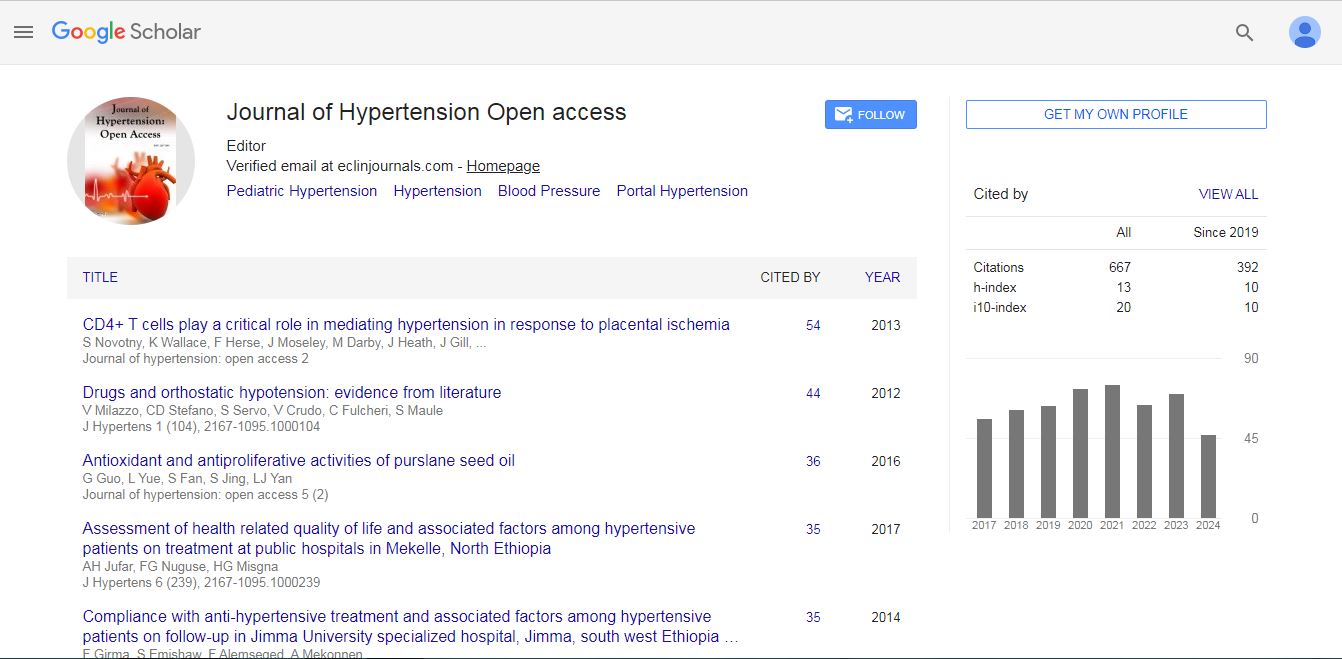
Journal of Hypertension: Open Access received 614 citations as per Google Scholar report