Short Communication - (2025) Volume 13, Issue 3
Received: 01-Jun-2025, Manuscript No. JCMG-26-185543;
Editor assigned: 03-Jun-2025, Pre QC No. P-185543;
Reviewed: 17-Jun-2025, QC No. Q-185543;
Revised: 23-Jun-2025, Manuscript No. ER-185543;
Published:
30-Jun-2025
, DOI: 10.37421/2472-128X.2025.13.346
Citation: Al-Mansouri, Ahmed. ”Prenatal Genomics: Revolutionizing Genetic Testing and Ethical Considerations.” J Clin Med Genomics 13 (2025):346.
Copyright: © 2025 Al-Mansouri A. This is an open-access article distributed under the terms of the Creative Commons Attribution License, which permits unrestricted use, distribution and reproduction in any medium, provided the original author and source are credited.
Prenatal genomics is undergoing a profound transformation, revolutionizing the early detection of genetic disorders and offering expectant parents unparalleled insights into their child's health. Non-invasive prenatal testing (NIPT) leveraging cell-free DNA (cfDNA) has emerged as a critical tool, providing accurate screening for common aneuploidies such as Down syndrome and trisomy 18, alongside microdeletion syndromes [1].
The clinical utility of cfDNA testing is progressively expanding beyond the detection of common aneuploidies. Current research is highlighting its efficacy in identifying single-gene disorders and microdeletions, thereby furnishing earlier and more comprehensive genetic information. The development of targeted cfDNA sequencing panels aims to enhance the detection rates for a broader spectrum of genetic conditions, ultimately improving prenatal diagnosis and informing obstetric management strategies [2].
Whole-exome sequencing (WES) is increasingly being employed in prenatal diagnosis to identify pathogenic variants linked to severe genetic disorders that might elude conventional diagnostic methods. This advanced technology facilitates the simultaneous analysis of thousands of genes, thereby offering a wider diagnostic yield, particularly in cases with ambiguous ultrasound findings or a family history of undiagnosed genetic conditions [3].
The ethical dimensions of prenatal genomic testing are intricate and demand meticulous attention to informed consent, genetic counseling, and the potential for psychological distress among prospective parents. Issues such as the detection of incidental findings, the management of uncertain genetic variants, and the broader societal impact of widespread prenatal screening are of paramount importance [4].
Non-invasive prenatal testing (NIPT) has become a standard of care for screening common chromosomal aneuploidies, but its application is continuously broadening to encompass the detection of sub-chromosomal abnormalities. Microdeletions and microduplications, which are often associated with distinct clinical syndromes, are now being identified with enhanced accuracy through sophisticated NIPT methodologies. This expanded scope facilitates earlier diagnosis and the implementation of more effective management strategies for affected pregnancies [5].
The integration of whole-genome sequencing (WGS) into prenatal diagnostics presents a comprehensive strategy for identifying a vast array of genetic variations, including single nucleotide variants, insertions, deletions, and structural rearrangements. While offering the highest diagnostic yield, WGS also poses challenges in data interpretation and the identification of clinically significant incidental findings. The development of robust bioinformatics pipelines and expert genetic interpretation is indispensable for maximizing its clinical utility [6].
Carrier screening has witnessed substantial advancements with the emergence of next-generation sequencing technologies, enabling more comprehensive and efficient testing for an extensive range of recessive genetic disorders. Prenatal carrier screening empowers prospective parents to ascertain their carrier status for conditions that could be transmitted to their offspring, thereby facilitating informed reproductive decisions and the planning of early interventions [7].
The diagnostic accuracy of prenatal genetic testing is significantly influenced by the presence of fetal mosaicism, a condition where different cells within the fetus exhibit distinct genetic compositions. Detecting and accurately interpreting mosaicism is crucial for precise diagnosis and prognosis. Innovations in sequencing technologies and bioinformatics are progressively enhancing the ability to detect low-level mosaicism, leading to more refined genetic counseling and management approaches [8].
The interpretation of variants of unknown significance (VUS) continues to represent a substantial hurdle in prenatal genomics. Although advanced sequencing techniques can identify numerous genetic variants, establishing their clinical relevance to fetal health necessitates rigorous analysis and, frequently, further investigation. Collaborative initiatives and the establishment of robust databases are critical for improving the accurate classification and interpretation of VUS in the prenatal context [9].
The trajectory of prenatal genomics is oriented towards the integration of diverse data types, including genomic, epigenomic, and transcriptomic information, to foster a more holistic comprehension of fetal development and disease pathogenesis. Advances in artificial intelligence and machine learning are poised to play a pivotal role in analyzing these complex datasets, ultimately paving the way for more precise diagnoses and personalized management strategies for genetic disorders [10].
Prenatal genomics is revolutionizing early detection of genetic disorders, providing expectant parents with profound insights into their child's health. Non-invasive prenatal testing (NIPT) using cell-free DNA (cfDNA) has become a cornerstone, offering accurate screening for aneuploidies like Down syndrome and trisomy 18, as well as microdeletion syndromes [1].
The clinical utility of cell-free DNA (cfDNA) testing is expanding beyond common aneuploidies. Current research underscores its effectiveness in detecting single-gene disorders and microdeletions, providing earlier and more comprehensive genetic information. The development of targeted cfDNA sequencing panels is designed to improve detection rates for a wider array of genetic conditions, thereby enhancing prenatal diagnosis and guiding obstetric management [2].
Whole-exome sequencing (WES) is increasingly adopted in prenatal diagnosis to identify pathogenic variants associated with severe genetic disorders that traditional methods might miss. This technology allows for the simultaneous analysis of thousands of genes, increasing the diagnostic yield, especially in cases with ambiguous ultrasound findings or a family history of undiagnosed genetic conditions. The interpretation of WES data requires careful consideration of variant pathogenicity and the potential for incidental findings, highlighting the importance of specialized genetic counseling [3].
The ethical implications of prenatal genomic testing are multifaceted, necessitating careful consideration of informed consent, genetic counseling, and the potential for psychological distress in expectant parents. Key issues include the detection of incidental findings, the management of uncertain genetic variants, and the societal impact of widespread prenatal screening. A balanced approach prioritizing parental autonomy and well-being is essential for the responsible implementation of these advanced genomic technologies [4].
Non-invasive prenatal testing (NIPT) has achieved standard-of-care status for screening common chromosomal aneuploidies, and its application is now extending to the detection of sub-chromosomal abnormalities. Microdeletions and microduplications, which can lead to distinct clinical syndromes, are identified with increasing accuracy using advanced NIPT methodologies. This broadened scope enables earlier diagnosis and improved management strategies for affected pregnancies [5].
The integration of whole-genome sequencing (WGS) into prenatal diagnostics offers a comprehensive approach to identifying a vast spectrum of genetic variations, including single nucleotide variants, insertions, deletions, and structural rearrangements. While WGS provides the highest diagnostic yield, it also presents challenges in data interpretation and the identification of clinically significant incidental findings. Robust bioinformatics pipelines and expert genetic interpretation are critical for maximizing its clinical utility [6].
Carrier screening has evolved significantly with the advent of next-generation sequencing technologies, allowing for more comprehensive and efficient testing for a wider range of recessive genetic disorders. Prenatal carrier screening enables prospective parents to understand their carrier status for conditions that could be passed to their offspring, facilitating informed reproductive decisions and early intervention planning [7].
The diagnostic yield of prenatal genetic testing is considerably impacted by the presence of fetal mosaicism, where different cells in the fetus have varying genetic makeup. Detecting and interpreting mosaicism is critical for accurate diagnosis and prognosis. Advancements in sequencing technologies and bioinformatics are improving the ability to detect low-level mosaicism, leading to more refined genetic counseling and management strategies [8].
Interpreting variants of unknown significance (VUS) remains a significant challenge in prenatal genomics. While advanced sequencing can identify numerous genetic variants, determining their clinical relevance for fetal health requires rigorous analysis and often further investigation. Collaborative efforts and the development of robust databases are essential for improving the accurate classification and interpretation of VUS in the prenatal setting [9].
The future of prenatal genomics involves integrating multiple data types, including genomic, epigenomic, and transcriptomic information, to provide a more holistic understanding of fetal development and disease. Advancements in artificial intelligence and machine learning will be crucial in analyzing these complex datasets, leading to more precise diagnoses and personalized management strategies for genetic disorders [10].
Prenatal genomics, particularly Non-invasive Prenatal Testing (NIPT) using cell-free DNA (cfDNA), is revolutionizing genetic disorder detection. It now screens for aneuploidies, microdeletions, single-gene disorders, and sub-chromosomal abnormalities, offering earlier and more comprehensive genetic information. Advanced techniques like whole-exome sequencing (WES) and whole-genome sequencing (WGS) expand diagnostic capabilities but present challenges in data interpretation, including variants of unknown significance (VUS) and fetal mosaicism. Ethical considerations, informed consent, and genetic counseling are paramount. Future directions involve integrating diverse omics data and artificial intelligence for precise diagnoses and personalized management. Expanded carrier screening also aids reproductive planning.
None
None
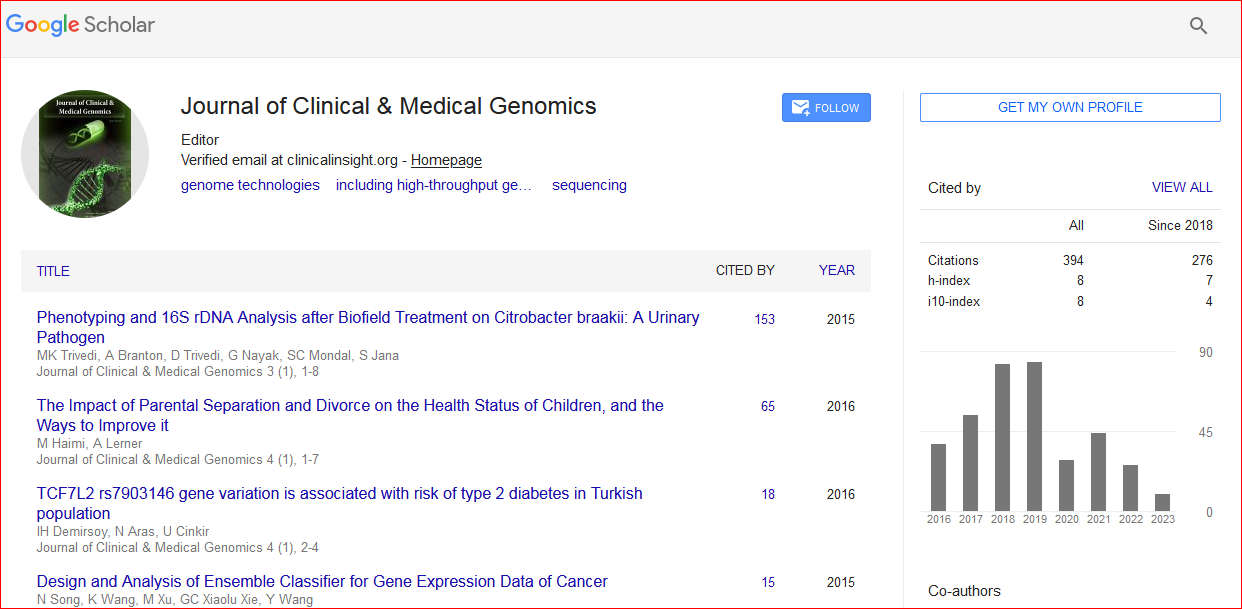
Journal of Clinical & Medical Genomics received 391 citations as per Google Scholar report