Brief Report - (2025) Volume 10, Issue 4
Received: 01-Aug-2025, Manuscript No. jomp-26-185096;
Editor assigned: 04-Aug-2025, Pre QC No. P-185096;
Reviewed: 18-Aug-2025, QC No. Q-185096;
Revised: 22-Aug-2025, Manuscript No. R-185096;
Published:
29-Aug-2025
, DOI: 10.37421/2576-3857.2025.10.314
Citation: Ivanova, Larissa. ”Predictive Melanoma Immunotherapy Response Through Data Integration.” J Oncol Med and Pract 10 (2025):314.
Copyright: © 2025 Ivanova L. This is an open-access article distributed under the terms of the Creative Commons Attribution License, which permits unrestricted use, distribution and reproduction in any medium, provided the original author and source are credited.
Predictive modeling for immunotherapy response in advanced melanoma is a critical area of research, aiming to optimize patient selection and treatment strategies. Recent advancements have focused on integrating multi-omics data, encompassing genomic, transcriptomic, and proteomic profiles, along with clinical factors and imaging data, to construct more accurate predictive models [1].
Machine learning algorithms, especially deep learning, are demonstrating significant promise in identifying intricate patterns associated with both response and resistance to immunotherapy. These models can provide valuable insights into potential biomarkers and therapeutic targets, facilitating personalized treatment approaches [1].
Understanding the tumor microenvironment (TME) is paramount for predicting immunotherapy response in melanoma. Advanced techniques like spatial transcriptomics and multiplex immunohistochemistry are illuminating the cellular composition and spatial organization of immune infiltrates within tumors, which directly influence treatment efficacy. Incorporating these spatial features into predictive models can enhance the ability to distinguish between responders and non-responders, potentially revealing novel targets for combination therapies [2].
The gut microbiome has emerged as a profoundly influential factor in the efficacy of immune checkpoint inhibitors for melanoma patients. Ongoing studies are identifying specific microbial signatures that correlate with favorable treatment responses. Predictive models are beginning to integrate this microbiome data to stratify patients more effectively, suggesting that modulating the gut microbiota could represent a viable strategy for improving immunotherapy outcomes [3].
Radiomics, which involves the extraction of quantitative features from medical images such as CT and PET scans, shows considerable potential for predicting immunotherapy response in melanoma. These image-derived features reflect tumor heterogeneity and the immune microenvironment, and their integration into predictive models can offer a valuable non-invasive complement to molecular profiling for patient stratification [4].
Liquid biopsies, particularly the analysis of circulating tumor DNA (ctDNA), provide a dynamic and accessible method for monitoring treatment response and identifying resistance mechanisms in melanoma. Analyzing ctDNA mutations and tracking clonal evolution can inform predictive models and enable real-time adjustments to treatment strategies, offering a more adaptive approach to patient management [5].
Epigenetic modifications, including DNA methylation and histone modifications, play a significant role in regulating gene expression and influencing immune cell function within the melanoma tumor microenvironment. The integration of epigenetic data into predictive models holds the potential to uncover novel biomarkers that can predict response to immunotherapy, thereby deepening our understanding of the underlying biological processes [6].
The application of artificial intelligence (AI) and machine learning (ML) is fundamentally transforming predictive modeling in the field of melanoma immunotherapy. These powerful tools are capable of analyzing vast and complex datasets to discern subtle patterns and interactions that are indicative of treatment response, paving the way for the development of more sophisticated and highly accurate predictive algorithms [7].
Combination immunotherapies are increasingly becoming the standard of care for advanced melanoma. The development of predictive models is crucial for identifying patients who are most likely to benefit from specific combination regimens. These models consider the patient's underlying molecular and immune profiles to optimize therapeutic selection and minimize potential toxicities, ensuring a more tailored and effective treatment approach [8].
Germline genetic variations can significantly influence an individual's immune response and susceptibility to cancer, potentially impacting the outcomes of immunotherapy in melanoma patients. Genome-wide association studies (GWAS) are actively identifying germline variants that are associated with treatment response, and these findings can be incorporated into predictive models to enhance their accuracy and applicability [9].
Understanding both intrinsic and acquired resistance mechanisms to immunotherapy in melanoma is of paramount importance. Predictive models are continuously evolving to incorporate dynamic changes in tumor biology and the immune evasion strategies employed by cancer cells. The ultimate goal is to anticipate and overcome resistance, thereby improving long-term patient outcomes and the overall effectiveness of immunotherapy [10].
Predictive modeling for immunotherapy response in advanced melanoma is a critical area of research aimed at optimizing patient selection and treatment strategies. Recent advancements have focused on integrating multi-omics data, including genomic, transcriptomic, and proteomic profiles, along with clinical factors and imaging data, to construct more accurate predictive models [1].
Machine learning algorithms, particularly deep learning, are demonstrating significant promise in identifying intricate patterns associated with both response and resistance to immunotherapy, offering valuable insights into potential biomarkers and therapeutic targets to facilitate personalized treatment approaches [1].
Understanding the tumor microenvironment (TME) is paramount for predicting immunotherapy response in melanoma. Advanced techniques like spatial transcriptomics and multiplex immunohistochemistry are illuminating the cellular composition and spatial organization of immune infiltrates within tumors, which directly influence treatment efficacy. Incorporating these spatial features into predictive models can enhance the ability to distinguish between responders and non-responders, potentially revealing novel targets for combination therapies [2].
The gut microbiome has emerged as a profoundly influential factor in the efficacy of immune checkpoint inhibitors for melanoma patients. Ongoing studies are identifying specific microbial signatures that correlate with favorable treatment responses. Predictive models are beginning to integrate this microbiome data to stratify patients more effectively, suggesting that modulating the gut microbiota could represent a viable strategy for improving immunotherapy outcomes [3].
Radiomics, which involves the extraction of quantitative features from medical images such as CT and PET scans, shows considerable potential for predicting immunotherapy response in melanoma. These image-derived features reflect tumor heterogeneity and the immune microenvironment, and their integration into predictive models can offer a valuable non-invasive complement to molecular profiling for patient stratification [4].
Liquid biopsies, particularly the analysis of circulating tumor DNA (ctDNA), provide a dynamic and accessible method for monitoring treatment response and identifying resistance mechanisms in melanoma. Analyzing ctDNA mutations and tracking clonal evolution can inform predictive models and enable real-time adjustments to treatment strategies, offering a more adaptive approach to patient management [5].
Epigenetic modifications, including DNA methylation and histone modifications, play a significant role in regulating gene expression and influencing immune cell function within the melanoma tumor microenvironment. The integration of epigenetic data into predictive models holds the potential to uncover novel biomarkers that can predict response to immunotherapy, thereby deepening our understanding of the underlying biological processes [6].
The application of artificial intelligence (AI) and machine learning (ML) is fundamentally transforming predictive modeling in the field of melanoma immunotherapy. These powerful tools are capable of analyzing vast and complex datasets to discern subtle patterns and interactions that are indicative of treatment response, paving the way for the development of more sophisticated and highly accurate predictive algorithms [7].
Combination immunotherapies are increasingly becoming the standard of care for advanced melanoma. The development of predictive models is crucial for identifying patients who are most likely to benefit from specific combination regimens. These models consider the patient's underlying molecular and immune profiles to optimize therapeutic selection and minimize potential toxicities, ensuring a more tailored and effective treatment approach [8].
Germline genetic variations can significantly influence an individual's immune response and susceptibility to cancer, potentially impacting the outcomes of immunotherapy in melanoma patients. Genome-wide association studies (GWAS) are actively identifying germline variants that are associated with treatment response, and these findings can be incorporated into predictive models to enhance their accuracy and applicability [9].
Understanding both intrinsic and acquired resistance mechanisms to immunotherapy in melanoma is of paramount importance. Predictive models are continuously evolving to incorporate dynamic changes in tumor biology and the immune evasion strategies employed by cancer cells. The ultimate goal is to anticipate and overcome resistance, thereby improving long-term patient outcomes and the overall effectiveness of immunotherapy [10].
Predictive modeling for immunotherapy response in melanoma is advancing through the integration of diverse data sources such as multi-omics profiles, clinical data, and imaging. Machine learning and AI are crucial for identifying complex patterns related to response and resistance. The tumor microenvironment, gut microbiome, radiomic features, and liquid biopsies are increasingly incorporated into predictive models. Epigenetic modifications, germline genetics, and dynamic resistance mechanisms are also being investigated. These efforts aim to enhance patient stratification, guide personalized treatment strategies, and improve therapeutic outcomes by anticipating and overcoming resistance.
None
None
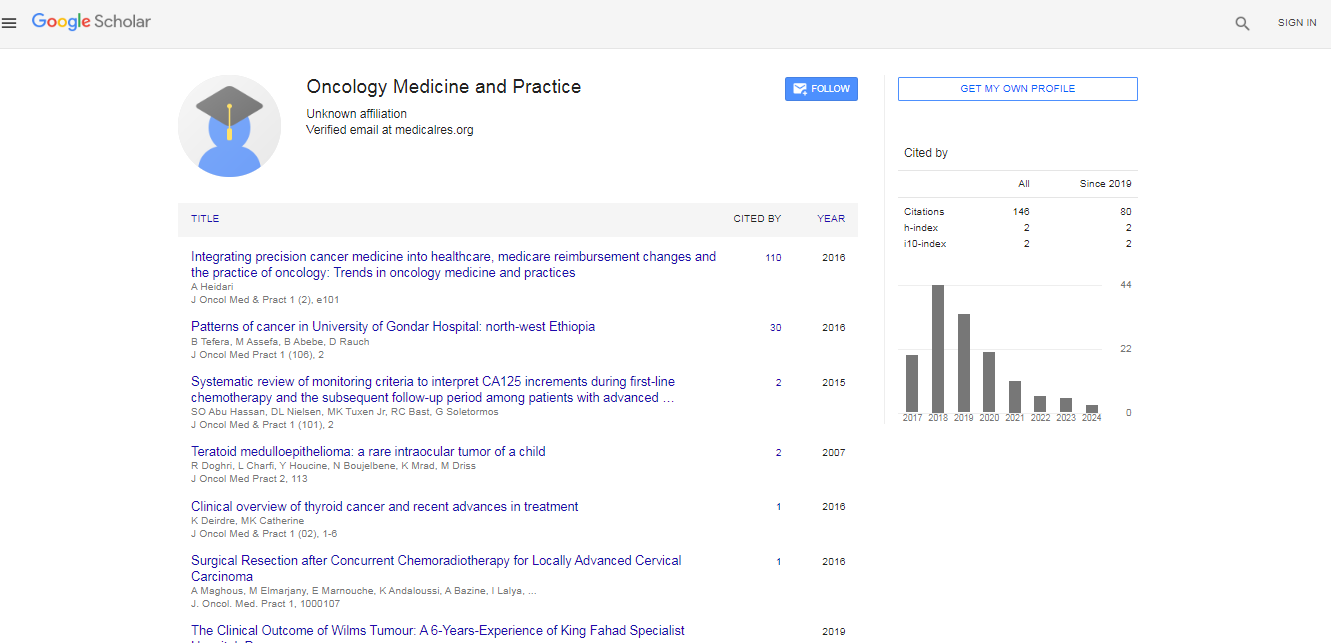
Journal of Oncology Medicine & Practice received 142 citations as per Google Scholar report