Short Communication - (2025) Volume 9, Issue 6
Received: 01-Dec-2025, Manuscript No. ahbs-26-182575;
Editor assigned: 03-Dec-2025, Pre QC No. P-182575;
Reviewed: 17-Dec-2025, QC No. Q-182575;
Revised: 22-Dec-2025, Manuscript No. R-182575;
Published:
29-Dec-2025
, DOI: 10.37421/2952-8097.2025.9.351
Citation: Muller, Sylvia. "Predictive Animal Health: Data, Deep
Learning, Welfare." J Anim Health Behav Sci 09 (2025):351.
Copyright: © 2025 Muller S. This is an open-access article distributed under the terms of the Creative Commons Attribution License, which permits unrestricted use, distribution
and reproduction in any medium, provided the original author and source are credited.
The application of machine learning to animal health monitoring represents a significant advancement in veterinary science and animal welfare. Predictive models, powered by sophisticated algorithms, can analyze vast datasets to identify subtle patterns indicative of health issues. This proactive approach allows for timely interventions, potentially preventing severe illness and improving overall well-being for a wide range of animal species. The quality and comprehensiveness of the data collected are paramount to the success of these models, necessitating careful consideration of data acquisition and management strategies. One of the most promising avenues for predictive animal health is through the analysis of behavioral data. By meticulously tracking an animal's daily routines, activity levels, and social interactions, predictive models can detect deviations that signal distress, illness, or welfare concerns. Early identification of these subtle changes enables prompt intervention, which can drastically improve health outcomes and reduce the reliance on reactive veterinary care. The effectiveness of these models is directly tied to the richness and accuracy of the behavioral datasets used for training [1].
Integrating sensor technology with machine learning presents a powerful method for real-time animal health monitoring. Wearable devices are capable of collecting continuous data on various parameters, including activity, posture, and even physiological indicators. This steady stream of information can be fed into predictive analytics to identify potential health problems before they become critical. A key challenge in this domain is the development of robust algorithms that can accurately differentiate between normal behavioral variations and actual signs of disease, while also factoring in the influence of environmental conditions [2].
The use of deep learning, particularly convolutional neural networks (CNNs), is showing considerable promise in the analysis of complex visual and auditory behavioral data. These advanced models possess the capability to learn intricate patterns from video footage or sound recordings, thereby enabling the detection of subtle behavioral anomalies that might elude human observation. However, a significant obstacle in this field remains the acquisition of sufficiently large and diverse datasets necessary for training these sophisticated models effectively [3].
Analyzing the social behavior of group-housed animals is of paramount importance for assessing their welfare. Predictive models can leverage data pertaining to proximity, interaction frequency, and established dominance hierarchies to identify individuals experiencing social stress or isolation. This aspect is particularly relevant in livestock settings, where complex social dynamics can significantly influence both productivity and overall health outcomes [4].
The development of effective predictive models for animal health necessitates a collaborative, interdisciplinary approach. Experts from veterinary medicine, animal behavior, data science, and engineering must work in concert to define pertinent behavioral indicators, collect appropriate data, and rigorously validate the outputs of these models. Crucially, ethical considerations, such as data privacy and the potential for misinterpretation of model predictions, must be carefully addressed throughout the entire development process [5].
Anomaly detection algorithms play a crucial role in the functioning of predictive models for animal health. These algorithms are designed to identify deviations from an individual animal's established baseline behavior, thereby signaling potential underlying problems. Various techniques, including K-means clustering, principal component analysis, and support vector machines, are being adapted for this purpose. Ongoing research efforts are focused on enhancing the sensitivity and specificity of these algorithms across diverse animal populations [6].
The exploration of reinforcement learning (RL) offers an exciting new frontier for dynamically optimizing animal well-being through environmental adjustments. Although not directly predictive of specific health conditions, RL algorithms can learn to implement optimal strategies for feeding, housing, and enrichment based on continuous behavioral feedback. This proactive approach can significantly contribute to improving overall health outcomes [7].
Combining biometric data, such as heart rate variability and body temperature, with behavioral observations can substantially enhance the predictive capabilities of animal health models. Wearable sensors that are adept at capturing both types of data provide a holistic view of an animal's physiological and behavioral state, facilitating earlier and more accurate detection of potential illnesses [8].
Before predictive models for animal health can be widely adopted, their validation is a critical prerequisite. This rigorous process involves testing the models against known health outcomes and comparing their predictions with expert veterinary diagnoses. Continuous evaluation and refinement are essential as new data emerge and as animal populations and their environments evolve over time [9].
Predictive models for animal health are significantly enhanced by the analysis of behavioral data, which can reveal subtle shifts in routine, activity, or social dynamics, thereby flagging early signs of distress or illness. This proactive approach allows for timely interventions, improving outcomes and reducing the need for reactive veterinary care. The accuracy of these models is directly dependent on the quality and comprehensiveness of the collected behavioral datasets [1].
The integration of sensor technology with machine learning provides a potent means for real-time animal health monitoring. Wearable devices continuously gather data on activity, posture, and physiological parameters, supplying a rich stream for predictive analytics. A primary challenge lies in developing algorithms capable of distinguishing normal behavioral variations from disease indicators, while also accounting for environmental factors [2].
Deep learning techniques, particularly convolutional neural networks (CNNs), demonstrate considerable potential in analyzing complex visual and audio behavioral data. These models can discern intricate patterns from video or audio recordings, enabling the identification of subtle behavioral anomalies that might be missed by human observers. However, acquiring adequately large and diverse datasets for training remains a substantial hurdle [3].
Analyzing social behavior is crucial for understanding the welfare of animals housed in groups. Predictive models can utilize data on proximity, interaction frequency, and dominance hierarchies to identify individuals experiencing social stress or isolation. This is especially relevant in livestock settings where social dynamics can impact both productivity and health [4].
The development of robust predictive models for animal health necessitates interdisciplinary collaboration among veterinarians, animal behaviorists, data scientists, and engineers. This collaboration is vital for defining relevant behavioral indicators, collecting appropriate data, and validating model outputs. Ethical considerations, including data privacy and the potential for misinterpretation, must be addressed throughout the development process [5].
Anomaly detection algorithms are central to predictive animal health models, identifying deviations from an individual animal's baseline behavior to signal potential problems. Techniques such as K-means clustering, principal component analysis, and support vector machines are being adapted for this purpose, with ongoing research focused on improving their sensitivity and specificity in various animal populations [6].
Reinforcement learning (RL) presents an exciting frontier for dynamically optimizing animal well-being by adjusting environmental factors. While not directly predictive of specific health events, RL can learn optimal strategies for feeding, housing, and enrichment based on continuous behavioral feedback, proactively enhancing health outcomes [7].
Biometric data, such as heart rate variability and body temperature, when integrated with behavioral observations, significantly bolster the predictive power of health models. Wearable sensors capturing both data types offer a holistic view of an animal's state, enabling earlier and more accurate disease detection [8].
Rigorous validation is a critical step before the widespread adoption of predictive models for animal health. This involves testing models against known health outcomes and comparing their predictions with expert veterinary diagnoses. Continuous evaluation and refinement are necessary as new data become available and environments change [9].
Natural language processing (NLP) can be applied to veterinary clinical notes to extract valuable behavioral information. Analyzing text-based records allows for the identification of patterns related to specific conditions or treatments, complementing sensor-based data by utilizing existing documentation, though it requires careful attention to note-taking variability and potential biases [10].
Predictive models for animal health leverage behavioral data, sensor technology, and deep learning to detect early signs of illness and improve welfare. These models analyze activity levels, social interactions, and physiological parameters to identify anomalies, enabling timely interventions. Challenges include data quality, algorithm development to distinguish normal variations from disease indicators, and the need for large, diverse datasets. Integrating biometric data with behavioral observations enhances accuracy. Social behavior analysis is crucial for group-housed animals. Interdisciplinary collaboration and ethical considerations are vital. Anomaly detection algorithms are key to identifying deviations from baseline behavior. Reinforcement learning can proactively optimize well-being. Validation of these models is essential before widespread adoption, requiring ongoing evaluation and refinement. Natural language processing of veterinary notes also offers a valuable data source.
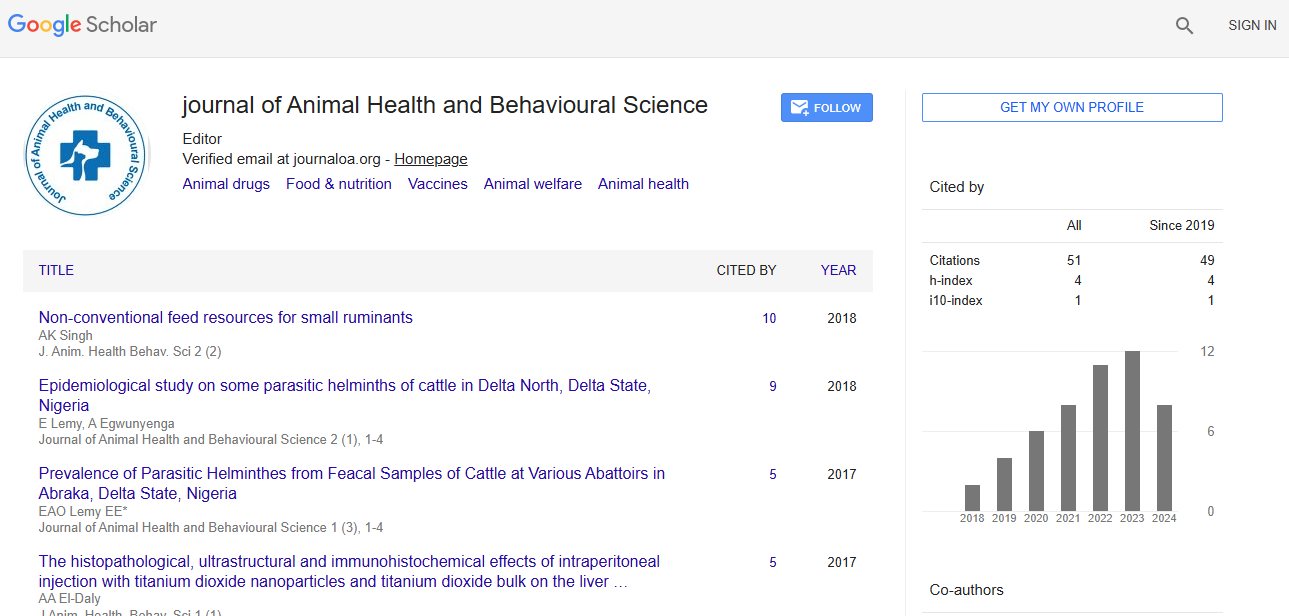
Journal of Animal Health and Behavioural Science received 38 citations as per Google Scholar report