Perspective - (2025) Volume 21, Issue 6
Received: 01-Nov-2025, Manuscript No. jos-26-185187;
Editor assigned: 03-Nov-2025, Pre QC No. P-185187;
Reviewed: 17-Nov-2025, QC No. Q-185187;
Revised: 24-Nov-2025, Manuscript No. R-185187;
Published:
01-Dec-2025
, DOI: 10.37421/1584-9341.2024.20.236
Citation: Stein, Rebecca. ”Predicting Postoperative Complications
With Inflammatory Markers.” J Surg 21 (2025):236.
Copyright: © 2025 Stein R. This is an open-access article distributed under the terms of the Creative Commons Attribution License, which permits unrestricted use, distribution
and reproduction in any medium, provided the original author and source are credited.
Elevated inflammatory markers, such as C-reactive protein (CRP) and procalcitonin (PCT), have demonstrated significant predictive capabilities for a range of postoperative complications, including surgical site infections, anastomotic leaks, and organ dysfunction, across various surgical procedures. The early identification facilitated by these markers enables prompt intervention, potentially leading to improved patient outcomes and reduced healthcare expenditures [1].
In the specific context of breast surgery, serum CRP levels have exhibited a strong correlation with the incidence of postoperative complications, notably seroma formation and wound dehiscence. Consequently, vigilant monitoring of CRP trends post-surgery can offer crucial insights into early-stage inflammatory responses, thereby guiding clinical decisions concerning drainage management and wound care protocols [2].
Procalcitonin (PCT) stands out as a marker with greater specificity for bacterial infections when compared to CRP. Its established utility lies in predicting severe infectious complications, such as sepsis, in the postoperative period, particularly following major abdominal or thoracic surgeries. The timely elevation of PCT levels can effectively trigger the initiation of appropriate antibiotic therapy [3].
The integration of multiple inflammatory markers, encompassing CRP, PCT, and white blood cell count (WBC), may offer a more comprehensive and accurate prediction of postoperative complications than reliance on single markers. This multi-marker approach can assist in stratifying patients into distinct risk categories, facilitating more focused monitoring and management [4].
Emerging as promising inflammatory markers for the prediction of postoperative complications are the neutrophil-to-lymphocyte ratio (NLR) and the platelet-to-lymphocyte ratio (PLR). These markers reflect systemic inflammation and the body's immune response, showing considerable potential in identifying patients at an elevated risk for adverse events following surgical interventions [5].
The temporal aspect of inflammatory marker elevation is of paramount importance. A rapid and sustained increase in CRP or PCT in the postoperative phase frequently signals an impending complication, whereas a gradual decline typically indicates a favorable recovery trajectory. Therefore, serial measurements are generally more informative than isolated measurements [6].
While inflammatory markers serve as valuable predictive tools, their interpretation necessitates a holistic consideration of the patient's overall clinical status, pre-existing comorbidities, and the specific type of surgery undertaken. It is important to recognize that inflammatory responses can also be elicited by non-infectious causes, such as significant tissue trauma or the inherent inflammation associated with the surgical procedure itself [7].
Recent investigations have explored the utility of Interleukin-6 (IL-6) as a predictive marker for postoperative complications in patients undergoing major surgical procedures. Preliminary findings suggest that elevated IL-6 levels are associated with an increased risk of organ dysfunction and prolonged hospital stays, presenting another potential avenue for risk stratification [8].
Research has also delved into the role of lipocalin-2 (LCN2) in predicting infectious complications subsequent to abdominal surgery. Elevated LCN2 levels have been linked to a higher incidence of intra-abdominal infections and sepsis, underscoring its potential as an early diagnostic marker in this patient population [9].
A comparative study evaluating the predictive performance of various inflammatory markers, including CRP, PCT, and WBC, for the prediction of anastomotic leaks after colorectal surgery, concluded that while all markers demonstrated some predictive value, a combined assessment of CRP and WBC offered the most robust discrimination for identifying high-risk patients [10].
Elevated levels of inflammatory markers, such as C-reactive protein (CRP) and procalcitonin (PCT), have been identified as significant predictors for the development of a spectrum of postoperative complications. These complications can include surgical site infections, anastomotic leaks, and organ dysfunction, and their prediction is relevant across a diverse range of surgical procedures. The capacity of these markers to facilitate early identification is crucial, as it allows for timely and appropriate clinical interventions, which can ultimately lead to improved patient outcomes and a reduction in overall healthcare costs [1].
Specifically within the domain of breast surgery, studies have indicated a robust correlation between elevated serum CRP levels and an increased incidence of postoperative complications. Among these, seroma formation and wound dehiscence are particularly noteworthy. The practice of monitoring CRP trends in the postoperative period can furnish valuable insights into the nascent stages of inflammatory responses. This information is instrumental in guiding clinical decisions related to the management of surgical drains and the provision of appropriate wound care [2].
Procalcitonin (PCT) has emerged as a marker that exhibits greater specificity for bacterial infections when contrasted with CRP. Its clinical utility is well-established in the prediction of severe infectious complications, including sepsis, particularly in the postoperative phase following extensive abdominal or thoracic surgical interventions. A timely elevation in PCT levels can serve as an early warning sign, prompting prompt initiation of antibiotic therapy [3].
The strategic combination of multiple inflammatory markers, such as CRP, PCT, and the white blood cell count (WBC), may provide a more comprehensive and consequently more accurate prediction of postoperative complications compared to relying on any single marker in isolation. This multi-marker approach can be instrumental in stratifying patients into different risk categories, thereby enabling closer and more tailored monitoring [4].
The neutrophil-to-lymphocyte ratio (NLR) and the platelet-to-lymphocyte ratio (PLR) are increasingly recognized as promising inflammatory markers for predicting postoperative complications. These ratios are reflective of the systemic inflammatory state and the body's immune response, demonstrating significant potential in the identification of patients who are at a higher risk for experiencing adverse events after undergoing surgery [5].
Crucially, the timing of the elevation of inflammatory markers is a critical factor in their interpretation. A rapid and sustained increase in CRP or PCT levels in the postoperative period often serves as an indicator of an impending complication. Conversely, a gradual decline in these markers typically suggests a favorable recovery trajectory. Hence, serial measurements are generally considered more informative than a single, isolated measurement [6].
While inflammatory markers are undoubtedly valuable predictive tools, their interpretation must always be contextualized within the patient's broader clinical picture. This includes considering their overall clinical status, any existing comorbidities, and the specific nature of the surgery performed. It is important to acknowledge that inflammatory responses can also be triggered by non-infectious etiologies, such as significant tissue trauma or the inherent inflammatory process associated with the surgical procedure itself [7].
A notable area of research has been the investigation into the utility of Interleukin-6 (IL-6) as a predictive marker for postoperative complications in patients who have undergone major surgical procedures. The findings from such studies suggest a correlation between elevated IL-6 levels and an increased risk of organ dysfunction and extended hospital stays, thereby offering another potential tool for effective risk stratification [8].
Further research has explored the role of lipocalin-2 (LCN2) in the prediction of infectious complications that may arise after abdominal surgery. Studies have indicated that elevated LCN2 levels are associated with a higher incidence of intra-abdominal infections and sepsis, positioning LCN2 as a potential early diagnostic marker in this surgical context [9].
A comparative study was conducted to evaluate the predictive performance of several key inflammatory markers, including CRP, PCT, and WBC, specifically for the prediction of anastomotic leaks following colorectal surgery. The results of this study indicated that although all assessed markers possessed some degree of predictive value, a combination of CRP and WBC provided the most effective discrimination in identifying patients who were at a high risk of developing this specific complication [10].
Inflammatory markers like CRP and PCT are valuable in predicting postoperative complications such as infections, anastomotic leaks, and organ dysfunction. Early detection through these markers allows for timely intervention. CRP is particularly relevant in breast surgery for seroma and wound complications, while PCT is more specific for bacterial infections and sepsis. Combining markers like CRP, PCT, and WBC may improve predictive accuracy. Other emerging markers include NLR, PLR, IL-6, and LCN2, which reflect systemic inflammation and immune responses. Serial measurements of these markers are more informative than single readings, and their interpretation requires clinical context. A combination of CRP and WBC has shown promise in predicting anastomotic leaks in colorectal surgery.
None
None
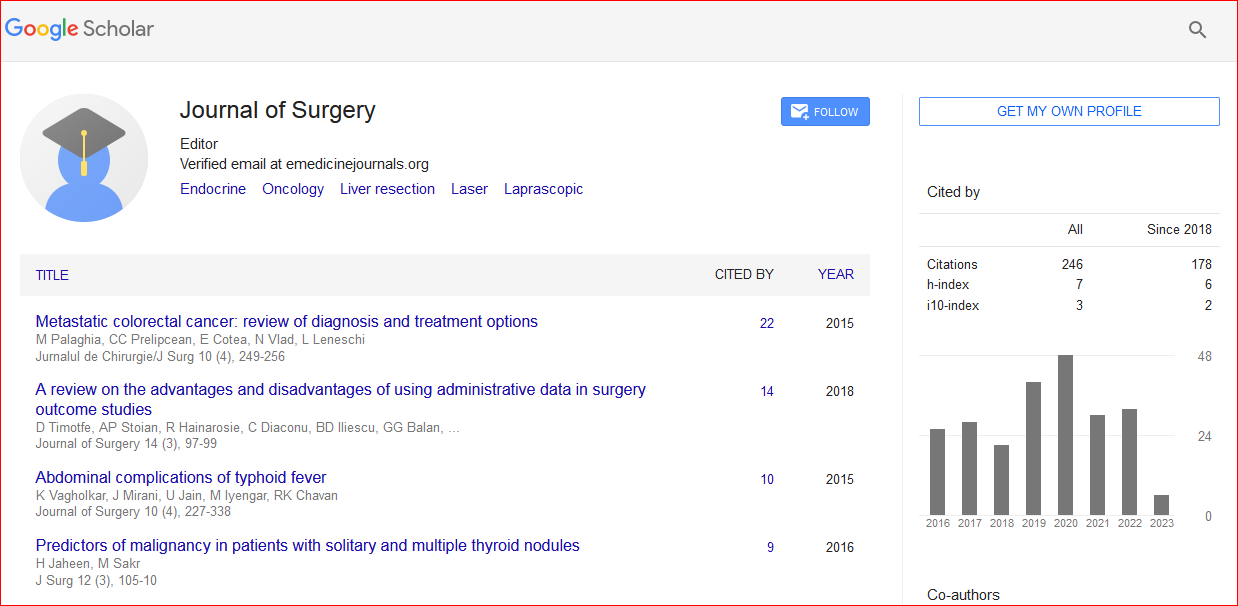
Journal of Surgery received 288 citations as per Google Scholar report